Recently in Love and Romance Category

Aspiration by Marjorie Quinn

| No Comments | No TrackBacks
If, for some fault committed here,
You are condemned, who are my dear;
Or, for a word you could not say
All hope of Heaven were cast away --
   I should pray to be wherever you be, my dear,
   Without blame and without fear.

Love is not love that cannot share
The fine lot with the commoner;
Nor, having known perfected joy,
Disdains that, mingled with alloy --
   I should pray to be wherever you be, my dear,
   Without blame, and without fear.

If perfect bliss were offered me
To keep for all eternity
Nor any memory of you
To give me hurt, to bring me true --
   I should pray to be wherever you be, my dear,
   Without blame, and without fear.

The deepest hell could not affright
My heart, that knew a pure delight,
And it would be my splendid pride
To stay forever by your side --
   I should pray to be wherever you be, my dear,
   Without blame, and without fear.

And should you, freed from taint of sin,
Go heavenward, might I enter in.
A loving soul? No power can slay
The soul of love; it lasts alway! --
   I should pray to be wherever you be my dear,
   Without blame, and without fear.  

First published in The Sydney Morning Herald, 19 May 1934

Author reference site: Austlit

See also

Love's Coming by John Shaw Neilson

| No Comments | No TrackBacks
Quietly as rosebuds
   Talk to thin air,
Love came so lightly
   I knew not he was there.

Quietly as lovers
   Creep at the middle noon,
Softly as players tremble
   In the tears of a tune;

Quietly as lilies
   Their faint vows declare,
Came the shy pilgrim:
   I knew not he was there.

Quietly as tears fall
   On a warm sin,
Softly as griefs call
   In a violin;

Without hail or tempest,
   Blue sword or flame,
Love came so lightly
   I knew not that he came.

First published in The Sun [Sydney], 14 May 1911;
and later in
The Oxford Book of Australasian Verse edited by Walter Murdoch, 1918;
An Australasian Anthology: Australian and New Zealand Poems edited by Percival Serle, R.H. Croll and Frank Wilmot, 1927;
New Song in an Old Land edited by Rex Ingamells, 1948;
The Penguin Book of Australian Verse edited by John Thompson, Kenneth Slessor and R.G. Howarth, 1958;
From the Ballads to Brennan edited by T. Inglis Moore, 1964;
Makar, May 1965;
Green Days and Cherries: the early verses of Shaw Neilson edited by Hugh Anderson and Leslie James Blake, 1981;
Cross-Country: A Book of Australian Verse edited by John Barnes, 1984;
The Illustrated Treasury of Australian Verse edited by Beatrice Davis, 1984;
My Country: Australian Poetry and Short Stories, Two Hundred Years edited by Leonie Kramer, 1985;
Love Came So Lightly: Australian Love Sonnets and Such, 1990;
John Shaw Neilson: Poetry, Autobiography and Correspondence edited by Cliff Hanna, 1991;
The Language of Love: An Anthology of Australian Love Letters, Poetry and Prose edited by Pamela Allardice, 1991;
The Oxford Book of Australian Love Poems edited by Jennifer Strauss, 1993;
Selected Poems edited by Robert Gray, 1993;
Hell and After: Four Early English Language Poets of Australia edited by Les Murray, 2005;
Two Centuries of Australian Poetry edited by Kathrine Bell, 2007;
The Penguin Anthology of Australian Poetry edited by John Kinsella, 2009; and
100 Australian Poems of Love and Loss edited by Jamie Grant, 2011.

Author reference sites: Austlit, Australian Dictionary of Biography, Australian Poetry Library

See also.

Life's Song by Emily Coungeau

| No Comments | No TrackBacks
My love is the rosy-fingered dawn,
Which heralds the birth of the fragrant morn,
And beareth a chalice which sheddeth showers
Of crystal dew o'er the dreaming flowers.    

My love is the king with the torch of gold,
Whose flambent rays doth dear earth enfold,
Who kissed the amorous, waiting west,
And gildeth a path o'er the ocean's breast.  

My love is that queenly vision meek,
With pale fires quenched, and a paler cheek,
Who walketh so softly and regal, yet sad,
But who wreathed in such beauty doth make me glad.

My love is that temple with dome so blue,
Where those gleaming jewels the stars peep through,
With the swinging earth a cushion where we
May behold the celestial pageantry.

My love is life's music-the deep rich chords
Hath the soul for a reed, though it breathe no words,
Like a string of gems in a holy shrine,
And each gem a pure note on a lute divine.  

Oh, love! Life's song which is sweetest flows
To the stately measure the dreamer knows,
With a thrilling cadenza in mortal ears.
Where life's song endeth there are no tears.

First published in The Brisbane Courier, 13 May 1914;
and later in
Rustling Leaves: Selected Poems by Emily Coungeau, 1920.

Author reference sites: Austlit, Australian Dictionary of Biography

See also.

The Barrier by Charles Henry Souter

| No Comments | No TrackBacks
For I have been no near -- so near
   That I could hear your heart's sweet rhyme
Singing its song of Love and Fear
   And joy of Youth and scorn of Time!
So near! The fragrance of your breast
   Beset me, bidding me forget
Name, fame and birthright and the rest --
   All things that bound me e'er we met!
So close I needs must hold my breath
   Lest it should shatter in a trice
The web 'twixt you and me and Death,
   Brittle as Love and cold as ice!
And I must school my eager hand
   To meet your hand and tell it nought!
Ah! Resolutions writ in sand!
   Ah! Selfish honor, dearly bought!
I know the soft sound of your tread,
   The sweetness of your loving lip,
And every curve from heel to head,
   From finger-tip to finger-tip!
And yet ---- . . .
   . . . The little space between
(Scarce a hand's breath, a tiny span!)
   Might all the world as well have been,
To part a woman and a man.

First published in The Bulletin, 28 April 1904;
and later in
Many Ladies (And Others) by Charles Souter, 1917.

Author reference sites: Austlit, Australian Dictionary of Biography

See also.

The Turn of the Tide by Roderic Quinn

| No TrackBacks
A long time waiting with little to show,
   We sat in our boat, at either side,
While the listless weeds washed to and fro.
   And here and there, at the will of the tide.

The bay was still. and the trees and flowers
   That nodded at noon were all asleep;
Yet never a silver-bream was ours.
   And never a crimson lord of the deep.

With little to say and much to think,
   We watched, while the velvet hours went by;
The ripples arise and the ripples sink,
   Alone on the water -- Rose and I.

I said to her then: "The good time flies.
   Let us get hence for the bay is wide."
Rose lifted her dark blue, laughing eys.
   And "Wait," she said, "till the turn of the tide."

The bay was azure from east to west --
   All still and azure from north to south;
The rose that reddened on Rose's breast
   Was red as the rose of Rose's mouth.

"'Tis weary waiting." I said to Rose.
   (Was ever a rose as fair as she?)
"The love-hour comes, and the love-hour goes.
   And when will the bright 'Yes° spoken be?."

Then Rose grew red -- do you wonder why? --
   And, somehow or other, I said or sighed:
"The line is set, but the prey is shy --
   I'll wait, dear Rose, till the turn of the tide."

First published in The Bulletin, 22 April 1915

Author reference sites: Austlit, Australian Dictionary of Biography, Australian Poetry Library

See also.

Good-bye by Douglas B. W. Sladen

| No TrackBacks
God be with you, whose golden hair
Has been to me a beacon-glare
Of bright and virtuous womanhood.
Graceful and arch no less than good!
You who have had your hearty share
In every pleasure, every care,
That fell to me, while living there,
At home or in the summer air,
   God be with you!

And, while I whisper kindling hopes
Of true love-freighted envelopes
From one well worthy of your choice
To make your gentle heart rojoice,
My heart still echoes, as it droops,
   God be with you!

First published
in The Queenslander, 21 April 1883;
and later in
A Poetry of Exiles and Other Poems by Douglas B. W. Sladen, 1884

Author reference sites: Austlit, Australian Dictionary of Biography

See also.

The Sliprails and the Spur by Henry Lawson

| No TrackBacks
The colours of the setting sun
Withdrew across the Western land ---
He raised the sliprails, one by one,
And shot them home with trembling hand;
Her brown hands clung --- her face grew pale ---
Ah! quivering chin and eyes that brim! ---
One quick, fierce kiss across the rail,
And, "Good-bye, Mary!" "Good-bye, Jim!"

      Oh! he rides hard to race the pain
      Who rides from love, who rides from home;
      But he rides slowly home again
      Whose heart has learnt to love and roam.


A hand upon the horse's mane,
And one foot in the stirrups set,
And, stooping back to kiss again,
With "Good-bye, Mary! don't you fret!
When I come back" --- he laughed for her ---
"We do not know how soon 'twill be;
I'll whistle as I round the 'spur' ---
You let the sliprails down for me."

She gasped for sudden loss of hope,
As, with a backward wave to her,
He cantered down the grassy slope
And swiftly round the dark'ning spur.
Black-pencilled panels standing high,
And darkness fading into stars,
And blurring fast against the sky,
A faint white form beside the bars.

And often at the set of sun,
In winter bleak and summer brown,
She'd steal across the little run,
And shyly let the sliprails down.
And listen there when darkness shut
The nearer spur in silence deep;
And when they called her from the hut
Steal home and cry herself to sleep.

A great white gate where sliprails were,
A brick house 'neath the mountain brow,
The "mad girl" buried by the spur
So long ago, forgotten now.

      And he rides hard to dull the pain
      Who rides from one that loves him best;
      And he rides slowly back again,
      Whose restless heart must rove for rest.


First published in The Bulletin, 1 April 1899;
and later in
In the Days When the World Was Wide and Other Verses by Henry Lawson, 1900;
An Anthology of Australian Verse edited by Bertram Stevens, 1907;
The Golden Treasury of Australian Verse edited by Bertram Stevens, 1909;
Winnowed Verse by Henry Lawson, 1924;
The Oxford Book of Australasian Verse edited by Walter Murdoch, 1924;
Selections from Australian Poets edited by Bertram Stevens, 1925;
The Australian Women's Mirror, 5 January 1926;
An Australasian Anthology: Australian and New Zealand Poems edited by Percival Serle, R. H. Croll and Frank Wilmot, 1927;
New Song in an Old Land edited by Rex Ingamells, 1943;
Out Back and Other Poems by Henry Lawson, 1943;
Spoils of Time: Some Poems of the English Speaking Peoples edited by Rex Ingamells, 1948;
From the Ballads to Brennan edited by T. Inglis Moore, 1964;
Poems of Henry Lawson edited by Walter Stone, 1973;
The World of Henry Lawson edited by Walter Stone, 1974;
The Essential Henry Lawson edited by Brian Kiernan, 1982;
A Treasury of Colonial Poetry, 1982;
Cross-Country: A Book of Australian Verse edited by John Barnes, 1984;
A Camp-Fire Yarn: Henry Lawson Complete Works 1885-1900 edited by Leonard Cronin, 1984;
The Language of Love: An Anthology of Australian Love Letters, Poetry and Prose edited by Pamela Allardice, 1991;
The Penguin Book of Australian Ballads edited by Elizabeth Webby and Philip Butterss, 1993;
Australian Verse: An Oxford Anthology edited by John Leonard, 1998; and
The Puncher & Wattmann Anthology of Australian Poetry edited by John Leonard, 2009.

Author reference sites: Austlit, Australian Dictionary of Biography, Australian Poetry Library, The Poetry of Henry Lawson website

See also.

The Free-Selector's Daughter by Henry Lawson

| No TrackBacks
I met her on the Lachlan Side --
   A darling girl I thought her,
And ere I left I swore I'd win
   The free-selector's daughter.

I milked her father's cows a month,
   I brought the wood and water,
I mended all the broken fence,
   Before I won the daughter.

I listened to her father's yarns,
   I did just what I 'oughter',
And what you'll have to do to win
   A free-selector's daughter.

I broke my pipe and burnt my twist,
   And washed my mouth with water;
I had a shave before I kissed
   The free-selector's daughter.

Then, rising in the frosty morn,
   I brought the cows for Mary,
And when I'd milked a bucketful
   I took it to the dairy.

I poured the milk into the dish
   While Mary held the strainer,
I summoned heart to speak my wish,
   And, oh! her blush grew plainer.

I told her I must leave the place,
   I said that I would miss her;
At first she turned away her face,
   And then she let me kiss her.

I put the bucket on the ground,
   And in my arms I caught her:
I'd give the world to hold again
   That free-selector's daughter!

First published in The Boomerang, 28 March 1891;
and later in
In the Days When the World Was Wide and Other Verses by Henry Lawson, 1900;
The Australian Town and Country Journal, 18 January 1905;
Humorous Verses by Henry Lawson, 1941;
Henry Lawson: Collected Verse: Vol 1 1885-1900 edited by Colin Roderick, 1967;
Along the Western Road: Bush Stories and Ballads, 1981;
A Camp-Fire Yarn: Henry Lawson Complete Works 1885-1900 edited by Leonard Cronin, 1984;
Henry Lawson: An Illustrated Treasury compiled by Glenys Smith, 1985;
A Collection of Australian Bush Verse, 1989; and
An Australian Treasury of Popular Verse edited by Jim Haynes, 2002.

Author reference sites: Austlit, Australian Dictionary of Biography, Australian Poetry Library, The Poetry of Henry Lawson website

See also.

The Empty Bowl by Emily Coungeau

| No TrackBacks
Lo, once thy loveliness a radiance shed,
   The lustre of the stars was in thine eye,   
An aureole of beauty o'er thy head,  
   Marked thee too beautiful a thing to die.

Silent and stiff, no breath of fragrance now
   Wafteth its balm to lead me to my goal,   
The silken hair that traileth o'er thy brow
   A girdle was which bound me to thy soul.

Or so I dreamed -- thy voice so softly low;
   The deepest fibres of my being stirred,
Falling in silver quivers from the bow
   Of thy curved lips as a sweet harpsichord.

And when thy slender fingers touched the strings
   In cadence sad or passionate lament,
In spirit I could feel the mystic wings  
   Of love which sanctified our sacrament.   

The golden bowl is empty, and in vain
   My burning tears on thy frail heart have shone;   
Living, yet dead, thou art another's gain,  
   Thou whom it breaks my heart to look upon.     

First published in The Brisbane Courier, 24 March 1915;
and later in
Rustling Leaves: Selected Poems by Emily Coungeau, 1920.

Author reference sites: Austlit, Australian Dictionary of Biography

See also.

The Song of the Bachelor Bold by P.Luftig (Peter Airey)

| No TrackBacks
Winnie was winsome and sunny and fair,
   Golden her tresses, her sweet eyes of blue;
(Dora's dark eyes are divine, I declare:
   Off with the old love and on with the new!)

Winnie was winsome --- and witty was she;
   Winnie would yield in her beauty to few;
(Dora's so dainty, so frank, and so free:
   Off with the old love and on with the new!)

Winnie I loved with an ardour divine;
   Swore to be faithful --- and tried to be, too;   
(Dora has promised at last to be mine:
   Off with the old love and on with the new!)

Sweet 'tis to flutter on butterfly wing,
   Visit each flower for its sweet honey-dew;
Sip at each cup as we find it and sing:
   "Off with the old love and on with the new!"   

If a youth love a dear damsel to-day,
   Shall he not give her fair sisters their due?
If the maid pout in a petulant way,
   Shall he not change the old love for the new?
   
'Way with your tales of the lovers of old,
   Constant and crazy --- a pitiful crew:
This be the song of the Bachelor Bold:
   "Linger not long if the maiden wax cold ---
Off with the old love and on with the new!"

First published
in The Queenslander, 11 March 1893

Author reference sites: Austlit, Australian Dictionary of Biography

See also.

The Hitching of the Sentimental Bloke by C. J. Dennis

| No TrackBacks
An'--wilt--yeh--take--this--woman--fer--to--be
   Yer--wedded--wife?-- .. . O, strike me!  Will I wot?
Take 'er?  Doreen?  'E stan's there arstin' me!
   As if 'e thort per'aps I'd rather not!
   Take 'er? 'E seemed to think 'er kind was got
Like cigarette-cards, fer the arstin'. Still,
   I does me stunt in this 'ere hitchin' rot,
An' speaks me piece: "Righto!" I sez, "I will."
 
"I will," I sez. An' tho' a joyful shout
   Come from me bustin' 'eart--I know it did--
Me voice got sorter mangled comin' out,
   An' makes me whisper like a frightened kid.
   "I will," I squeaks. An' I'd 'a' give a quid
To 'ad it on the quite, wivout this fuss,
   An' orl the starin' crowd that Mar 'ad bid
To see this solim hitchin' up of us.
 
"Fer--rich-er--er--fer--poorer." So 'e bleats.
   "In--sick-ness--an'--in--'ealth," ... An' there I stands,
An' dunno 'arf the chatter I repeats,
   Nor wot the 'ell to do wiv my two 'ands.
   But 'e don't 'urry puttin' on our brands --
This white-'aired pilot-bloke -- but gives it lip,
   Dressed in 'is little shirt, wiv frills an' bands.
"In sick-ness--an'--in--" Ar! I got the pip!
 
An' once I missed me turn; an' Ginger Mick,
   'Oo's my best-man, 'e ups an' beefs it out.
"I will!" 'e 'owls; an' fetches me a kick.
   "Your turn to chin!" 'e tips wiv a shout.
   An' there I'm standin' like a gawky lout.
(Aw, spare me! But I seemed to be all 'ands!)
   An' wonders wot 'e's goin' crook about,
Wiv 'arf a mind to crack 'im where 'e stands.
 
O, lumme! But ole Ginger was a trick!
   Got up regardless fer the solim rite.
('E 'awks the bunnies when 'e toils, does Mick)
   An' twice I saw 'im feelin' fer a light
   To start a fag; an' trembles lest 'e might,
Thro' force o' habit like. 'E's nervis too;
   That's plain, fer orl 'is air o' bluff an' skite;
An' jist as keen as me to see it thro'.
 
But, 'struth, the wimmnin! 'Ow they love this frill!
   Fer Auntie Liz, an' Mar, o' course, wus there;
An' Mar's two uncles' wives, an' Cousin Lil,
   An' 'arf a dozen more to grin and stare.
   I couldn't make me 'ands fit anywhere!
I felt like I wus up afore the Beak!
   But my Doreen she never turns a 'air,
Nor misses once when it's 'er turn to speak.
 
Ar, strike! No more swell marridges fer me!
   It seems a blinded year afore 'e's done.
We could 'a' fixed it in the registree
   Twice over 'fore this cove 'ad 'arf begun.
   I s'pose the wimmin git some sorter fun
Wiv all this guyver, an 'is nibs's shirt.
   But, seems to me, it takes the bloomin' bun,
This stylish splicin' uv a bloke an' skirt.
 
"To--be--yer--weddid--wife--" Aw, take a pull!
   Wot in the 'ell's 'e think I come there for?
An' so 'e drawls an' drones until I'm full,
   An' wants to do a duck clean out the door.
An' yet, fer orl 'is 'igh-falutin' jor,
   Ole Snowy wus a reel good-meanin' bloke.
   If 'twasn't fer the 'oly look 'e wore
Yeh'd think 'e piled it on jist fer a joke.
 
An', when at last 'e shuts 'is little book,
   I 'eaves a sigh that nearly bust me vest.
But 'Eavens! Now 'ere's muvver goin' crook!
   An' sobbin' awful on me manly chest!
   (I wish she'd give them water-works a rest.)
"My little girl!" she 'owls. "O, treat 'er well!
   She's young -- too young to leave 'er muvver's nest!"
"Orright, ole chook," I nearly sez. Oh, 'ell!
 
An' then we 'as a beano up at Mar's --
   A slap-up feed, wiv wine an' two big geese.
Doreen sits next ter me, 'er eyes like stars.
   O, 'ow I wished their blessed yap would cease!
   The Parson-bloke 'e speaks a little piece,
That makes me blush an' 'ang me silly 'ead.
   'E sez 'e 'opes our lovin' will increase --
I likes that pilot fer the things 'e said.
 
'E sez Doreen an' me is in a boat,
   An' sailin' on the matrimonial sea.
'E sez as 'ow 'e hopes we'll allus float
   In peace an' joy, from storm an' danger free.
   Then muvver gits to weepin' in 'er tea;
An' Auntie Liz sobs like a winded colt;
   An' Cousin Lil comes 'round an' kisses me;
Until I feel I'll 'ave to do a bolt.
 
Then Ginger gits end-up an' makes a speech --
   ('E'd 'ad a couple, but 'e wasn't shick.)
"My cobber 'ere," 'e sez, "'as copped a peach!
   Of orl the barrer-load she is the pick!
   I 'opes 'e won't fergit 'is pals too quick
As wus 'is frien's in olden days, becors,
   I'm trusting later on," sez Ginger Mick,
"To celebrate the chris'nin'." ... 'Oly wars!
 
At last Doreen an' me we gits away,
   An' leaves 'em doin' nothin' to the scram
(We're honey-moonin' down beside the Bay.)
   I gives a 'arf a dollar to the man
   Wot drives the cab; an' like two kids we ran
To ketch the train -- Ah, strike! I could 'a' flown!
   We gets the carridge right agen the van.
She whistles, jolts, an' starts ... An' we're alone!
 
Doreen an' me! My precious bit o' fluff!
   Me own true weddid wife! ... An' we're alone!
She seems so frail, an' me so big an' rough --
   I dunno wot this feelin' is that's grown
   Inside me 'ere that makes me feel I own
A thing so tender like I fear to squeeze
   Too 'ard fer fear she'll break ... Then, wiv a groan
I starts to 'ear a coot call, "Tickets, please!"
 
You could 'a' outed me right on the spot!
   I wus so rattled when that porter spoke.
Fer, 'struth! Them tickets I 'ad fair forgot!
   But 'e fist laughs, an' takes it fer a joke.
   "We must ixcuse," 'e sez, "new-married folk."
An' I pays up, an' grins, an' blushes red....
  It shows 'ow married life improves a bloke:
If I'd bin single I'd 'a' punched 'is head!

First published in The Bulletin, 4 March 1915;
and later in
The Songs of a Sentimental Bloke by C. J. Dennis, 1915;
Selected Works of C. J. Dennis by C. J. Dennis, 1988; and
Favourite Poems of C. J. Dennis by C. J. Dennis, 1989.

Author reference sites: C.J. Dennis, Austlit, Australian Dictionary of Biography, Australian Poetry Library

See also.

Lassiandra by Ella McFadyen

| No TrackBacks
Blue loveliness the Lassiandra flings
   Across the lawn and down the stone-flagged path --
A scattered host of broken, violet wings.
   The frail, drenched harvest of the storm wind's wrath;

Like songs some sweet, uncertain poet sings
   Amid life's storm - his heart's imaginings,
Lovely in hope, in young ambition's flings,
   But loveliest of all in aftermath.

First published in The Sydney Morning Herald, 25 February 1928

Author reference site: Austlit

See also.

He Knew by Victor J. Daley

| No TrackBacks
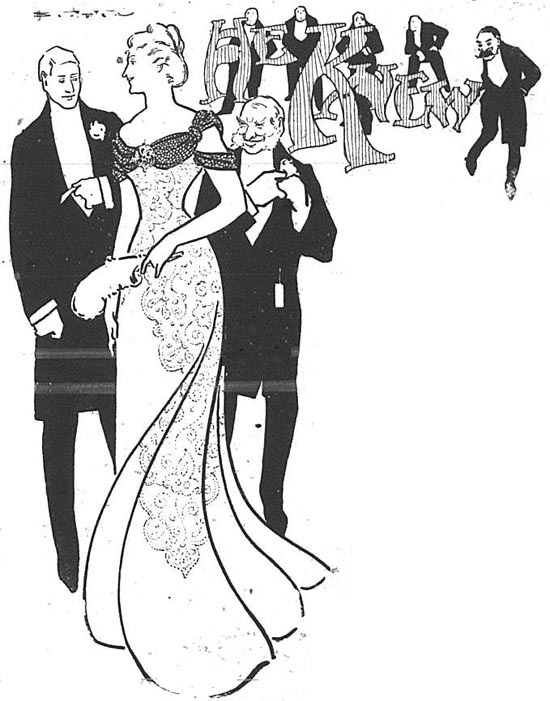
he knew2.jpg


She was the Ball-room Belle, said all --
   And there were many there to see --
At that Vice-Regal festival
   Of grace and chivalry.

The men admired her, young and old,
   And wide and foolish, fresh and take;
But she was an iceberg cold,
   And as an iceberg pale.

With scornful glance and queenly air,
   She gazed upon the glowing scene,
As if a queen indeed she were
   And men her subjects mean.

One man alone of all the throng
   Kept far aloof from her awhile;
And, as she proudly swept away,
   Surveyed her with a smile.

Had he with hopeless love gone mad?
   Or was his cynicism forced?
Not so -- not nearly so; they had
   Been married -- and divorced.

And so, while conquests marked her track,
   He merely smiled to think that she
Had two large warts upon her back
   And was bandy in one knee.

First published in The Bulletin, 24 February 1900

Note: this poem was originally published with the illustration shown here.

Author reference sites: Austlit, Australian Dictionary of Biography, Australian Poetry Library

See also.

The Orange Tree by John Shaw Neilson

| No TrackBacks
The young girl stood beside me.  I
   Saw not what her young eyes could see:
- A light, she said, not of the sky
   Lives somewhere in the Orange Tree.

- Is it, I said, of east or west?
   The heartbeat of a luminous boy
Who with his faltering flute confessed
   Only the edges of his joy?

Was he, I said, borne to the blue
   In a mad escapade of Spring
Ere he could make a fond adieu
   To his love in the blossoming?

- Listen! the young girl said.  There calls
   No voice, no music beats on me;
But it is almost sound: it falls
  This evening on the Orange Tree.

- Does he, I said, so fear the Spring
   Ere the white sap too far can climb?
See in the full gold evening
   All happenings of the olden time?

Is he so goaded by the green?
   Does the compulsion of the dew
Make him unknowable but keen
   Asking with beauty of the blue?

- Listen! the young girl said.  For all
   Your hapless talk you fail to see
There is a light, a step, a call
   This evening on the Orange Tree.

- Is it, I said, a waste of love
   Imperishably old in pain,
Moving as an affrighted dove
   Under the sunlight or the rain?

Is it a fluttering heart that gave
   Too willingly and was reviled?
Is it the stammering at a grave,
   The last word of a little child?

- Silence! the young girl said.  Oh, why,
   Why will you talk to weary me?
Plague me no longer now, for I
   Am listening like the Orange Tree.

First published in The Bookfellow, 15 February 1921;
and later in
An Australasian Anthology: Australian and New Zealand Poems edited by Percival Serle, R.H. Croll and Frank Wilmot, 1927;
Collected Poems of John Shaw Neilson by John Shaw Neilson, 1934;
A Book of Australian Verse edited by Judith Wright, 1956;
The Boomerang Book of Australian Poetry edited by Enid Moodie Heddle, 1956;
The Penguin Book of Australian Verse edited by John Thompson, Kenneth Slessor and R.G. Howarth, 1958;
From the Ballads to Brennan edited by T. Inglis Moore, 1964;
The Penguin Book of Australian Verse edited by Harry Heseltine, 1972;
Australian Poems in Perspective: A Collecton of Poems and Critical Commentaries edited by P.K. Elkin, 1978;
Golden Apples of the Sun: Twentieth Century Australian Poetry edited by Chris Wallace-Crabb, 1980;
The Collins Book of Australian Poetry compiled by Rodney Hall, 1981;
The World's Contracted Thus edited by J.A. McKenzie and J.K. McKenzie, 1983;
Cross-Country: A Book of Australian Verse edited by John Barnes, 1984;
The Illustrated Treasury of Australian Verse edited by Beatrice Davis, 1984;
My Country: Australian Poetry and Short Stories, Two Hundred Years edited by Leonie Kramer, 1985;
Two Centuries of Australian Poetry edited by Mark O'Connor, 1988;
The Macmillan Anthology of Australian Literature edited by Ken L. Goodwin and Alan Lawson, 1990;
John Shaw Neilson: Poetry, Autobiography and Correspondence edited by Cliff Hanna, 1991;
The Faber Book of Modern Australian Verse edited by Vincent Buckley, 1991;
Selected Poems edited by Robert Gray, 1993;
Australian Verse: An Oxford Anthology edited by John Leonard 1998;
Our Country: Classic Australian Poetry: From the Colonial Ballads to Paterson & Lawson edited by Michael Cook, 2004;
Hell and After: Four Early English Language Poets of Australia edited by Les Murray, 2005;
80 Great Poems From Chaucer to Now edited by Geoff Page, 2006;
100 Australian Poems You Need to Know edited by Jamie Grant, 2008;
Sixty Classic Australian Poems edited by Geoff Page, 2009;
The Penguin Anthology of Australian Poetry edited by John Kinsella, 2009;
Macquarie PEN Anthology of Australian Literature edited by Nicholas Jose, Kerryn Goldsworthy, Anita Heiss, David McCooey, Peter Minter, Nicole Moore and Elizabeth Webby, 2009; and
The Puncher & Wattmann Anthology of Australian Poetry edited by John Leonard, 2009.

Author reference sites: Austlit, Australian Dictionary of Biography, Australian Poetry Library

See also.

Castles in the Air by Louisa Lawson

| No TrackBacks
They leant upon the old sliprail,
   And she was mute, while he
Sent fairy ships away to sail
   Upon a rosy sea.
She listened, but no word she said,
   She knew it could not be.

He pictured what fate had in store
   When they came back from sea --
Great galleons from golden shore
   With treasure trove; but she
Just smiled and softly shook her head.
   She knew it could not be.

First published in The Sydney Mail, 9 February 1910;
and later in
Louisa Lawson: Collected Poems with Selected Critical Commentaries edited by L.M. Rutherford, M.E. Roughley and Nigel Spence, 1996.

Author reference sites: Austlit, Australian Dictionary of Biography, Australian Poetry Library

See also.

Ballad of Mabel Clare by Henry Lawson

| No TrackBacks
An Australian story to be read and sung hereafter.

Ye children of the Land of Gold
   I sing a song to you,
And if the jokes are somewhat old,
   The main idea is new.
So, be it sung, by hut and tent,
   Where tall the native grows;
And understand, the song is meant
   For singing through the nose.

There dwelt a hard old cockatoo
   On western hills far out --
Where ev'rything is green and blue,
   Except, of course, in drought --
A crimson Anarchist was he,
   Held other men in scorn,
Yet preach'd that ev'ry man was free,
   And also "ekal born."

He lived in his ancestral hut ---
   His missus wasn't there ---
And there was no one with him but
   His daughter, Mabel Clare.
Her eyes and hair were like the sun;
   Her foot was like a mat;
Her cheeks a trifle overdone;
   She was a democrat.

A manly independence, born
   Among the trees, she had,
She treated womankind with scorn,
   And often cursed her dad.
She hated swells and shining lights,
   For she had seen a few,
And she believed in "women's rights"
   (She mostly got'em, too).

A stranger at the neighb'ring run
   Sojourned, the squatter's guest,
He was unknown to anyone,
   But like a swell was dress'd;
He had an eyeglass to his eye,
   A collar to his ears,
His feet were made to tread the sky,
   His mouth was formed for sneers.

He wore the latest toggery,
   The loudest thing in ties ---
'Twas generally reckoned he
   Was something in disguise.
But who he was, or whence he came,
   Was long unknown, except,
Unto the squatter, who the name
   And noble secret kept.

And strolling in the noontide heat,
   Beneath the "blinding glare,"
This noble stranger chanced to meet
   The radiant Mabel Clare.
She saw at once he was a swell ---
   According to her lights ---
But, ah! 'tis very sad to tell,
   She met him oft of nights.

And, strolling through a moonlit gorge,
   She chatted all the while
Of Ingersoll, and Henry George,
   And Bradlaugh and Carlyle --
In short, he learned to love the girl,
   And things went on like this,
Until he said he was an Earl,
   And asked her to be his.

"Oh, say no more, Lord Kawlinee,
   Oh, say no more!" she said;
"Oh, say no more, Lord Kawlinee,
   I wish that I was dead:
My head is in a hawful whirl,
   The truth I dare not tell ---
I am a democratic girl,
   And cannot wed a swell!"

"Oh love!" he cried, "but you forget
   That you are most unjust;
'Twas not my fault that I was set
   Within the uppercrust.
Heed not the yarns the poets tell ---
   Oh, darling, do not doubt
A simple lord can love as well
   As any rouseabout!

"For you I'll give my fortune up ---
   I'd go to work for you!
I'll put the money in the cup
   And drop the title, too.
Oh, fly with me! Oh, fly with me
   Across the mountains blue!
Hoh, fly with me! Hoh, fly with me! ---"
    That very night she flew.

They took the train and journeyed down ---
   Across the range they sped ---
Until they came to Sydney town,
   Where shortly they were wed.
And still upon the western wild
   Admiring teamsters tell
How Mabel's father cursed his child
   For clearing with a swell.

"What ails my bird this bridal night,"
   Exclaimed Lord Kawlinee;
"What ails my own this bridal night ---
   Oh love, confide in me!"
"Oh now," she said, "that I am yaws
   You'll let me weep --- I must ---
I did desert the people's cause
   To join the upper crust."

O proudly smiled his lordship then ---
   His chimney-pot he floor'd ---
"Look up, my love, and smile again,
   For I am not a lord!"
His eye glass from his eye he tore,
   The dickey from his breast,
And turned and stood his bride before
   A rouseabout --- confess'd!

"Unknown I've loved you long," he said,
   "And I have loved you true ---
A-shearing in your guv'ner's shed
   I learned to worship you.
I do not care for place or pelf,
   For now, my love, I'm sure
That you will love me for myself
   And not because I'm poor.

"To prove your love I spent my cheque
   To buy this swell rig-out;
So fling your arms about my neck
   For I'm a rouseabout!"
At first she gave a startled cry,
   Then, safe from care's alarms,
She sigh'd a soul-subduing sigh
   And sank into his arms.

He pawned the togs, and home he took
   His bride in all her charms;
The proud old cockatoo received
   The pair with open arms.
And long they lived, the faithful bride,
   The noble rouseabout ---
And if she wasn't satisfied
   She never let it out.

First published in The Bulletin, 16 January 1892;
and later in
Humorous Verses by Henry Lawson, 1941;
Freedom on the Wallaby: Poems of the Australian People edited by Marjorie Pizer, 1953;
Along the Western Road: Bush Stories and Ballads, 1981;
The Essential Henry Lawson edited by Brian Kiernan, 1982;
A Camp-Fire Yarn: Henry Lawson Complete Works 1885-1900 edited by Leonard Cronin, 1984;
The Penguin Book of Australian Satirical Verse edited by Philip Neilsen, 1986;
The Sting in the Wattle: Australian Satirical Verse edited by Philip Neilsen, 1993; and
The Penguin Book of Australian Ballads edited by Elizabeth Webby and Philip Butterss, 1993.

Author reference sites: Austlit, Australian Dictionary of Biography, Australian Poetry Library, The Poetry of Henry Lawson website

See also.

Love's Interpreter by Clarinda Parkes

| No TrackBacks
In silence I had loved her long:
   In silence for my words were weak,
   And any prayer that I might speak
Had only done my passion wrong.

Till, as it chanced upon a day,
   Under the spreading garden limes,
   I read to her the burning rhymes
Of Love's own poet past away.

And, lo! the might of my desire
   Made his high minstrelsy my own,
   And breathed in every word and tone
The lover's not the poet's fire.

His eloquence grew mine -- nay, more,
   Taught by his pure imagining,
   My love became an altered thing,   
Holier and deeper than before.      

Then, as I laid the volume by  
   And turned to meet her eyes with mine,   
   I caught the long unhoped-for shine
Of love's light dawning in their sky.

So won I that sweet prize of her;
   The voice of the immortal dead
   Had pleaded for me as I read,
And been my love's interpreter.

First published
in The Australian Town and Country Journal, 28 December 1895

Author: Clarinda Sarah Parkes (1839-1915) was the eldest child of Henry Parkes and his wife Clarinda. She started writing poetry in her teens and also completed 6 novels during her writing career.  She had some success with her writing during her lifetime but little is known of it now.  She died in Ashfield, New South Wales, in 1915.

Author reference site: Austlit

See also.

The Girl with the Black Hair by John Shaw Neilson

| No TrackBacks
Her lips were a red peril
   To set men quivering
And in her feet there lived the ache
   And the green lilt of Spring.

'Twas on a night of red blossoms,
   Oh, she was a wild wine!
The colour of all the hours
   Lie in this heart of mine.

I was impelled by the white moon
   And the deep eyes of the Spring,
And the voices of purple flutes
   Waltzing and wavering.

Of all the bloom most delicate
   Sipping the gold air
Was a round girl with round arms,
   The Girl with the Black Hair.

Her breath was the breath of roses,
   White roses clean and clear,
Her eyes were blue as the high heavens
   Where God is always near.

Her lips were a red peril
   To set men quivering
And in her feet there lived the ache
   And the green lilt of Spring.

First published in The Bookfellow, 15 December 1913;
and later in
Poems by John Shaw Neilson, 1964;
Australian Letters, 4 September 1964;
Green Days and Cherries: the early verses of Shaw Neilson edited by Hugh Anderson and Leslie James Blake, 1981;
John Shaw Neilson: Poetry, Autobiography and Correspondence edited by Cliff Hanna, 1991;
Selected Poems edited by Robert Gray, 1993; and
Macquarie PEN Anthology of Australian Literature edited by Nicholas Jose, Kerryn Goldsworthy, Anita Heiss, David McCooey, Peter Minter, Nicole Moore and Elizabeth Webby, 2009.

Author reference sites: Austlit, Australian Dictionary of Biography, Australian Poetry Library

See also.

I Am Shut Out of Mine Own Heart by Christopher Brennan

| No TrackBacks
I am shut out of mine own heart
because my Love is far from me
nor in the wonder have I part
that fills its hidden empery:

the wildwood of adventurous thought
and lands of dawn my dream had won,
the riches out of Faerie brought
are buried with our bridal sun;

and I am in a narrow place
and all its little streets are cold
because the absence of her face
hath reft the sullen air of gold.

My home is in a broader day
-- sometimes I catch it glistening
thro' the dull gate, a flower'd play
and odour of undying spring;

the long days that I lived alone,
sweet madness of the springs I miss'd,
are shed beyond, and thro' them blown
clear laughter, and my lips are kiss'd

-- and here from mine own joy apart
I wait the turning of the key:
I am shut out of mine own heart
because my Love is far from me.

First published in The Bulletin, 10 December 1898, and again in the same magazine on 1 February 1950, and 29 January 1980;
and later in
The Golden Treasury of Australian Verse edited by Bertram Stevens, 1909;
The Bookfellow, 15 March 1915;
Poetry in Australia 1923;
An Australasian Anthology: Australian and New Zealand Poems edited by Percival Serle, R. H. Croll and Frank Wilmot, 1927;
The Verse of Christopher Brennan edited by A. R. Chisholm and John Joseph Quinn, 1960;
Poems [1913] by Christopher Brennan,1972;
Selected Poems by Christopher Brennan, 1973;
Christopher Brennan edited by Terry Sturm, 1984;
The Illustrated Treasury of Australian Verse edited by Beatrice Davis, 1984;
My Country: Australian Poetry and Short Stories, Two Hundred Years edited by Leonie Kramer, 1985;
The Language of Love: An Anthology of Australian Love Letters, Poetry and Prose edited by Pamela Allardice, 1991;
Two Centuries of Australian Poetry edited by Kathrine Bell, 2007.

Author reference sites: Austlit, Australian Dictionary of Biography, Australian Poetry Library

See also.

When Horses are Saddled for Love by Will H. Ogilvie

| No TrackBacks
The saddle-slaves of Love are we
   Who mount by sun and moon,
No matter what the season be
   So long as it be soon!
The golden and the gray light
   Have seen the girth-straps drawn
For Love that rules the daylight,
   The dark and dusk and dawn.

What hoof beat on the gravel!
   What haste with Love to be!
What snatching at the snaffle!
   What reefing, head to knee!
Now faster still and faster --
   The white Moon laughs above --
She knows we have no master
   Except the Lord of Love.

The low road keeps the river,
   The high road skirts the hill ---
No road so short but ever
   We find a shorter still;
And if the floods run blindly
   Where Love, not Life, 's the loss,
Dame Fortune treats us kindly
   And holds our hands across.

The bush-Wind blows to meet us
   As though she understands,
The hop-bush holds to greet us
   A hundred clasping hands;
There's not a bird but sings us
   A welcome in the grove,
They know 'tis Love that brings us ---
   And all the world loves Love!

Be skies alight or leaden
   Long miles bring no regret,
And if the white spurs redden
   Our horses soon forget:
So toss the bars, my beauty,
   And cream the reins with foam ;
It's ten moon-miles to duty,
   And ten more dawn-miles home!

Gleam lights in the verandah,
   Flash lamps across the lawn;
But soft the shadows yonder
   Where reins are tightly drawn.
Out there the dews are glistening;
   The leaves are scarcely stirred,
So close the Night-Wind's listening
   To every whispered word!

The moon she dips to morning,
   The lamps are burning low,
Our love belated scorning --
   "One kiss before I go!"
Now slowly through the starlight,
   Slow, slow, in dreams away,
Till eastward gleams the far light
   That leads the breaking Day.

First published in The Bulletin, 27 November 1897;
and later in
Fair Girls and Gray Horses: With Other Verses by Will H. Ogilvie, 1958

Author reference sites: Austlit, Australian Dictionary of Biography

See also.

The Emigrant to His Wife by Henry Parkes

| No TrackBacks
I remember days all glowing, love,
   With sunshine and delight,  
When the tide of life was flowing, love,
   With many a sail in sight.
I remember evermore, love,   
   That long-ago of ours,      
When the sands along the shore, love,  
   Were strewed with shells and flowers.

What a nest of flowers that cottage was,
   The Severn's flow beside,
Where, to see my rose, I used to pass
   At morn and eventide:
Oh ! thou little then didst dream, love,
   That other loving eyes
Than thy white-hair'd sire's did beam, love,
   On all thy reveries.

And I could have watched for ever, love,
   Methinks, in secret so,
If the spoiler's hand had never, love,
   There scattered death and woe!   
And I think I see thee yet, love,
   As 'midst thy garden flowers,
When the sun seemed loth to set, love,
   And leave thy happy bowers.

I remember, I remember, love,
   One later Autumn eve,
When the leaves of chill September, love,
   Had changed like things that grieve,
How I saw thee sit and mourn, love,
   Where sat thy sire before,
With the crape about thee worn, love,
   Which told he was no more.

And my heart found voice in sorrow, then,
  Thy comforter to be;  
And it sought no garb to borrow, then,
   For true love's sympathy.
Soon unfeeling strangers came, love,
   Who bade thee thence begone;
And thy beauty and fair name, love,
   Were left to thee alone.

Then I woo'd and won thee for my bride,
   Nor did more fondly vow,
When we left the winding Severn's side,
   To love, than I do now.
In the city's depths we dwelt, love,  
   Till half life's sands were run;
And fair children round us knelt, love,
  'Twas joy to gaze upon.

Still the memory of those early days
   Came fresh, and at all hours,  
How I used to steal unknown to gaze  
   On thee among thy flowers!
And misfortunes came at last, love,  
   Which fell like tempest rain:
But the sunlight of the past, love,
   Broke through the clouds again.

Thou didst cling to me the fonder, love,    
   Alone on ruin's brink,
When the storm had burst asunder, love,
   Poor Friendship's frailer link.
I remembered 'mid the blast, love,
   Which rushed o'erwhelming on,
Other days of light long passed, love!  
   And blest thee, faithful one!

When I rose up from affliction's bed,
   Hope beckoned o'er the sea,
And how cheerfully the word was said --
   That thou would'st go with me.
As we watched the levelling shore, love,
   From 'mid the waves' unrest,
To behold it never more, love,
   No murmur 'scaped thy breast.

I remembered, on the billow rude,
   The happy Severn's side,
By our little daughter's pillow rude,
   Even in the night she died:
As they lowered her dust unurned, love,
   Down in the restless sea,
To my brain that light returned, love,
   That blessed memory.

I remember days all glowing, love,
   With sunshine and delight;  
Now the sea is round us flowing, love,
   Nor land nor sail in sight.
I'll remember evermore, love,
   Beneath a milder sun,
All those happy days of yore, love,
   Mine own beloved one!  

First published in The Empire, 22 November 1853;
and later in
Murmurs of the Stream by Henry Parkes, 1857.

Author reference sites: Austlit, Australian Dictionary of Biography, Australian Poetry Library

See also.

Song be Delicate by John Shaw Neilson

| No TrackBacks
Let your song be delicate.
   The skies declare
No war --- the eyes of lovers
   Wake everywhere.

Let your voice be delicate.
   How faint a thing
Is Love, little Love crying
   Under the Spring.

Let your song be delicate.
   The flowers can hear:
Too well they know the tremble,
   Of the hollow year.

Let your voice be delicate.
   The bees are home:
All their day's love is sunken
   Safe in the comb.

Let your song be delicate.
   Sing no loud hymn:
Death is abroad ... oh, the black season!
   The deep --- the dim!

First published in The Bookfellow, 15 November 1913;
and later in
Poetry in Australia 1923;
An Australasian Anthology: Australian and New Zealand Poems edited by Percival Serle, R. H. Croll and Frank Wilmot, 1927;
Collected Poems of John Shaw Neilson by John Shaw Neilson, 1934;
A Book of Australian Verse edited by Judith Wright, 1956;
From the Ballads to Brennan edited by T. Inglis Moore, 1964;
The Penguin Book of Australian Verse edited by Harry Heseltine, 1972;
The Golden Apples of the Sun: Twentieth Century Australian Poetry edited by Chris Wallace-Crabb, 1980;
Green Days and Cherries: the early verses of Shaw Neilson edited by Hugh Anderson and Leslie James Blake, 1981;
Cross-Country: A Book of Australian Verse edited by John Barnes, 1984;
The Illustrated Treasury of Australian Verse edited by Beatrice Davis, 1984;
My Country: Australian poetry and Short Stories, Two Hundred Years edited by Leonie Kramer, 1985;
Two Centuries of Australian Poetry edited by Mark O'Connor, 1988;
John Shaw Neilson: Poetry, Autobiography and Correspondence edited by Cliff Hanna, 1991;
The Oxford Book of Australian Love Poems edited by Jennifer Strauss, 1993;
Selected Poems edited by Robert Gray, 1993;
A Return to Poetry 2000, edited by Michael Duffy, 2000;
Our Country: Classic Australian Poetry: From the Colonial Ballads to Paterson & Lawson edited by Michael Cook, 2004;
Hell and After: Four Early English Language Poets of Australia edited by Les Murray, 2005;
Southerly, Vol. 68, No.3, 2008; and
100 Australian Poems of Love and Loss edited by Jamie Grant, 2011.

Author reference sites: Austlit, Australian Dictionary of Biography, Australian Poetry Library

See also.

The Evening Scene by Charles Harpur

| No TrackBacks
Here, by the brook, at eve to meet
   Idalia promised me --
But even, with her zephyrs sweet,
   Is here, and where is she!
And naught are sweetest airs that fall
Around me, if beyond my call
Be my sweet love -- my all in all.

The flowers beneath -- the clouds above --
   Imbibe a deeper glow;
The shadows of each ancient grove
   To giant phantoms grow:
But nature's blushes charm not, thine,
Idalia, absent -- nor seem fine
Her shadows while thus lone is mine.

A thousand songsters 'tune their throats
   Along the gleaming brook;
In every air their music floats,
   From every bough is shook:
But if her happy voice I hear
Not mingled, to my anxious ear
No song is sweet, no music dear.

The sun sinks - and, in pairs or lone,
   All birds that far must go,
The crane and eagle, voyage on,
   The plover and the crow:
So, love, upon thy wonted wing,
To her wild bower beside the spring
The lingering Idalia bring.

Now first from heaven's dim dome, one star
   Looks down with eye of gold;
First o'er the eastern clouds afar
   The lady moon behold:
And, kindred sight! enwreathed with blooms,
Snatched, passing, from the fragrant brooms,
My bright, my chaste Idalia comes.

First published in The Australasian Chronicle, 10 November 1842;
and later in
The Poetical Works of Charles Harpur edited by Elizabeth Perkins, 1984.

Author reference sites: Austlit, Australian Dictionary of Biography, Australian Poetry Library

See also.

Truth by Mabel Forrest

| No TrackBacks
Beloved! And if this bitter thing must be,
Look up to God --- then turn in faith to me,
And let there be bare truth twixt me and thee.
Let there be truth; the lie has ceased to be ---
The lie of love, that was so sweet to me,
The gracious mask that hid reality.

Beloved! Remember all it might have been   
Had both hearts meant what only one can mean --
Had we both known what only one has seen.
Let there be truth --- unvarnished, curt, and keen.
Skies are but blue, and meadows only green ---
Ah God! That still the lie had been!

First published in The Queenslander, 6 November 1897

Author reference sites: Austlit, Australian Dictionary of Biography

See also.  

Grey-Eye: A Bleating by Will Lawson

| No TrackBacks
(Overheard in Rose Bay Tram.)

Grey-eye fritters love away
   To hapless ones who woo her;
Grey-eye smiles at what they say,
   Content that they pursue her.
Grey eyes smile -- that is all:
Yet could Love wish a sweeter pall?

Grey-eye smiles when each has said
   Whats ense forbade him tell her;
Grey-eye smiles when love is dead,
   And pique and hate repel her.
Grey eyes smiles -- and yet grow old
While the same old tale is told!

Grey-eye, will you come and play
   On shining sands with me-ee?
Grey-eye, smile not when I say
   What I so long to be-ee!
Grey-eye in the moonlight stroll
Near the languid waters' roll...
         Will yer?  Ah -- do!

First published in The Bulletin, 29 October 1898

Author reference sites: Austlit, Australian Dictionary of Biography

See also.

The Dying Wife by Mabel Forrest

| No Comments | No TrackBacks
I did not want that you should tire of me,
   That I should each day see the shadow grow,
   That all I used to be I still might know,
Feeling I was not as of yore to thee.

I did not want to see your eyes meet mine
   And then pass quickly, caring not to rest
   One moment on me, just to catch the best
Of Love's replying, that would answer thine.

I did not want to live to sea you fall
   Into indifference of my smile or frown;
   I did not want pale Pity bending down
In place of Love, that once was over all.

'Twere not enough of comfort, knowing this,
   No other was before me in your heart,
   No other life could thrust our lives apart,
No other lips would quiver to your kiss.

And because all you strove for is your own,
   The worth must leave the prize for which you strove,
   "'Tis only foolishness"; what once was Love,   
It was not worth the winning, now 'tis won,

Yet unwise I to blame, unwise to cry
   To-day a secret that the world has known.
   Forgive me, dear; when you are left alone
Think not of what I said -- not bitterly.

But ah! prophetic heart! and so I die,
   Not much regretting, while you are unchanged;  
   'Twere harder to have lived with Love estranged,
To feel that custom held you, and not I.

And I shall go while yet your eager hand
   Is stretched to hold me, longs to keep me there,
   Loves still to smooth with trembling touch my hair,
And all my feebleness can understand.

Ah! weep not ! Do you think that I could bear
   Never to hear one note of unasked praise,
   Never to feel, as in the dear dead days,
That I was something greater by your care?

No, let me go. Man-like, you cannot see
   Beyond, as I can see, the passion pale;
   See how I strive to tell, and how you fail
To understand, what once was life to thee!

What profit then to think "I had my day;
   He lay there gladly, even at my feet"?
   The bitter in that knowledge kills the sweet,
Feeling how very much has passed away.

How long abides the truth of heart to heart?
   Good-bye, dear. This is not the hardest thing;
   Fresh hope to you unfettered years will bring,
And you will love me, now, until we part!

First published in The Queenslander, 17 October 1896

Author reference sites: Austlit, Australian Dictionary of Biography

See also.

"The Little More...The Little Less... by Mary Corringham

| No TrackBacks
"The Little More..."

Powerless we are when love will come;
   Powerless, when love will go.
The tender voice, how soon grown dumb!
   The racing pulse, how slow!

'Twere better then, while love is strong--
   At the high heat of bliss--
To seize the passions that belong
   To each impetuous kiss;

And, undivided in our will,
   Join hands, and lips, and eyes;
Even though morning holds no thrill
   Of wakening surprise. . . .

Life is a road that I have trod;
   Is a known, charted sea.
What I have had, not even God
   Can take away from me.

"The Little Less..."

You are more distant from me than that star!
   I scarce believe that we have ever met --
   So sweet, so brief, with no time to regret --
And now you trace your orbit aeons afar.
So soon grown inaccessible you are,
   As if you were a planet that had set
   Beyond my outer universe; and yet
What leagues of space to dreams were ever bar?

There was a moment when you drew as near
   As does the sun to ocean at nightfall,
On some still evening when no clouds appear.
   And nothing stirs the peace but a birdcall ....
Yea! Close as sun and ocean have we been --
Why should I weep if worlds now roll between?

First published in The Sydney Morning Herald, 2 October 1937

Author reference site: Austlit

See also.

Doreen by C. J. Dennis

| No TrackBacks
"I wish't yeh meant it, Bill." Oh, 'ow me 'eart
   Went out to 'er that ev'nin' on the beach.
I knoo she weren't no ordinary tart,
      My little peach!
I tell yeh, square an' all, me 'eart stood still
To 'ear 'er say, "I wish't yeh meant it, Bill."
 
To 'ear 'er voice! Its gentle sorter tone,
   Like soft dream-music of some Dago band.
An' me all out; an' 'oldin' in me own
      'Er little 'and.
An' 'ow she blushed! O, strike! it was divine
The way she raised 'er shinin' eyes to mine.
 
'Er eyes! Soft in the moon; such boshter eyes!
   An' when they sight a bloke ... O, spare me days!
'E goes all loose inside; such glamour lies
       In 'er sweet gaze.
It makes 'im all ashamed uv wot 'e's been
To look inter the eyes of my Doreen.
 
The wet sands glistened, an' the gleamin' moon
   Shone yeller on the sea, all streakin' down.
A band was playin' some soft, dreamy choon;
       An' up the town
We 'eard the distant tram-cars whir an' clash.
An' there I told 'er 'ow I'd done me dash.
 
"I wish't yeh meant it." 'Struth! And did I, fair?
   A bloke 'ud be a dawg to kid a skirt
Like 'er. An' me well knowin' she was square.
      It 'ud be dirt!
'E'd be no man to point wiv 'er, an' kid.
I meant it honest; an' she knoo I did.
 
She knoo. I've done me block in on 'er, straight.
   A cove 'as got to think some time in life
An' get some decent tart, ere it's too late,
      To be 'is wife.
But, Gawd! 'Oo would 'a' thort it could 'a' been
My luck to strike the likes of 'er? ... Doreen!
 
Aw, I can stand their chuckin' off, I can.
   It's 'ard; an' I'd delight to take 'em on.
The dawgs! But it gets that way wiv a man
      When 'e's fair gone.
She'll sight no stoush; an' so I 'ave to take
Their mag, an' do a duck fer 'er sweet sake.
 
Fer 'er sweet sake I've gone and chucked it clean:
   The pubs an' schools an' all that leery game.
Fer when a bloke 'as come to know Doreen,
      It ain't the same.
There's 'igher things, she sez, for blokes to do.
An' I am 'arf believin' that it's true.
 
Yes, 'igher things -- that wus the way she spoke;
   An' when she looked at me I sorter felt
That bosker feelin' that comes offer a bloke,
      An' makes 'im melt;
Makes 'im all 'ot to maul 'er, an' to shove
'Is arms about 'er ... Bli'me? But it's love!
 
That's wot it is. An' when a man 'as grown
   Like that 'e gets a sorter yearn inside
To be a little 'ero on 'is own;
      An' see the pride
Glow in the eyes of 'er 'e calls 'is queen;
An' 'ear 'er say 'e is a shine champeen.
 
"I wish't yeh meant it," I can 'ear 'er yet,
   My bit o' fluff! The moon was shinin' bright,
Turnin' the waves all yeller where it set --
      A bonzer night!
The sparklin' sea all sorter gold an' green;
An' on the pier the band -- O, 'Ell! ... Doreen!

First published in The Bulletin, 30 September 1909;
and later in
The Songs of a Sentimental Bloke by C.J. Dennis, 1915.

Author reference sites: C.J. Dennis, Austlit, Australian Dictionary of Biography, Australian Poetry Library

See also.

Lady O' Mine by Will Lawson

| No TrackBacks
"You must not pause in Life's bye-ways and listen,
         Dear, to Love's songs --
Your way lies up where the glory-stars glisten
         Far from the throngs.
You may not wait till to-day is to-morrow,
         Lest you repine.
You must forget me" -- (Life's studded with sorrow,
         Lady o' mine!)

So wrote you on to the end of your letter,
         Once came the thought.
"Does she but fret at the gall of the fetter
         We two have wrought?"
Dream how the moon shone that night in her glory
         Through forests of pine;
When the night winds came whispering story on story,
         Lady o' mine!

I will not turn from the things I am doing,
         Striving for you.
Nor will I cool from the heat of my wooing,
         Knowing you true.
I will win up where, in every weather,
         Glory-stars shine --
"You must forget!" -- Nay, we'll go there together,
         Lady o' mine!

First published in Melbourne Punch, 29 September 1904

Author reference sites: Austlit, Australian Dictionary of Biography

See also.

Boronia by Mary Fortune

| No TrackBacks
Welcome, sweet Spring, but not for wealth
   Of wattle bloom, or daffodil,
Or violets, or lilies fair,
   Or perfumed, pale jonquil;
We love them all, but willingly
   We would them all delete,
Rather than lose thy heavenly breath,
   Boronia, brown and sweet.

Thou fair, fair West, what wealth is then,
   Thy kauri forests grand,
Thy happy homesteads, and thy stretch
   Of green, productive land;
Thy streamlets margined rich with flowers,
   Thy rivers deep and wide,
Where the graceful black swans thou hast limned
   For thy insignia glide.

Thou hast thy "Gold of Ophir," too,
   Where in the deep, dark mine,
With hidden wealth for workers' hands
   The wine-red rubies shine;
We envy not thee one or all,
   But gladly turn to greet
Thy spring-sent messages of love,
   In brown Boronia sweet.

The lover lays thee on his lips,
   And sighs for kisses fled,
The mother lays thee on her breast,
   And weeps her baby dead;
I place thy by my weakling pen,
   And Heaven-sent tidings greet,
For well I know thou hast been there,
   Boronia, brown and sweet.

First published in The Australasian, 23 September 1907

Author: Mary Helena Fortune (nee Wilson) (1833?-1910?) was born in Belfast and emigrated to Canada as a child.  While there she married Joseph Fortune in 1851.  When her father emigrated to Australia in 1855 Fortune followed him with her child, probably leaving her husband behind.  For the rest of her life she supported her family by her writing, mainly in The Australian Journal.  She is best known for her detective stories and other works, including poetry, under the pseudonym "Waif Wander".  She died in Melbourne sometime around 1910.

Author reference sites: Austlit, Australian Dictionary of Biography

Devil-May-Care! by Will H. Ogilvie

| No TrackBacks
(AN AUSTRALIAN BALLAD.)

Well-known on the border, strong, handsome and straight,
A reckless, wild liver, but true-hearted mate --
What his name was I'm not in position to swear,
But we called him --- it suited him--- Devil-may-care!

Drink! He drank Bullocky Jim out of breath!
Dance! He could dance the red stars to their death!
Ride! There was nothing in hide or in hair
Too rough to be ridden by Devil-may-care!

Where did he come from? Well! where are they bred
With those laughing blue eyes, that proud lift of the head?
Oh! it's England, and England, and only up there
Where they breed 'em light-hearted, like Devil-may-care!

He was fond of the women! Ay, that you might think;
Love 'o women goes mostly with dancing and drink;
He had eyes for the dark ones and lips for the fair,
And a careless, gay gallant was Devil-may-care!

But there came to our hero, as mostly to those
Who expect to go scatheless, a wound of love's woes,
And an armful of roses and ruddy-gold hair
Set the love-stars a-reeling for Devil-may-care!

It was merely in touch with the fitness of things
And the maxim of "true love" --- which somebody sings
That the gallant went droving all day in the sun,
And the maid was the heiress of Merrida run.

But love laughs at locksmiths, so, somewhere, they say,
And true love tastes sweeter for bars in the way;
And bars must be big ones to part a fond pair
When the one is a rebel like Devil-may-care!

So it chanced that on camp where the tired cattle lay
And the drovers kept double night-watch till the day,
The boss took the road on his ambling bay mare
And a girl in the dim light met Devil-may-care.

When he reined the bay mare at the love-chosen place
It was pure love that shone on his wild, haggard face,
And the men that had drunk with this reckless Lothair
Would hardly have known him as Devil-may-care!

So they met -- so they parted --- a kiss for a troth!
And the earth seemed a fairy land built for them both;
But some late laggard passing caught sight of the mare,
And --- True Heart no longer met Devil-may-care!

And they took her away --- for her good --- to the South
With a rebel's wild kiss on her rosy child-mouth;
And ah! for her good were they right to beware
That she sent no word Northward to Devil-may-care!

And he curses her mem'ry on Merrida Run
Since she cared to make light of the love that she won --
Yet he broods all alone o'er one lock of her hair
Who had wakened a pure love in Devil-may-care!

When the long trip is done, and the cattle safe down,
Then he drinks --- how he drinks! down in Albury Town;
And "Why should I sorrow, it's only my share
Who believed in a woman!" says Devil-may-care!

First published in The Bulletin, 30 August 1902;
and later in
The Overlander Songbook edited by Ronald George Edwards, 1971;
Old Ballads from the Bush edited by Bill Scott, 1987; and
ReCollecting Albury Writing: Poetry and Prose from Albury and District 1859 to 2000 edited by Jane Downing and Dirk H. R. Spenneman, 2000.

Author reference sites: Austlit, Australian Dictionary of Biography

See also.

After Johnson's Dance by Charles Souter

| No TrackBacks
After Johnson's dance --
   Don't you recollects?
I says, "Goin' 'ome?"
   You says, "I expect!"
I says, "So am I!"
   You says, "Not with me!"
I says, "An' for w'y?"
   Blowed if I could see!
      You says, "Go to France!"
      After Johnson's dance.

After Johnson's dance --
   I says, "Em, you might!"
"Might I, tho'!" says you.
   "Garn, you silly fright!"
Then I kissed you, fair!
   (How you did object!)
Towsled all your hair!
   Don't you recollect?
      Took my bloomin' chance --
      After Johnson's dance!

After Johnson's dance --
   Smacked my face, you did!
Then I caught you -- so! --
   Like you was a kid.
"Just do it again --
   Just you do," you says.
You says, "do it!" plain:
   An' of course, I does!
      Who made that advance --
      After Johnson's dance?

First published
in The Bulletin, 19 August 1899;
and later in
To Many Ladies (And Others) by Charles Henry Souter, 1917;
From the Ballads to Brennan edited by T. Inglis Moore, 1964; and
Along the Western Road: Bush Stories and Ballads, 1981.

Author: Charles Henry Souter (1864-1944) was born in Aberdeen, Scotland, and emigrated to Australia in 1879.  He returned to Scotland to study medicine before settling in South Australia, where he lived in a number of locations around the state.  Mainly known as a "Bulletin" poet, he published four collections of his poetry during his lifetime.  He died in Adelaide in 1944.

Author reference sites: Austlit, Australian Dictionary of Biography

See also.

Rosebud by Peter Airey

| No TrackBacks
I asked her for a rosebud,
   She quickly answered "No!"
Swept gaily laughing by me,
   And left me grieving so;
Around me sweet are blooming
   A thousand flowers and more,
But not one hath the beauty
   Of the blossom that she bore.

Tho' deeply thou hast wronged me,
   Yet mayst thou never rue,
May joy's dear fount ne'er fail thee,
   Nor soft affection's dew;
And though thy love hath left me
   I may not angry be,
For, deep within my bosom,
   Remembrance pleads for thee.

First published in The Queenslander, 17 August 1895

Author reference sites: Austlit, Australian Dictionary of Biography

See also.

The Intro by C. J. Dennis

| No TrackBacks
'Er name's Doreen ...Well, spare me bloomin' days!
You could er knocked me down wiv 'arf a brick!
   Yes, me, that kids meself I know their ways,
   An' 'as a name for smoogin' in our click!
I just lines up 'an tips the saucy wink.
But strike! The way she piled on dawg! Yer'd think
   A bloke was givin' back-chat to the Queen....
      'Er name's Doreen.
 
I seen 'er in the markit first uv all,
Inspectin' brums at Steeny Isaacs' stall.
   I backs me barrer in -- the same ole way --
   An' sez, "Wot O!  It's been a bonzer day.
'Ow is it fer a walk?" ... Oh, 'oly wars!
The sorta look she gimme! Jest becors
   I tried to chat 'er, like you'd make a start
      Wiv any tart.
 
An' I kin take me oaf I wus perlite.
An' never said no word that wasn't right,
   An' never tried to maul 'er, or to do
   A thing yeh might call croook.  Ter tell yeh true,
I didn't seem to 'ave the nerve -- wiv 'er.
I felt as if I couldn't go that fur,
   An' start to sling of chiack like I used...
      Not intrajuiced!
 
Nex' time I sighted 'er in Little Bourke,
Where she was in a job.  I found 'er lurk
   Wus pastin' labels in a pickle joint,
   A game that -- any'ow, that ain't the point.
Once more I tried to chat 'er in the street,
But, bli'me!  Did she turn me down a treat!
   The way she tossed 'er head an' swished 'er skirt!
      Oh, it wus dirt!
 
A squarer tom, I swear, I never seen,
In all me natchril, than this 'ere Doreen.
   It wer'n't no guyver neither; fer I knoo
   That any other bloke 'ad Buckley's 'oo
Tried fer to pick 'er up.  Yes, she was square.
She jest sailed by an' lef me standin' there
   Like any mug.  Thinks I, "I'm out er luck,"
      And done a duck.
 
Well, I dunno.  It's that way wiv a bloke.
If she'd ha' breasted up ter me an' spoke.
   I'd thort 'er jist a common bit er fluff,
   An' then fergot about 'er, like enough.
It's jest like this.  The tarts that's 'ard ter get
Makes you all 'ot to chase 'em, an' to let
   The cove called Cupid get a 'ammer-lock;
      An' lose yer block.
 
I know a bloke 'oo knows a bloke 'oo toils
In that same pickle found-ery.  ('E boils
   The cabbitch storks or somethink.)  Anyway,
   I gives me pal the orfis fer to say
'E 'as a sister in the trade 'oo's been
Out uv a jorb, an' wants ter meet Doreen;
   Then we kin get an into, if we've luck.
      'E sez, "Ribuck."
 
O' course we worked the oricle; you bet!
But, 'struth, I ain't recovered frum it yet!
   'Twas on a Saturdee, in Colluns Street,
   An' - quite by accident, o' course -- we meet.
Me pal 'e trots 'er up an' does the toff --
'E allus wus a bloke fer showin' off.
   "This ere's Doreen," 'e sez.  "This 'ere's the Kid."
      I dips me lid.
 
"This 'ere's Doreen," 'e sez.  I sez "Good day."
An' bli'me, I 'ad nothin' more ter say!
   I couldn't speak a word, or meet 'er eye.
   Clean done me block!  I never been so shy,
Not since I was a tiny little cub,
An' run the rabbit to the corner pub --
   Wot time the Summer days wus dry and 'ot --
      Fer me ole pot.
 
Me! that 'as barracked tarts, an' torked an' larft,
An' chucked orf at 'em like a phonergraft!
   Gorstrooth!  I seemed to lose me pow'r o' speech.
   But 'er!  Oh, strike me pink!  She is a peach!
The sweetest in the barrer!  Spare me days,
I carn't describe that cliner's winnin' ways.
   The way she torks!  'Er lips!  'Er eyes!  'Er hair! ...
      Oh, gimme air!
 
I dunno 'ow I done it in the end.
I reckerlect I arst ter be 'er friend;
   An' tried to play at 'andies in the park,
   A thing she wouldn't sight.  Aw, it's a nark!
I gotter swear when I think wot a mug
I must 'a' seemed to 'er.  But still I 'ug
   That promise she give me fer the beach.
      The bonzer peach!
 
Now, as the poit sez, the days drag by
On ledding feet.  I wish't they'd do a guy.
   I dunno 'ow I 'ad the nerve ter speak,
   An' make that meet wiv 'er fer Sundee week!
But strike!  It's funny wot a bloke'll do
When 'e's all out ... She's gorn, when I come-to.
   I'm yappin' to me cobber uv me mash....
      I've done me dash!
 
'Er name's Doreen....An' me -- that thort I knoo
   The ways uv tarts, an' all that smoogin' game!
An' so I ort; fer ain't I known a few?
   Yet some'ow ... I dunno.  It ain't the same.
I carn't tell wot it is; but all I know,
I've dropped me bundle -- an' I'm glad it's so.
   Fer when I come ter think uv wot I been....
      'Er name's Doreen.

First published
in The Bulletin, 3 August 1911;
and later in
The Songs of a Sentimental Bloke by C. J. Dennis, 1916;
Favourite Australian Poems edited by Ian Mudie, 1963;
The Illustrated Treasury of Australian Verse edited by Beatrice Davis, 1984;
Selected Works of C.J. Dennis by C.J. Dennis, 1988; and
Favourite Poems of C.J. Dennis by C.J. Dennis, 1989.

Author reference sites: C.J. Dennis, Austlit, Australian Dictionary of Biography, Australian Poetry Library

See also.

Sweethearts and Wives by Douglas B. W. Sladen

| No TrackBacks
Who will not drink the toast of wives and sweet hearts?
   Who will not pledge "Our sweethearts and our wives?"
What greater boon is deigned us than to greet hearts
   Destined to sway the current of our lives
With influence, like a good star, benignant,
   With magnet-power drawing men to home;
And counter-spells to break the spell malignant,
   The curse of Cain, that tempts us all to roam?

Your healths, great-hearted, staunch, devoted women,
   Ready, for sake of home, to live the life
Of serfs, in duty fearless as are few men,
   Who if Death stood amidst the path of wife
Would swerve not to the left side or the right side,
   But walk straight on into his cold embrace;
Who carry your life-exile from life's bright side
   Branded indelibly upon your face.

Your healths, stout-hearted, cheery, little women,
   With little homes, small means, and little spheres,
Who manage with your small lights to illumine
   Lives not too full of this world's gifts and cheers;
Who smiling share the struggle for subsistence,
   And laughing lighten many a hard day;
And all without one glimmer in the distance
   To give you hope that clouds will clear away.

Your healths, brave sufferers in the early trials
   Of genius in uncongenial straits,
Who feel that, when ill-fate has drained her vials,
   Veiled in the future somewhere glory waits:
Wives of Carlyles and sisters loved of Wordsworths,
   Who fight the good fight spite of toils and strains,
Confident that your hero has whole herds worths
   Of ordinary mortals' aims and brains.

Your healths, refined, appreciative, women,
   Graceful and bright, easy in circumstance,   
Who make it yours to cheer all good and true men
   Upon their high emprize with kindly glance;
Women with yearnings noble and poetic,
   Women with worship for heroic deeds,
Longing to make oblation sympathetic
   Or all your witchery for great men's meeds.

Your health, O much revered and Royal Woman
   Sitting aloft on empire's dazzling heights,
Crowned with a halo almost superhuman,
   And thrown into relief with such strong lights;
And yours, Princess, whose days have ever found you
   Offering some fresh word or act of grace
To the poor folk who love to throng around you
   To gaze upon the fairness of your face,

Who will not drink the toast of wives and sweet hearts?
   Who will not pledge "Our sweethearts and our wives?"
Bright hearts and brave hearts, gentle hearts and great hearts,
   Deigned to be stars or flowers of our lives;
Beautiful, graceful, love-inspiring lovers,
   Dutiful, dauntless, uncomplaining mates?
Each woman that I meet to me discovers
   Some new gift to alleviate our fates.

First published in The Queenslander, 21 July 1883

Author reference sites: Austlit, Australian Dictionary of Biography

See also.

The Play by C. J. Dennis

| No TrackBacks
Wot's in a name? -- she sez . . . An' then she sighs,
An' clasps 'er little 'ands, an' rolls 'er eyes.
"A rose," she sez, "be any other name
Would smell the same.
Oh, w'erefore art you Romeo, young sir?
Chuck yer ole pot, an' change yer moniker!"
 
Doreen an' me, we bin to see a show --
The swell two-dollar touch. Bong tong, yeh know.
A chair apiece wiv velvit on the seat;
A slap-up treat.
The drarmer's writ be Shakespeare, years ago,
About a barmy goat called Romeo.
 
"Lady, be yonder moon I swear!" sez 'e.
An' then 'e climbs up on the balkiney;
An' there they smooge a treat, wiv pretty words
Like two love-birds.
I nudge Doreen. She whispers, "Ain't it grand!"
'Er eyes is shining an' I squeeze 'er 'and.
 
'Wot's in a name?" she sez. 'Struth, I dunno.
Billo is just as good as Romeo.
She may be Juli-er or Juli-et --
'E loves 'er yet.
If she's the tart 'e wants, then she's 'is queen,
Names never count ... But ar, I like "Doreen!"
 
A sweeter, dearer sound I never 'eard;
Ther's music 'angs around that little word,
Doreen! ... But wot was this I starts to say
About the play?
I'm off me beat. But when a bloke's in love
'Is thorts turns 'er way, like a 'omin' dove.
 
This Romeo 'e's lurkin' wiv a crew --
A dead tough crowd o' crooks -- called Montague.
'Is cliner's push -- wot's nicknamed Capulet --
They 'as 'em set.
Fair narks they are, jist like them back-street clicks,
Ixcep' they fights wiv skewers 'stid o' bricks.
 
Wot's in a name? Wot's in a string o' words?
They scraps in ole Verona wiv the'r swords,
An' never give a bloke a stray dog's chance,
An' that's Romance.
But when they deals it out wiv bricks an' boots
In Little Lon., they're low, degraded broots.
 
Wot's jist plain stoush wiv us, right 'ere to-day,
Is "valler" if yer fur enough away.
Some time, some writer bloke will do the trick
Wiv Ginger Mick,
Of Spadger's Lane.
'E'll be a Romeo,
When 'e's bin dead five 'undred years or so.
 
Fair Juli-et, she gives 'er boy the tip.
Sez she: "Don't sling that crowd o' mine no lip;
An' if you run agin a Capulet,
Jist do a get."
'E swears 'e's done wiv lash; 'e'll chuck it clean.
(Same as I done when I first met Doreen.)
 
They smooge some more at that. Ar, strike me blue!
It gimme Joes to sit an' watch them two! '
E'd break away an' start to say good-bye,
An' then she'd sigh
"Ow, Ro-me-o!" an' git a strangle-holt,
An' 'ang around 'im like she feared 'e'd bolt.
 
Nex' day 'e words a gorspil cove about
A secret weddin'; an' they plan it out.
'E spouts a piece about 'ow 'e's bewitched:
Then they git 'itched ...
Now, 'ere's the place where I fair git the pip!
She's 'is for keeps, an' yet 'e lets 'er slip!
 
Ar! but 'e makes me sick! A fair gazob!
E's jist the glarsey on the soulful sob,
'E'll sigh and spruik, a' 'owl a love-sick vow --
(The silly cow!)
But when 'e's got 'er, spliced an' on the straight
'E crools the pitch, an' tries to kid it's Fate.
 
Aw! Fate me foot! Instid of slopin' soon
As 'e was wed, off on 'is 'oneymoon,
'Im an' 'is cobber, called Mick Curio,
They 'ave to go
An' mix it wiv that push o' Capulets.
They look fer trouble; an' it's wot they gets.
 
A tug named Tyball (cousin to the skirt)
Sprags 'em an' makes a start to sling off dirt.
Nex' minnit there's a reel ole ding-dong go ---
'Arf round or so.
Mick Curio, 'e gets it in the neck,
"Ar rats!" 'e sez, an' passes in 'is check.
 
Quite natchril, Romeo gits wet as 'ell.
"It's me or you!" 'e 'owls, an' wiv a yell,
Plunks Tyball through the gizzard wiv 'is sword,
'Ow I ongcored!
"Put in the boot!" I sez. "Put in the boot!"
"'Ush!" sez Doreen ... "Shame!" sez some silly coot.
 
Then Romeo, 'e dunno wot to do.
The cops gits busy, like they allwiz do,
An' nose around until 'e gits blue funk
An' does a bunk.
They wants 'is tart to wed some other guy.
"Ah, strike!" she sez. "I wish that I could die!"
 
Now, this 'ere gorspil bloke's a fair shrewd 'ead.
Sez 'e "I'll dope yeh, so they'll think yer dead."
(I tips 'e was a cunnin' sort, wot knoo
A thing or two.)
She takes 'is knock-out drops, up in 'er room:
They think she's snuffed, an' plant 'er in 'er tomb.
 
Then things gits mixed a treat an' starts to whirl.
'Ere's Romeo comes back an' finds 'is girl
Tucked in 'er little coffing, cold an' stiff,
An' in a jiff,
'E swallows lysol, throws a fancy fit,
'Ead over turkey, an' 'is soul 'as flit.
 
Then Juli-et wakes up an' sees 'im there,
Turns on the water-works an' tears 'er 'air,
"Dear love," she sez, "I cannot live alone!"
An' wiv a moan,
She grabs 'is pockit knife, an' ends 'er cares ...
"Peanuts or lollies!" sez a boy upstairs.

First published in The Bulletin, 16 July 1914, and again in the same magazine on 1 February 1950 and 29 January 1980;
and later in
The Songs of a Sentimental Bloke by C. J. Dennis, 1915;
Favourite Australian Poems edited by Ian Mudie, 1963;
From the Ballads to Brennan edited by T. Inglis Moore, 1964;
Australian Kaleidoscope edited by Barbara Ker Wilson, 1968;
Selected Works of C. J. Dennis by C. J. Dennis, 1988;
Favourite Poems of C. J. Dennis by C. J. Dennis, 1989;
The Language of Love: An Anthology of Australian Love Letters, Poetry and Prose edited by Pamela Allardice, 1991;
The Penguin Book of Australian Ballads edited by Elizabeth Webby and Philip Butterss, 1993;
The Illustrated Treasury of Australian Verse compiled by Beatrice Davis, 1996;
Our Country: Classic Australian Poetry: From the Colonial Ballads to Paterson & Lawson edited by Michael Cook, 2004;
Two Centuries of Australian Poetry edited by Kathrine Bell, 2007;
Sixty Classic Australian Poems edited by Geoff Page, 2009;
The Puncher & Wattman Anthology of Australian Poetry edited by John Leonard, 2009;
The Sentimental Bloke: The Poems of C. J. Dennis by C. J. Dennis, 2010; and
100 Australian poems of Love and Loss edited by Jamie Grant, 2011.

Author reference sites: C.J. Dennis, Austlit, Australian Dictionary of Biography, Australian Poetry Library

See also.

Living Dream by Zora Cross

| No TrackBacks
That day was the last of realities.
Life now is but a living dream. These trees,
These flowers, these grasses that I used to know
Seem but some memory of long ago.

That day I doubted that your love was true;
And, doubting, lost you as poor mortals do
Lose the Bright gleam of Ideality.
You were the link between my God and me.

This morning I was glad for all of this.
Death's fears like a far flower are all dispelled.
In my eternal dream e'en in a kiss
For ever and for ever you are held.

First published in The Sydney Mail, 15 July 1925

Author reference sites: Austlit, Australian Dictionary of Biography, Old Qld Poetry

See also.

Three Years Ago by George Essex Evans

| No TrackBacks
Not many years have passed away
   Since last I saw that gentle face;
         Not many years!
To those whose hearts are light and gay
   The time of such a little space
        Swift disappears.
But those few years have been to me
A weary blank eternity.

Three years ago! I knew you then,
   You were the fairest of the fair
         Three years ago!
Your beauty stirred the hearts of men;
   They said none could with your's compare.
         I loved you so,
I felt with pride my bosom swell
To hear her praised I loved so well.

Where beauties grew like comely flowers,
   Your stately grace outshone them all,
         Like some sweet rose
Which from the sheltering leafy bowers
   Has climbed the garden wall,
         And lovelier grows;
Blooms Queen amongst the roses there,
Sweet like her sisters, but more fair.

You thought it was a boyish dream
   That future years would drive away;
         Three years have past.
That years like centuries can seem,
   That weeks seem years, an hour a day,
         I know at last;
But still my "boyish dream" remains,
And in my heart thine image reigns.

"Come what come may!" I know that now
   For ever thou art lost to me,
         In three short years.
To Fate's relentless law I bow.
   And wish all happiness to thee,
         Till death appears
With lightning stride or footstep slow;
I love you as "Three Years Ago."

First published
in The Queenslander, 12 July 1884

Author reference sites: Austlit, Australian Dictionary of Biography, Australian Poetry Library

See also.

My Queen of Dreams by Philip J. Holdsworth

| No TrackBacks
In the warm flushed heart of the rose-red West,
   When the great sun quivered and died to-day,
You pulsed, O star, by yon pine-clad crest --
   And throbbed till the bright eve ashened grey --
         Then I saw you swim
         By the shadowy rim
Where the grey gum dips to the western plain,
         And you rayed delight
         As you winged your flight
To the mystic spheres where your kinsmen reign!

O star, did you see her? My queen of dreams!
   Was it you that glimmered the night we strayed
A month ago by these scented streams?
   Half-checked by the litter the musk-buds made?
         Did you sleep or wake? --
         Ah, for Love's sweet sake
(Though the world should fail and the soft stars wane!)
         I shall dream delight
         Till our souls take flight
To the mystic spheres where your kinsmen reign!

First published in The Bulletin, 11 July 1885, and again in the same magazine on 13 June 1896 and 1 February 1902;
and later in
Australian Ballads and Rhymes: Poems Inspired by Life and Scenery in Australia and New Zealand edited by Douglas Sladen, 1888;
A Century of Australian Song edited by Douglas Sladen, 1888;
An Anthology of Australian Verse edited by Bertram Stevens, 1907; and
The Golden Treasury of Australian Verse edited by Bertram Stevens, 1909.

Author: Philip Joseph Holdsworth (1851-1902) was born and educated in Sydney.  He joined the State Treasury office in 1871, and continued in public service until 1893 when the Forestry Department, of which he was secretary, was abolished.  He was associated with Sydney literary circles for most of his adult life and was editor of the Illustrated Sydney News in the 1880s.  He died suddenly in Sydney in 1902.

Author reference sites: Austlit, Australian Dictionary of Biography

"She Pined in Thought" by Henry Halloran

| No TrackBacks
She has around her sunshine and sweet flowers,
And music which might lull her heart to rest;
But peace has fled for ever from her breast,
And hope can gild no more her joyless hours.

Ah! ye who gaze upon that girlish brow,
So radiant still with beauty's beams unshorn,
Can little guess the anguish it has home,
Or deem what misery wrings it even now.

Look on those eyes where love has reared a throne,
Filling the gazer's soul with tender dread;
Alas! what tears of sorrow have they shed,
How many a sleepless vigil have they known.

That mouth, a paradise of rosy bloom,
Has never uttered one fond word of woe;
Her voiceless sorrow "passes outward show,"
And only hopes for peace within the tomb.

And yet fond bud of beauty, as thou art,
Will not the false, tho' still adored, return!
He will, to mourn above the insensate urn,
Which holds the ashes of a broken heart.

First published in The Weekly Register of Politics, Facts and General Literature, 5 July 1845

Author reference sites: Austlit, Australian Dictionary of Biography

See also.

Her Eyes by John Shaw Neilson

| No TrackBacks
Dark eyes are hers; but in their darkness
   lies all the white holiness of Paradise;
A tender violet within them shows
   and the unsullied beauty of the rose;
         Dark eyes are hers.

Dark eyes are hers --- that move my heart to sing.
They have consumed the Summer! caught the Spring!
Stolen the star-light, and exultingly
   lifted the moon-beams' old embroidery:
         Dark eyes are hers.

First published in The Sun [Sydney], 25 June 1911;
and later in
Collected Poems of John Shaw Neilson by John Shaw Neilson, 1934;
Poems by John Shaw Neilson, 1964;
Australian Letters, 4 September 1964;
Green Days and Cherries: the early verses of Shaw Neilson edited by Hugh Anderson and Leslie James Blake, 1981; and
John Shaw Neilson: Poetry, Autobiography and Correspondence edited by Cliff Hanna, 1991.

Author reference sites: Austlit, Australian Dictionary of Biography, Australian Poetry Library

See also.

The Evening Star by Charles Harpur

| No TrackBacks
The stars were lit in heaven, and we did rove,
   Rosa and I, in the cool shadowless haze
   Of early night, at those wild lights to gaze,
Ere yet the moon, whose rim was now above
An eastern hill, should dim them. Soon did move
   In both strange sympathies, as though their rays
   Were memories of bright eyes, that in the days
Of the still past look'd heavenward in love.
Distinguishingly then our thoughts begun
   To single for regard such as were rare;
To fix at length, by mute consent, on one
   That burns in the deep west beyond compare --
And fixing, deem, that when the day was done,
   The spirit of our love resided there.

First published in The Maitland Mercury & Hunter River General Advertiser, 22 June 1844

Author reference sites: Austlit, Australian Dictionary of Biography, Australian Poetry Library

See also.

The Drover's Sweetheart by Henry Lawson

| No TrackBacks
An hour before the sun goes down
   Behind the ragged boughs,
I go across the little run
   And bring the dusty cows;
And once I used to sit and rest
   Beneath the fading dome,
For there was one that I loved best
   Who'd bring the cattle home.

Our yard is fixed with double bails,
   Round one the grass is green,
The bush is growing through the rails,
   The spike is rusted in;
And 'twas from there his freckled face
   Would turn and smile at me --
He'd milk a dozen in the race
   While I was milking three.

I milk eleven cows myself
   Where once I milked but four;
I set the dishes on the shelf
   And close the dairy door;
And when the glaring sunlight fails
   And the fire shines through the cracks,
I climb the broken stockyard rails
   And watch the bridle-tracks.

He kissed me twice and once again
   And rode across the hill,
The pint-pots and the hobble-chain
   I hear them jingling still;
He'll come at night or not at all --
   He left in dust and heat,
And when the soft, cool shadows fall
   Is the best time to meet.

And he is coming back again,
   He wrote to let me know,
The floods were in the Darling then --
   It seems so long ago;
He'd come through miles of slush and mud,
   And it was weary work,
The creeks were bankers, and the flood
   Was forty miles round Bourke.

He said the floods had formed a block,
   The plains could not be crossed,
And there was foot-rot in the flock
   And hundreds had been lost;
The sheep were falling thick and fast
   A hundred miles from town,
And when he reached the line at last
   He trucked the remnant down.

And so he'll have to stand the cost;
   His luck was always bad,
Instead of making more, he lost
   The money that he had;
And how he'll manage, heaven knows
   (My eyes are getting dim),
He says -- he says -- he don't -- suppose
   I'll want -- to -- marry -- him.

As if I wouldn't take his hand
   Without a golden glove --
Oh! Jack, you men won't understand
   How much a girl can love.
I long to see his face once more --
   Jack's dog! thank God, it's Jack! --
(I never thought I'd faint before)
   He's coming -- up -- the track.

First published in The Boomerang, 20 June 1891;
and later in
The Bulletin, 22 February 1896;
In the Days When the World Was Wide and Other Verses by Henry Lawson, 1900;
The Water Lily by Henry Lawson, 1977;
A Camp-Fire Yarn: Henry Lawson Complete Works 1885-1900 edited by Leonard Cronin, 1984;
A Collection of Australian Bush Verse, 1989;
The Language of Love: An Anthology of Australian Love Letters, Poetry and Prose edited by Pamela Allardice, 1991; and
Classic Australian Verse edited by Maggie Pinkney, 2001.

Author reference sites: Austlit, Australian Dictionary of Biography, Australian Poetry Library, The Poetry of Henry Lawson website

See also.

Over the Stockyard Rails by Edward S. Sorenson

| No TrackBacks
Hard by the bells are jingling,
   The nags are feeding near,
The quaint bush sounds come mingling
   With memories that are dear;
The warm night-wind caresses
   As o'er the grass it sails,
Like Nelly's soft brown treeses
   Across the stockyard rails.

She was a "free selector,"
   Her beau a station swell,
And "Dad" was the objector
   When I went courting Nell;
But Nelly met me slyly,
   Though he was hard as nails --
And, oh! she kissed me shyly
   Across the stockyard rails!

Now, many years have vanished,
   And many girls I've kissed;
Some long from memory banished,
   Some dear ones sadly missed;
And these come gaily trooping
   From 'yond the yester veils,
And once again I'm stooping
   Across the stockyard rails.

Ah, girls will love a rover --
   And pretty lips are met,
On every track a drover
   Has ever wandered yet.
So Love must wait and languish
   Where wand'ring life entails
A parting kiss of anguish
   Across the stockyard rails.

Now in the autumn mellow
   Sweet faces come in train,
All smiling round a fellow
   Who may not kiss again!
But, oh! the fire burns brightly,
   And Memory gladly hails
The kisses Nell kissed nightly
   Across the stockyard rails.

First published in The Bulletin, 31 May 1902

Author reference sites: Austlit, Australian Dictionary of Biography

See also.

I Met Her on the Railway by Henry Halloran

| No TrackBacks
I met her on the Railway, in the joyous month of May,
And of her beauty did I think throughout the livelong day; --
That beauty which all hearts subdues, majestic and yet mild --
The dignity of Woman, with the sweetness of the Child.      

I know not what some people think of this bright world of ours
To me it seems a paradise, and Woman first of flowers;
Whose love makes sweet the Summer air, and cheers the Winter sky;
Our safety when we spring to life -- our solace when we die!

Pass on thy way, fair innocence! enough that I have had
One smile from those bright eyes of thine to make my bosom glad.  
We may not meet again, perchance, but to my heart I fold  
That sunbeam smile, and prize it more, than miser can his gold.

First published in The Sydney Morning Herald, 26 May 1856

Author: Henry Halloran (1811-93) was born in Cape Town, South Africa, and arrived in Australia in1822, after spending his childhood in England.  He traveled to Australia with his family to join his father who had been transported for forgery.  Halloran worked mainly in the New South Wales civil service, attaining the position of chief clerk.  He was active in the literary community of Sydney and was friendly with Henry Parkes and Henry Kendall. He died in Ashfield, New South Wales, in 1893.

Author reference sites: Austlit, Australian Dictionary of Biography

See also.

"Love's Young Dream" by George Essex Evans

| No TrackBacks
There is no love like "love's young dream,"
   The purest first, and best;
No other love so sweet can seem --
   To strangely stir the breast
When Cupid's dart first strikes the heart,
And we awake with sudden start
   To find the boy our guest.

Deep in the chambers of the soul
   This buried treasure lies,
Our spirits brook its sweet control,
   Its influence never dies;
         And in the strife
         Of after life
   Its memory strength supplies.

For many a worn storm-beaten man
   Teased on Life's troubled sea,
Who strives to do the best he can,
   Yet bows to destiny,
Hath, graven on his heart of hearts,
An image which fresh hope imparts,
         Cheering his way
         From day to day;
The influence of that love, far from the loved one's sight,
Shall like a guardian-angel guide his steps aright.

Oh! scoff not, then, at "love's young dream,"
   Though love may unrequited be;
For to have loved has changed a stream
   Of meanness to nobility.
You may have done so at a cost
   Which grieves you. --- Hear the poet's call!
"'Tis better to have loved and lost,
   Than never to have loved at all."

First published in The Queenslander, 24 May 1884;
and later in
The Queanbeyan Age, 24 October 1884.

Author reference sites: Austlit, Australian Dictionary of Biography, Australian Poetry Library

See also.

Moon-Mirth by Zora Cross

| No TrackBacks
Dip me a gallon of golden mirth
   Out of your well, my maiden moon,
Bubbling, doubling over the earth --
   Dimpled joy of a starry noon.

Ladle me laughing bowls of light
   Giddily glad from pools of bliss,
Winking, blinking beads of delight --
   Weal and wine of a woman's kiss.

Dear little moon, when the world goes wrong
   I and my love look up to you,
Flowering, showering laughter and song
   Over the land the long night though.

Oh, for a glass of your gaiety,
   Fair little moon, to spill o'er men,
Pearling, whirling all of them free,
   Making them lovers like us again.

First published in The Bulletin, 17 May 1917

Author reference sites: Austlit, Australian Dictionary of Biography, Old Qld Poetry

See also.

"Yesterdays" by M. Burkinshaw (Mabel Forrest)

| No TrackBacks
Sweetheart, clasp close your loving arms,
   And let us dream of yesterdays,
Of winter's snows and summer's balms,
   And all the unforgotten ways.

Sweetheart, let dusky love-locks play
   Unheeded o'er your forehead's white;
Let love re-dawn that bygone day,
   And flash a glory through the night.

Sweatheart, before we twain must part,
   Let fancy touch the golden lyre
That trembled through each passionate heart
   And fanned the ever holy fire.

And just because we two must go
   Alone, upon diverging ways,
Forget "tomorrows" draped in woe,
   And let us dream of "yesterdays."

First published in The Queenslander, 8 May 1897

Author reference sites: Austlit, Australian Dictionary of Biography

See also.

Perdita by James Hebblethwaite

| No TrackBacks
The sea-coast of Bohemia
   Is pleasant to the view
When singing larks spring from the grass
   To fade into the blue;
And all the hawthorn hedges break
   In wreaths of purest snow,
And yellow daffodils are out,
   And roses half in blow.

The sea-coast of Bohemia
   Is sad as sad can be,
The prince has ta'en our flower of maids    
   Across the violet sea;    
Our Perdita has gone with him,    
   No more we dance the round    
Upon the green in joyous play,
   Or wake the tabor's sound.    
 
The sea-coast of Bohemia   
   Has many wonders seen,   
The shepherd lass wed with a king,   
   The shepherd with a queen;
But such a wonder as my love   
   Was never seen before --   
It is my joy and sorrow now   
   To love her evermore.   
 
The sea-coast of Bohemia
   Is haunted by a light   
Of memory of lady's eyes,   
   And fame of gallant knight;   
The princes seek its charmèd strand,   
   But ah! it was our knell
When o'er the sea our Perdita   
   Went with young Florizel.   
 
The sea-coast of Bohemia   
   Is not my resting-place,   
For with her waned from out the day
   A beauty and a grace:   
O, had I kissed her on the lips   
   I would no longer weep,   
But live by that until the day   
   I fall to shade and sleep.

First published in The Bulletin, 29 April 1899;
and then later in
The Golden Treasury of Australian Verse edited by Bertram Stevens, 1909;
The Oxford Book of Australasian Verse edited by Walter Murdoch, 1918; and
An Australasian Anthology: Australian and New Zealand Poems edited by Percival Serle, R. H. Croll and Frank Wilmot, 1927.

Author: James Hebblethwaite (1857-1921) was born in Preston, Lancashire, England, and arrived in Australia in 1890 to recover from a bout of ill-health. He taught in various Tasmanian schools before entering the Anglican ministry. He died in Hobart in 1921.

Author reference sites:
Austlit, Australian Dictionary of Bibliography

See also.

Beyond the Barrier by Will H. Ogilvie

| No TrackBacks
Are you tired of the South Land, comrade
   The smoke and the city's din,
And the roar of the chiding ocean
   When the sobbing tide comes in?
Would you ride to the northward, rather,
   To the skirmish-posts of earth,
Where the darkest dust-storms gather
   And the wildest floods have birth?
Are you tired of the revel, comrade,
   The life of folly and wine
With its one half lived in the shadow
   And one half lived in shine?
Are you tired of the poison glasses,
   The lawless love and the kiss,
Out East where the brown range passes
   Do you hope for dearer than this --
Where the sweetest maid that ever knew
   Love's bliss and parting's pain
Is waiting open-armed for you
   Beyond the Barrier Chain?
Let us steer to the northward, comrade,
   To the Bush, with her witching spells,
The sun-bright days and the camp-fire blaze
   And the chime of the bullock-bell--
Down the long, long leagues behind us
   The rain shall cover our track,
And the dust of the North shall blind us
   Or ever we follow it back,
Away from the old friends, comrade,
   The grasp of the strong, brown hand,
The love and the life and the laughter
   That brighten the brave North Land --
So long as the sunlight fills it,
   So long as the red stars shine,
So long as the Master wills it
   The North is your home and mine.

First published in The Bulletin, 21 April 1894;
and later in
Fair Girls and Gray Horses: With Other Verses by Will H. Ogilvie, 1958; and
Breaker's Mate: Will Ogilvie in Australia edited by John Meredith, 1996.

Author reference sites: Austlit, Australian Dictionary of Biography

See also.

Absence by M. Burkinshaw (Mabel Forrest)

| No TrackBacks
I think I had forgotten you, sweetheart,
   Forgotten half my life a little while,
   Forgotten all the treasure of your smile,
Remembering only that we were apart,

That here my life thread idly runs along
   While yours is being woven over there
   Alone --- each has the daily load to bear,
And teach the faltering spirit to be strong.

But, in a moment, all came back again ---
   I seemed to see the day when last we met,
The range where rosy lights were lingering yet,
And all the wind-swept width of grassy plain.

What was it brought it back to me, sweetheart?
   The sadden sad remembering of your smile.
   I had forgotten you a little while;
The world is wide, and we so far apart!

First published in The Queenslander, 16 April 1898

Author reference sites: Austlit, Australian Dictionary of Biography

See also.

When the Postman Brings the Cheques by Edward Dyson

| No TrackBacks
Lovers thrill with rapture fine
   When the lady fair to see
Drops the customary line
   Swearing life-long constancy,
But romantic ravings tend
   Worldly commonsense to vex,
Since delights that far transcend
Cooling foolishness attend
   When the postman brings the cheques.

Base I'm held, and sordid too,
   Worthy of the lofty scorn
Of the sentimental crew
   Watching out at eve and morn,
But I snigger at the flock,
   Knowing well that either sex
Still enjoys a keener shock
Summoned by his double knock
   When the postman brings the cheques.
 
Missives that a friend indites
   Oft invite a little loan,
Dainty screeds that Sophie writes
   When she says she's all our own
Copies are, perchance, no more;
   Other fellows may annex
All their treasures o'er and o'er;
No such apprehensions bore
   When the postman brings the cheques.

So the lank, lean bards may reel
   Tiresome rhymes about the post,
Singing of his "winged heel"
   Dragging in a classic host.
Hermes' staff nor Cupid's toy
   My prosaic poem decks,
But I know the little boy
Born of Venus shrieks with joy
   When the postman brings the cheques.

First published in Melbourne Punch, 11 April 1907

Author reference sites: Austlit, Australian Dictionary of Biography, Australian Poetry Library

See also.

Jim's Whip by Barcroft Boake

| No TrackBacks
Yes, there it hangs upon the wall
And never gives a sound,
The hand that trimmed its greenhide fall
Is hidden underground,
There, in that patch of sally shade,
Beneath that grassy mound.

I never take it from the wall,
That whip belonged to him,
The man I singled from them all,
He was my husband, Jim;
I see him now, so straight and tall,
So long and lithe of limb.

That whip was with him night and day
When he was on the track;
I've often heard him laugh. and say
That when they heard its crack,
After the breaking of the drought,
The cattle all came back.

And all the time that Jim was here
A-working on the run
I'd hear that whip ring sharp and clear
Just about set of sun
To let me know that he was near
And that his work was done.

I was away that afternoon,
Penning the calves, when, bang!
I heard his whip, 'twas rather soon -
A thousand echoes rang
And died away among the hills,
As toward the hut I sprang.

I made the tea and waited, but,
Seized by a sudden whim,
I went and sat outside the hut
Watching the light grow dim -
I waited there till after dark,
But not a sign of Jim.

The evening air was damp with dew;
Just as the clock struck ten
His horse came riderless - I knew
What was the matter then.
Why should the Lord have singled out
My Jim from other men?

I took the horse and found him where
He lay beneath the sky
With blood all clotted on his hair;
I felt too dazed to cry -
I held him to me as I prayed
To God that I might die.

But sometimes now I seem to hear -
Just when the air grows chill -
A single whip-crack, sharp and clear,
Re-echo from the hill.
That's Jim, to let me know he's near
And thinking of me still.

First published in The Bulletin, 19 March 1892;
and later in
Where the Dead Men Lie and Other Poems by Barcroft Boake, 1897;
Australian Bush Songs and Ballads edited by Will Lawson, 1944;
Old Ballads from the Bush edited by Bill Scott, 1987;
A Collection of Australian Bush Verse, 1989;
Australian Bush Poems, 1991;
Classic Australian Verse edited by Maggie Pinkney, 2001;
Barcroft Henry Boake edited by Hugh Capel, 2002;
Where the Dead Men Lie: The Story of Barcroft Boake, Bush Poet of the Monaro: 1866-1892  by Hugh Capel, 2002;
Our Country: Classic Australian Poetry: From the Colonial Ballads to Paterson & Lawson  edited by Michael Cook, 2004;
Two Centuries of Australian Poetry edited by Kathrine Bell, 2007; and
Barcroft Boake: Collected Works, Edited, with a Life edited by W. F. Refshauge, 2007.

Author: Barcroft Henry Thomas Boake (1866-1892)  was born in Sydney, New South Wales, in 1866. He received a better than usual education but turned his back on the city in favour of bush life, believing it to be 'the only life worth living.' He worked as assistant to a surveyor in the Snowy River country and later as a drover and boundary-rider in the Monaro and Western Queensland. He returned to Sydney in 1891 for family reasons but disappeared in May 1892. His body was found eight days later, hanging by the neck from a stockwhip, in scrub at Middle Harbour in Sydney.

Author reference sites: Austlit, Australian Dictionary of Biography, Australian Poetry Library

See also.

At the Church Picnic by Edward Dyson

| No TrackBacks
'Neath the saplings straight and slender,
   'Mid the heather full of bloom,
Sat I by a lady tender,
   Whispering in the grateful gloom;
Fitful breezes slyly stealing
   Shook the blossom-burdened shrub
Our enchanted haunt concealing
   From the crowd beneath the scrub.

Fair was she and plump and pleasing,
   With the brightest, bluest eyes,
Soft, small hands for covert squeezing;
   P'r'aps the action was not wise,
But I ventured soon to press them -
   We were strangers ere that day -
'Twas no harm though to caress them,
   Picnics now are run this way.

Was her waist not trim and taper -
   Tempting to a supple arm?
Doubtless this looks bold on paper,
   But I yielded to its charm.
There and then I did enfold its
   Dainty shape.  I here avow
Frowned she not nor sought to scold - it's
   Quite the thing at picnics now.

Glanced her dancing eyes demurely,
   And her lips were ripe and red,
'Twas the proper sequence surely,
   First to kiss her cheek instead.
Kissed I it, and tasted Heaven;
   Sure the dame did not demur -
Kisses stolen six or seven
   Do not count at picnics, sir.

Thirty summer suns had glimmered
   O'er her shapely golden head,
Where the wavy meshes simmered,
   She'd been married once, she said.
Then I kissed her full lips flushing,
   And an answ'ring pressure got -
Where's the reason there for blushing?
    Picnics sanctify a lot.

Sate we long amongst the heather,
   'Till they rang the bell for tea,
Hearts and faces close together,
   Talking sweetest poetry.
Ten with parting pressure hearty -
   Soft regrets shone in her face -
Both rejoined the picnic party
   Just in time to join in grace.

Soon again I saw her quaintly
   Superintendent o'er an urn
With an aspect sweet but saintly;
   Hungered I her name to learn.
"Who is she, so plump, with panik-
   Ins of Congou by her side?"
"Parson's wife!" a grim, laconic
   Party on my right replied.

So she was - the Reverend Mrs.
   Abram Ebenezer Bunce -
Yes, she told me 'tween the kisses
   That she had been married once.
Caesar, though! she didn't say that
   Abram still was at the plough;
Well, it's Kismet!  'Tis a way that
   They have got at picnics now.

First published in The Bulletin, 15 March 1890

Author reference sites: Austlit, Australian Dictionary of Biography, Australian Poetry Library

See also.

Spring Song of a Bloke by C. J. Dennis

| No TrackBacks
The world 'as got me snouted jist a treat;
   Crool Forchin's dirty left 'as smote me soul;
An' all them joys o' life I 'eld so sweet
   Is up the pole.
Fer, as the poit sez, me 'eart 'as got
The pip wiv yearnin' fer -- I dunno wot.
 
I'm crook; me name is Mud; I've done me dash;
   Me flamin' spirit's got the flamin' 'ump!
I'm longin' to let loose on somethin' rash....
   Aw, I'm a chump!
I know it; but this blimed ole Springtime craze
Fair outs me, on these dilly, silly days.
 
The young green leaves is shootin' on the trees,
   The air is like a long, cool swig o' beer,
The bonzer smell o' flow'rs is on the breeze
   An 'ere's me, 'ere,
Jist mooching around like some pore, barmy coot,
Of 'ope, an' joy, an' forchin destichoot.
 
I've lorst me former joy in gettin' shick,
   Or 'eadin' browns; I 'aven't got the 'eart
To word a tom; an' square an' all, I'm sick
   Of that cheap tart
'Oo chucks 'er carcis at a feller's 'head
An' mauls 'im ... Ar! I wish't that I wus dead!...
 
Ther's little breezes stirrin' in the leaves,
   An sparrers chirpin' 'igh the 'ole day long;
An 'on the air a sad, sweet music breaves
   A bonzer song --
A mournful sorter choon thet gits a bloke
Fair in the brisket 'ere, an' makes 'im choke...
 
What is the matter wiv me? ... I dunno.
   I got a sorter yearning 'ere inside,
A dead-crook sorter thing that won't let go
   Or be denied --
A feelin' I want to do a break,
An' stoush creation for some woman's sake.
 
The little birds is chirpin' in the nest,
   The parks an' gardings is a bosker sight,
Where smilin' tarts walks up an' down, all dressed
   In clobber white.
An', as their snowy forms goes steppin' by,
It seems I'm seekin' something on the sly.
 
Somethin' or someone -- I don't rightly know;
   But, seems to me, I'm kind er lookin' for
A tart I knoo a 'undred years ago,
   Or, maybe, more.
Wot's this I've 'eard them call that thing? ... Geewhizz!
Me ideel bit o' skirt!  That's wot it is!
 
Me ideel tart! ... An, bli'me, look at me!
   Jist take a squiz at this, an' tell me can
Some square an' honist tom take this to be
   'Er own true man?
Aw, Gawd!  I'd be as true to 'er, I would --
As straight an' stiddy as ... Ar, wot's the good?
 
Me, that 'as done me stretch fer stoushin' Johns,
   An' spen's me leisure getting on the shick,
An' 'arf me nights down there in Little Lon.,
   Wiv Ginger Mick,
Jist 'eading 'em, an' doing in me gilt.
Tough luck!  I s'pose it's 'ow a man is built.
 
It's 'ow Gawd builds a bloke; but don't it 'urt
   When 'e gits yearnin's fer this 'igher life,
On these Spring mornin's, watchin' some sweet skirt --
   Some fucher wife --
Go sailin' by, an' turnin' on his phiz
The glarssy eye -- fere bein' wot 'e is.
 
I've watched 'em walkin' in the gardings 'ere --
   Cliners from orfices an' shops an' such;
The sorter skirts I dursn't come too near,
   Or dare to touch.
An, when I see the kind er looks they carst ...
Gorstooth!  Wot is the use o' me, I arst?
 
Wot wus I slung 'ere for?  An' wot's the good
   Of yearnin' after any ideel tart?
Ar, if a bloke wus only understood!
   'E's got a 'eart:
'E's got a soul inside 'im, poor or rich.
But wot's the use, when 'Eaven's crool'd 'is pitch?
 
I tells meself some day I'll take a pull
   An' look around fer some good, stiddy job,
An' cut the push fer good an' all; I'm full
   Of that crook mob!
An', in some Spring the fucher 'olds in store,
I'll cop me prize an' long in vain no more.
 
The little winds is stirrin' in the trees,
   Where little birds is chantin' lovers' lays;
The music of the sorft an' barmy breeze ...
   Aw, spare me days!
If this 'ere dilly feelin' doesn't stop
I'll lose me block an' stoush some flamin' cop!

First published in The Bulletin, 13 March 1913, and then again in the same magazine on 29 January 1980;
and later in
The Songs of a Sentimental Bloke by C. J. Dennis, 1915 [titled changed to "A Spring Song"];
My Country: Australian Poetry and Short Stories, Two Hundred Years edited by Leonie Kramer, 1985;
Selected Works of C. J. Dennis by C. J. Dennis, 1988;
Favourite Poems of C. J. Dennis by C. J. Dennis, 1989; and
The Oxford Book of Australian Love Poems edited by Jennifer Strauss, 1993.

Author reference sites: C.J. Dennis, Austlit, Australian Dictionary of Biography, Australian Poetry Library

See also.

O Lady of the Dazzling Flowers by John Shaw Neilson

| No TrackBacks
O, lady of the dazzling flowers
And the frock so white and fine,
How hopeless is thy prettiness
And that cool heart of thine!

Thou has not been to the rude field
Where men and women war;
Thou hast not found what a woman's mouth
And a man's full heart are for.

Thy speech is all of a thin calm,
Of sleep and slow sunshine:
Oh, hopeless is thy happiness
And that pale heart of mine!

Through the love-feud and the love-thirst
Thou hast not fought and smiled;
Thou hast not heard the strings that speak
In the crying of a child.

Thou has not seen where tears lie hot
And words can only run,
Thou has not cried to the bare night
Nor prayed for the white sun.

First published in The Bookfellow, 15 February 1914;
and later in
Green Days and Cherries: the early verses of Shaw Neilson edited by Hugh Anderson and Leslie James Blake, 1981; and
Selected Poems edited by Robert Gray, 1993.

Author: John Shaw Neilson (1872-1942) was born in Penola, South Australia.  His father, John Neilson was also a published poet who earned his living on the land, mostly as an itinerant labourer after his farm in Victoria failed.  Shaw Neilson had little schooling but did have a flair for poetry and began publishing in the early 1870s in local papers such as the Nhill Mail.  He graduated to appearing in major periodicals such as The Bulletin and Bookfellow, and published 6 collections of his work during his lifetime.  Since his death his reputation has only continued to grow. He died in Melbourne in 1942.

Author reference sites: Austlit, Australian Dictionary of Biography, Australian Poetry Library

See also.

At Morn, At Noon, At Eve by F. C. Urquhart

| No TrackBacks
I said to my love at the dawning:
      "Arise, love, and come with me
   To gather the flowers of morning
      That are fresh and fair like thee."
And the lark was carolling far above
His song of happiness, joy, and love;
And the music fell from the vault on high
As a welcome to her from the morning sky.

   I said to my love at the noonday:
      "O stay, love, and rest thee here
   In this fair green glade by Nature made
      For the child she holds most dear."
And the sunlight glinted beneath the shade   
As she rested with head on her nosegays laid,
And the bright beams played with her golden hair
As if they had found their sisters there.

   I cried to my love at evening:
      "O, love, leave me not alone!
   O plead for me to be joined with thee
      In bliss near the Great White Throne!"
And the cypress is waving to and fro
O'er the grave where my hopes are lying low,
And an angel is echoing far away
The song of the skylark at break of day.  

First published in The Queenslander, 11 February 1888

Author: Frederic Charles Urquhart (1858-1935) was born at St-Leonards-on-Sea, Sussex, England, and migrated to Australia in 1875.  He worked in the sugar and cattle industries, and as a telegraph linesman, before joining the Queensland Native Mounted Police Force in 1882.  He rose to the rank of police commissioner in Queensland (1917-21) before taking on the role of administrator of the Northern Territory.  He died in Brisbane in 1935.

Author reference sites: Austlit, Australian Dictionary of Biography

A Contrast by M. Burkinshaw (Mabel Forrest)

| No TrackBacks
Across the road I see the rain
Against my neighbour's window pane,
And weary-eyed she looks in vain
      Adown the street.
And I, who have found what I seek,
Lean my hot cheek against your cheek,
So happy that I dare not speak ---   
      Silence is sweet!      

First published in The Queenslander, 5 February 1898

Author: Mabel Forrest (1872-1935) was born on the Darling Downs in Queensland.  She was, in the main, home-schooled by her mother as the family moved from station to station, following the father's managerial work.  She married John Frederick Burkinshaw in 1893 but the marriage was an unhappy one - with Burkinshaw moving to Perth in 1896, and the couple being divorced in 1902; she married John Forrest a few months later.  She had begun writing during her first marriage and her prolific output was maintained up till her death in Brisbane in 1935.

Author reference sites: Austlit, Australian Dictionary of Biography

See also.

Loneliness of Heart by Charles Harpur

| No TrackBacks
(Composed while wandering over a beautiful scene on the Banks of the Hunter.)

Oh, who would bear a lonely heart
   'Mid nature's summer mirth?
Oh, who would walk from Love apart,
   On this so lovely earth?
Though Fate should signalise our lot
   With Glory's trumpet tone,
Yet, if some sweet soul mirror'd not
   The sweetness of our own,
Even joy to madness were but kin,
   And hope too like despair;
A weary, weary load within --   
   The burthen that I bear.

The hills are green, the stream is bright,
   The azure heavens above
Bend ready to distil delight,
   Where'er they bend o'er love:
But where its effluence may not flow
   From woman's eyes the while,
To give all brightest shapes to glow
   The brighter for her smile,         
Even poesy is but a din,
   And taste itself a care:
A weary, weary load within --
   The burthen that I bear.   

Yet love I crave not for the zest   
   It lends to passion's gust,   
But that I might on nature's breast
   Repose with blander trust;
That I might gaze with homlier mind
   On all beneath the sun,   
And love the whole of human kind
   The more in loving One.     
Then say not that it tastes of sin,   
   This fond -- this clinging care
To east the weary load within --
   The burthen that I bear.  

First published in The Australasian Chronicle, 4 February 1843

Author reference sites: Austlit, Australian Dictionary of Biography

See also.

Bannerman of Dandenong: An Australian Ballad by Alice Werner

| No TrackBacks
I rode through the Bush in the burning noon,
   Over the hills to my bride, --
The track was rough and the way was long,
And Bannerman of the Dandenong,
   He rode along by my side.

A day's march off my Beautiful dwelt,
   By the Murray streams in the West; --
Lightly lilting a gay love-song
Rode Bannerman of the Dandenong,
   With a blood-red rose on his breast.

"Red, red rose of the Western streams"
   Was the song he sang that day --
Truest comrade in hour of need, --
Bay Mathinna his peerless steed --
   I had my own good grey.

There fell a spark on the upland grass --
   The dry Bush leapt into flame; --
And I felt my heart go cold as death,
And Bannerman smiled and caught his breath, --
   But I heard him name Her name.

Down the hill-side the fire-floods rushed,
   On the roaring eastern wind; --
Neck and neck was the reckless race, --
Ever the bay mare kept her pace,
   But the grey horse dropped behind.

He turned in the saddle -- "Let's change, I say!"
   And his bridle rein he drew.
He sprang to the ground, -- "Look sharp!" he said
With a backward toss of his curly head --
   "I ride lighter than you!"

Down and up -- it was quickly done --
   No words to waste that day! --
Swift as a swallow she sped along,
The good bay mare from Dandenong, --
   And Bannerman rode the grey.

The hot air scorched like a furnace blast
   From the very mouth of Hell: --
The blue gums caught and blazed on high
Like flaming pillars into the sky; . . .
   The grey horse staggered and fell.

"Ride, ride, lad, -- ride for her sake!" he cried; --
   Into the gulf of flame
Were swept, in less than a breathing space
The laughing eyes, and the comely face,
   And the lips that named HER name.

She bore me bravely, the good bay mare; --
   Stunned, and dizzy and blind,
I heard the sound of a mingling roar --
'Twas the Lachlan River that rushed before,
   And the flames that rolled behind.

Safe -- safe, at Nammoora gate,
   I fell, and lay like a stone.
O love! thine arms were about me then,
Thy warm tears called me to life again, --
   But -- O God! that I came alone! --

We dwell in peace, my beautiful one
   And I, by the streams in the West, --
But oft through the mist of my dreams along
Rides Bannerman of the Dandenong,
   With the blood-red rose on his breast.

First published in The Bulletin, 10 January 1891,
and later in :
The Bulletin, 24 March 1900;
An Anthology of Australian Verse edited by Bertram Stephens, 1907;
The Golden Treasury of Australian Verse edited by Bertram Stepehens, 1909
School Paper: Grades V and VI, March 1926;
The North Queensland Register, 16 July 1928;
On the Track with Bill Bowyang: With Australian Bush Recitations edited by Dawn Anderson, 1991-92; and
Two Centuries of Australian Poetry edited by Kathrine Bell, 2007.

Author: Alice Werner (1859-1935) was born in Trieste, Italy in 1859 and moved with her family to Dunedin, New Zealand the same year.  She later became an expert in African Languages and dialects, teaching at both Oxford and Cambridge Universities.

Author reference sites: Austlit

About this Archive

This page is an archive of recent entries in the Love and Romance category.

Life is the previous category.

Mateship is the next category.

Find recent content on the main index or look in the archives to find all content.

Powered by Movable Type 4.23-en