Recently in Shearing Category

The Shearers' Cook by W. T. Goodge

| No TrackBacks
Now, shearers' cooks, as shearers know,
Are very seldom wont to blow;
But when I took to dabbing tar
And "picking-up" on Blaringar,
The cook, when "barbers" came at morn
To get a snack, would say, with scorn:
   "Tea on the left,
   Coffee on the right,
Brownie on the bunk, and blast yez!"

The "bunk" or slab was in the hut,
And on it "brownie" ready cut;
Two buckets o'er the fire would be -
One filled with coffee, one with tea;
And when the chaps came filing in
The cook would say, with mirthless grin:
    "Tea on the left,
    Coffee on the right,
Brownie on the bunk, and blast yez!"

Peculiar man, this shearers' cook,
And had a very ugly look.
To me - a new-chum rouseabout,
Said he, one day when all were out:
"There's nothing in this world, my lad,
That's worth your worry, good or bad;
   Grief on the left,
   Sorrow on the right,
Trouble on the bunk, but blast it!"

First published in The Bulletin, 19 November 1898

Author reference sites: Austlit, Australian Poetry Library

See also.

Shearing Shed Echoes by Henry O'Donnell

| No TrackBacks
"May be, you don't think," argued Peter the Ringer,
The dad of the shed as a "pitcher" and singer,
"That a shed, full of shearers both perky and fly,
Is the place for a man who is painfully shy.

"But, way back in Brunee, near Berrigan's Gap,
Somewhere in the eighties, I knew such a chap
With an eye-lid that drooped, and a delicate curl
In his lip, that made all of us think him a girl.

"When the 'tally' soon fell to his lightning-like shears,
And they dubbed him the 'ringer,' he blushed to his ears.
But, thunder! he just was a man you would love,
With the heart of a horse, and the eye of a dove.

"But -- the timidest man that the shed ever knew,
His diffidence almost to lunacy grew,
When the shed had 'cut out,' he so little would reck
That he hadn't the nerve, boys, to ask for his cheque.

"But, plucky? by snakes! 'twould have kindled your blood
When he swam the Bogung, when the creek was in flood,
To rescue a child; but, when just coming round,
He seemed half ashamed that he hadn't been drowned.

At last, when he lay on the banks of the Grumbie,
Stretched out out on the grass, by a kick from a brumby,
We knew that his very last 'jumbuck' was shorn,
And bitterly waited the first streak of dawn.

"When the priest cantered over from Crooked Creek Slip --
Thought the delicate curl has gone out of his lip,
Hang me! if he wasn't -- ask Father M'Minns --
Too timid to ask to be shrived of his sins."

First published in Melbourne Punch, 28 June 1906

Author reference site: Austlit.

See also.

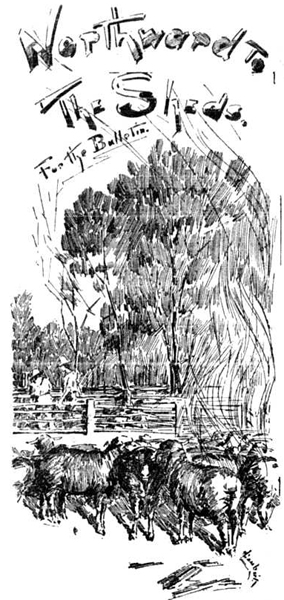
Northward to the Sheds by Will H. Ogilvie

| No TrackBacks
There's a whisper from the regions out beyond the Barwon banks,
There's a gathering of the legions and a forming of the ranks,
There's a murmur coming nearer with the signs that never fail,
And it's time for every shearer to be out upon the trail;
They must leave their girls behind them and their empty glasses, too,
For there's plenty left to mind them when they cross the dry Barooo:
There'll be kissing, there'll be sorrow much as only sweethearts know,
But before the noon to-morrow they'll be singing as they go;
      For the Western creeks are calling,
         And the idle days are done,
      With the snowy fleeces falling,
         And the Queensland sheds begun.

There is shortening of the bridle, there is tightening of the girth,
There is fondling of the idol that they love the best on earth,
Northward from the Lachlan River and the sun-dried Castlereagh,
Outward to the Never-Never ride the "ringers" on their way.
From the green bends of the Murray they have run their horses in,
For there's haste and there is hurry when the Queensland sheds begin;
On the Bogan they are bridling, they are saddling on the Bland,
There is plunging and there's sidling -- for the colts don't understand
      That the Western creeks are calling,
         And the idle days are done,
      With the snowy fleeces falling,
         And the Queensland sheds begun.

They will camp below the station, they'll be outting peg and pole,
Rearing tents for occupation till the "calling of the roll,"
And it's time the nags were driven, and it's time to strap the pack,
For there's never license given to the laggards on the track.
Hark! The music of the battle: it in time to bare our swords!
Do you hear the rush and rattle as they tramp along the boards?
They are past the pen-doors picking light-wooled weeners one by one;
I can hear the shear-blades clicking, and I know the fight's begun!
   Northward to the Sheds - illo.jpg

First published in The Bulletin, 8 June 1895, and again in the same magazine on 26 August 1959;
and then later in
Fair Girls and Gray Horses by Will H. Ogilvie, 1958;
The Shearers: Songbook edited by Ted Egan, 1984;
The Penguin Book of Australian Ballads edited by Elizabeth Webby and Philip Butterrs, 1993;
Breaker's Mate: Will Ogilvie in Australia by Will H. Ogilvie and edited John Meredith, 1996; and
Two Centuries of Australian Poetry edited by Kathrine Bell, 2007.

Note: the poem was originally published with the illustration shown here.

Author reference sites: Austlit, Australian Dictionary of Biography

See also.

The Shearing at Cuppacumbalong by Anonymous

| No TrackBacks
Before I tells my story, if you asks me who I are,
I'm the shearer from the Billybong who never called for tar:
And on this first occasion I came out very strong,
Stripping off the fleeces at Cuppabacumlong.

Good shearing there, you bet; no man might tomahawk;
For if he did, he got the sack, and from the shed might walk;
Indeed a few poor fellows, their hearts it well nigh broke,
When they found they could not slash along the Murrumbidgee stroke.

Now I'm a steady hand, and do not try to go too fast,
And proved that careful shearing pays better at the last;
For when well nigh a month is lost, by reason of the rain,
It surely must be worth the while our rations free to gain.

And so it proved: for while the two great ringers got the sack
I shore all through, and in return a decent cheque got back.
And as I settled with the boss, he said, almost in tears,
"My bully boy, your tucker's free, and you may take your shears."

There's one remark I'd wish to make for which I have good reasons --
And that's to make more roomy sheds in case of rainy seasons;
For many a man I think would go more easy to his bed,
If he knew his next day's sheep were safe and drily in the shed.

I never seed such rain before, my word, what work we had:
To finish before Christmas day we wired in like mad;
We rose with dawn at four o'clock, and freshened with our sleep,
We thronged the pens like eaglehawks to dart upon the sheep.

You know the price we got this year; 't was three and six the score;
The same they got at Tuggranong: and though we tried for more,
The boss held out, and in a tone that seemed by half too knowing,
He said that shearers might be scarce but rather guessed it blowing.

"And how about the grub ?" I knew you'd ask that vital qusestion,
For none can work ten hours a day, upon a a bad digestion;
'T was mainly good, the beef was fat, we'd doughboys pretty often,   
And now and then a good plum duff, our labours helped to soften.

Well now we've done; on Christmas-eve we finished the last cobblers,
And galloped off to Queanbeyan, to take some social nobblers;
I stay at Land's: so join me, mate, I'm scarcely ever out;
The shearer from the Billybong is always free to shout.

First published in The Queanbeyan Age, 9 January 1873

Note: the author of this poem is unknown.

About this Archive

This page is an archive of recent entries in the Shearing category.

Self is the previous category.

Society is the next category.

Find recent content on the main index or look in the archives to find all content.

Powered by Movable Type 4.23-en