Mischa Merz Interview

| No TrackBacks
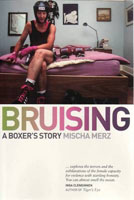
bruising.jpg    I must admit that, post Ali, I haven't had a lot of interest in boxing. In the sixties and seventies it seemed to be a global cultural phenomenon. Maybe because, aside from the Olympics, it was the only sport that seemed to be televised and viewed across the world. I've noticed the steady rise of women's boxing, but only in passing. Angela Meyer may have a similar overall view of the sport - I can't be sure - but she was certainly intrigued and captivated by Mischa Merz's Bruising, an account of her life in the ring. Meyer interviewed the author for her weblog LiteraryMinded.

You mention in the book that women are encouraged to be aware of aggression, or aggressive exercise as catharsis, but are generally discouraged to take it as far as fighting. Do you think many women might be held back by what they still see as 'inappropriate' displays of strength and ferocity?

I think probably less and less with each generation. Women of my age (without being too specific) were probably more self-conscious and you still hear them worry about building too much muscle or looking strong. And in some of the classes I have taken they are appalled at the suggestion of hitting someone. Even when I ask them to hit me, who has been hit many times and is virtually immune to it, they shake their heads as if I have asked them to decapitate me. Others are more keen to give it a go and a small number of them can be quite dangerous and I have to really watch myself with them. Back when I started, though, aggression by women was still regarded as something only the insane or hysterical would do or maybe a last resort for a woman being attacked. People struggled with the idea that it was functional rather than emotional and that physical aggression has legitimate application in sport. But this idea that you only hit someone if you're upset or out of control made it hard for women to take it on. They quite naturally didn't want to look crazy. And fair enough. But these days I see teenage girls really mixing it up and getting very physical and aggressive in sport without a second thought. I think there's a parallel with surfing. Women's surfing has really taken off in the same time frame as I have been boxing and they had to deal with the same doubts and discouragement. But then men were teaching their daughters from young and so a whole bunch of women have popped up fully formed. But there is still a bit of resistance with boxing. Men still say things like 'girls are too pretty to box' as if there are no pretty boys also boxing. It also implies that a woman's looks are more important than anything else about them. But I've seen quite a few women now with slightly bent noses and frankly, it enhances their looks. Maybe that's just me seeing them through the skewed eyes of a fanatic. I tend to regard anyone with a broken nose as being slightly more beautiful.

No TrackBacks

TrackBack URL: http://www.middlemiss.org/cgi-bin/movabletype/mt-tb.cgi/1899

Currently Reading

A Feast for Crows

A Feast for Crows by George R.R. Martin
Book Four for Martin's huge series and the canvas and cast of characters continues to expand. This tells half a story, with the other half in Book Five.


River of Shadows

River of Shadows by Valerio Varesi
Shortlisted for the CWA International Dagger award. The translation is a bit clunky and it's rather a slow burn to a so-so ending.


Recently Read

The Quiet American

The Quiet American by Graham Greene
Greene's famous novel about the French War in Vietnam in the 1950s and the beginnings of American involvement. Such power behind such a delicate touch.


The Marvellous Boy

The Marvellous Boy by Peter Corris
The third Cliff Hardy novel from 1982. Corris writes in the classic Private Investigator tradition, mixing a complicated plot with memorable characters and solid locale descriptions. Terrific stuff.


A Storm of Swords

A Storm of Swords by George R.R. Martin
Book Three in Martin's "A Song of Ice and Fire" saga. Many, many story-threads come to a head and then open back out again to maintain a stunning series.


Killing Floor

Killing Floor by Lee Child
The first Jack Reacher novel, in which he investigates the death of his brother and a major crime ring in a small country town. A little rough around the edges but you can see where the later novels sprung from.


The Eerie Silence

The Eerie Silence: Are we Alone in the Universe? by Paul Davies
Davies contemplates the subtitle, examining all the evidence and possibilities.


The Diggers Rest Hotel

The Diggers Rest Hotel by Geoffrey McGeachin
The 2011 Ned Kelly Award winner - the first Charlie Berlin novel. A Melbourne detective investigates a series of robberies and a murder in Albury-Wondonga in the 1950s.


A Clash of Kings

A Clash of Kings by George R.R. Martin
The second volume of Martin's monumental Song of Fire and Ice sequence. Not as good as the first volume and acts more as a stage-setting set of exercises, but you can tell it's building up to something big.


The Sense of an Ending

The Sense of an Ending by Julian Barnes
The 2011 Man Booker Prize winner. Not Barnes's best book but highly readable and echoes some of his very early work.


Hook's Mountain

Hook's Mountain by James McQueen
McQueen's sadly neglected novel from the early eighties. A WW II returned serviceman dives headfirst into environmental confrontation. This may be Australia's first "eco-terrorism" novel.


The Troubled Man

The Troubled Man by Henning Menkell
Menkell's last "Kurt Wallander" novel. As the detective investigates the disappearance of his daughter's future parents-in-law he encounters dark clouds everywhere, including his own life, past and future.


Shatter

Shatter by Michael Robotham
This 2008 Ned Kelly Award winner is an excellent thriller featuring a revenge-seeking ex-army killer, and a physically and mentally scarred psychologist who races to avoid being the next victim.


Odd and the Frost Giants

Odd and the Frost Giants by Neil Gaiman
Gaiman's coming-of-age story about a crippled boy and his attempt to save Asgard from the Frost Giants.


Goldilocks Enigma

The Goldilocks Enigma by Paul Davies
Davies's investigation into why the universe is like it is - "weak", "strong" and "final" anthropic theories all get a going over.


The Devil and Sherlock Holmes.jpg

The Devil and Sherlock Holmes by David Grann
A collection of Grann's journalism featuring tales of murder, madness and obsession. Varied but generally fairly interesting, and sometimes just plain bizarre.


Outliers

Outliers by Malcolm Gladwell
Gladwell's investigation of why some people are more successful than others. Interesting but not up to his previous work.


impossible_dead.jpg

The Impossible Dead by Ian Rankin
Rankin's second novel featuring his new detective Malcolm Fox of The Complaints. There are echoes of Rebus here, but it still has some way to go to reach those heights.


About this Entry

This page contains a single entry by Perry Middlemiss published on August 7, 2012 11:33 AM.

Australian Bookcovers #316 - Blueback by Tim Winton was the previous entry in this blog.

Reprint: Australian Writers: To the Editor of the Herald is the next entry in this blog.

Find recent content on the main index or look in the archives to find all content.

Monthly Archives

Powered by Movable Type 4.23-en