 |
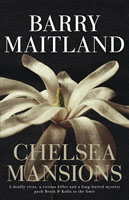
Chelsea Mansions Barry Maitland Allen & Unwin 2011 |
[This novel has been shortlisted for the 2012 Ned Kelly Award.]
From the publisher's page:
When Nancy Haynes, an elderly American tourist, is brutally murdered in a seemingly senseless attack after visiting the Chelsea Flower Show, DI Kathy Kolla suspects there is more to the case than first appears. When another occupant of the palatial Chelsea Mansions is murdered hot on the heels of the first - but this time a Russian oligarch - everybody wants to get involved.
Is it a Litvinenko-style KGB assassination? The spooks muscling in certainly think so. Are the murders linked? Or is Nancy's death just the result of mistaken identity? Kathy is determined to dig deeper, but comes up against walls of silence. If she persists, does she risk her career - and possibly more? DCI Brock, meanwhile, faces the fight of his life as his past comes back to haunt him.
A crime long buried, a deadly African virus, and some of the most resourceful criminals Brock and Kolla have ever faced, conspire to make this Maitland's best mystery yet.
Reviews
Christine Cremen in "The Sydney Morning Herald": "Back in the golden age of crime fiction, it was all location, location, location. From the 1920s to the 1950s, mysteries were published with floor plans of houses and even maps of whole villages to help readers work out who the murderer might be. Since the 1960s, writers haven't been quite as focused on where a crime takes place but when they are, their books can stand out from the rest. This is the case with former professor of architecture Barry Maitland's Brock and Kolla mysteries, an award-winning series of British police procedurals set in various well-realised locations. In these books, Maitland (who lives in Australia but has set all but one of his novels overseas) manages to accomplish what many other authors who make a feature of place can only aspire to - his setting becomes one of the characters."
"AustCrimeFiction" weblog: "One of the quirks of Maitland's books is the settings that he uses for the main component of the action in his books. In this case, this small square, with it's row of houses - part of which is the hotel, the rest of which has been progressively turned into a massive townhouse by our Russian victim Mikhail Moszynski. Not just a setting, this area because an intricate part of the plot itself as is often the way. As is also often the way Kolla's investigation is characterised by her dogged determination. Brock's part in the investigation is more thoughtful, cerebral, intuitive. Along the way there's some nice touches of the personal, and there's a bit of professional skullduggery just to make everyone's lives more complicated than they need to be."
"Fair Dinkum Crime" weblog: "There are a number of connecting threads between CHELSEA MANSIONS and SPIDER TRAP, but that shouldn't prevent you from reading this if it is your first book by Barry Maitland. I think this one will send you looking for earlier titles. And there are plenty of openings for a sequel to this one."
Roger Hainsworth in "The Adelaide Review": "If you read Chelsea Mansions you had better pay attention. It has more characters than Little Dorrit and if you lack total recall you might find it difficult to keep track of the dead, never mind the living. This is not a criticism. It is Barry Maitland at his best and that is very good indeed."
Caroline Curtis on the "Australian Women Online" weblog: "The beautiful construction of Chelsea Mansions might well owe something to Barry Maitland's architectural background. The story rises, like an interesting-looking building, with attractive, simple lines that reveal immensely intricate and complicated details only on closer examination. It immerses and entices the reader to follow every twist and turn...The foundations of the novel lie firmly in the reliable characters of D.I. Kathy Kolla and her boss D.C.I. Brock. Kathy Kolla is likeable - admirably holding her own in a male-dominated and chauvinistic environment; she is hard-working, dedicated and loyal. D.C.I. Brock exists to catch criminals. He is a creature of rare intelligence, his brilliant investigative mind able to pinpoint the right questions to ask. Neither accept appearances at face value. Both have courage and integrity in their pursuit of the truth, where others might have settled for easier, politically-correct compromises."
Interview
John Purcell asks the author "Ten Terrifying Questions" on the "Booktopia Blog".
Other
The author writes about how the novel came about on the "Readings" blog.

