Chris Lawson, of the “Talking Squid” weblog, has alerted us to the new YouTube trailer for Scott Westerfeld’s upcoming novel Leviathan.
As Chris puts it, this is “seriously cool”, but it also brings to mind a discussion that ran here on this weblog a few weeks back. In a piece about the current flood of vampire media - books, film and television - I alluded to a James Bradley interview in which he mentioned that the “undead” genre might be on the wane. Which then led me to ponder what might be the “next big thing”.
Various correspondonents, including my 16-year-old daughter, thought vampires still had a lot more to offer in the YA world, and I was happy to accept that. My question really went to: what happens after that?
We all know the effect that the Harry Potter books had on the younger section of the reading public - and, yes, the older one as well - but the last book in the series, Harry Potter and the Deathly Hallows, was published on 21 December 2006, nearly three years ago. The “big thing” after that was the Twilight series of teenage vampire novels from Stephanie Meyer, the first of which was published on 5 October 2005, and the second, New Moon, on 6 September 2006. So, by the time the Harry Potter series of novels had run its course, the Twilight series was in second gear and accelerating fast. Now, although Meyer - unlike Rowling - is still publishing novels in her preferred genre, the Twilight books at least have come to an end with the fourth in the series, Breaking Dawn, being published in August 2008.
All of which, in my view, leaves a bit of a gap. And it was this gap that I alluded to in my earlier post. One of the commenters on that earlier blog suggested “steampunk” might be the genre to step up and make its mark.
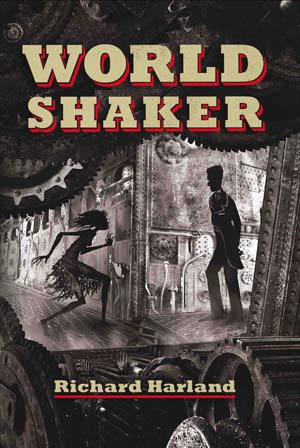 |
For those not in the know, “steampunk” according to Wikipedia, “is a sub-genre of fantasy and speculative fiction that came into prominence in the 1980s and early 1990s. The term denotes works set in an era or world where steam power is still widely used—usually the 19th century, and often Victorian era England—but with prominent elements of either science fiction or fantasy, such as fictional technological inventions like those found in the works of H. G. Wells and Jules Verne, or real technological developments like the computer occurring at an earlier date.” It’s a genre that doesn’t restrict itself to strictly adult or YA literature: novels fitting the description can easily be read by readers across the age-spectrum and therein lies its appeal. Quest adventures fit, as do “alternate histories” and “gaslight romances”. Works such as The Difference Engine by William Gibson and Bruce Sterling, Perdido Street Station by China Miéville, and Worldshaker by Richard Harland all fall under the steampunk umbrella. |
Zombies and werewolves, by their very nature are too bloody to have much more than a peripheral appeal. The same might have been said of vampires originally - if you’ve seen the 1920s film Nosferatu you’ll understand what I mean - but Meyer, and Anne Rice before her, have shifted the boundaries of the vampire genre away from the blood and more towards the romance. I just can’t see the same emphasis shift happening with zombies, with their mindless brain-munching, or werewolves whose monthly human cycle is punctuated with brief stints of ultra-violence.
No, I think the “next big thing” will probably occur within the steampunk genre. There will be enough elements to attract both young male and female readers and enough adults will be able to remember their youthful infatuations with balloons and steam trains, dark foggy laneways, and things that go bump in the night. And, if that’s the case then I also suspect that Scott Westerfeld and Richard Harland might well be in the forefront of that new movement.


On the werewolf side, dunno, but my wife the YA-consuming librarian read the ARC of Maggie Stiefvater's Shiver and thought it was the next big thing. It has an interesting non-traditional take on werewolves.
And just when I come out and state that werewolves are just a bit too violent for the next big teen thing comes the following news:
'MTV is also pondering a reinvention of '80s film "Teen Wolf" in series format, with a greater emphasis on romance, horror and werewolf mythology. Jeff Davis ("Criminal Minds") is the writer, with Marty Adelstein ("Prison Break") and Rene Echevarria ("Castle") executive producing.'
The original 1985 film starred Michael J. Fox, which was followed by a cartoon series of the same name.
I win! I win! Steampunk it is.