100 Australian Poems 9.0: "The Wail of the Waiter (A Tavern Catch)" by Marcus Clarke

I had never really considered Marcus Clarke to be much of a poet until I come across this poem - and, by that, I mean from a point of view of quantity rather than quality, having never encountered any poetry by him previously. The Australian literature resource Austlit lists 129 works by the author but only 9 poems.  Granted not all possible publication sources have been indexed, but the major magazines and newspapers show that Clarke was more a novelist, journalist and playwright than poet.

So we come to Clarke's poem of a day in the life of a restaurant waiter, the first truly urban poem in the collection so far.   

The eponymous waiter is given a hard time by all sections of the tavern's clientele. He is yelled at, abused, and cursed by all as he tells the story of his day.  It comes across as one mad rush oorm one dish to another, from one glass or porter to a "soda and a dash".  He is given little rest.

An interesting aspect of the poem is the glimpse it gives of the eating habits of the people of Melbourne in the 1870s: we see mutton chops and steak along with coffee, toast, flathead (fish), ham and beef for breakfast; and there's oxtail soup, curry, cold boiled beef, irsh stew and pickled cabbage for lunch. The poet doesn't actually detail any dinner-time fare but you get the impression that steak and oinions, pork and greens, and spirit-reared cow-heel might just be on the menu.

By the end of the day the waiter has about had it, contemplating the "hideous Babel" that he encounters in the tavern as his "soul is slowly melting" and his "brain is softening fast".  Does man live only to eat, he wonders.  From his perspective that's all there is: eating, shouting, drinking - like something from a Gordon Ramsay kitchen without the swearing.  Or, at least, without the swearing appearing here.  If he was writing today I doubt whether Clarke, or his editor, would have been so restrained.

Clarke was believed to drink heavily - which may have contributed to his early demise at the age of 35 - so we can be fairly certain that the poem is told from his experiences watching put-upon slave labour going about their work.  It's a form of drudgery, I suspect, still very much in evidence today.

Text: "The Wail of the Waiter" by Marcus Clarke

Author bio: Australian Dictionary of Biography 
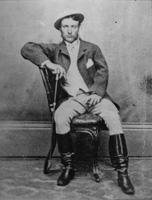
marcus_clarke_small.jpg

Publishing history: First published in The Bulletin on 29 September 1900, and subsequently reprinted in Freedom on the Wallaby: Poems of the Australian People (1953), The New Oxford Book of Australian Verse (1986 and 1996), and The Oxford Book of Australian Light Verse (1991).

Next five poems in the book:

"Where the Pelican Builds" by Mary Hannay Foott

"Catching the Coach" by Alfred T. Chandler ("Spinifex")

"Narcissus and Some Tadpoles" by Victor Daley

"Nine Miles from Gundagai" by Jack Moses

"The Duke of Buccleuch" by JA Philp

Note: this post forms part of my series on the poems contained in the anthology 100 Australian Poems You Need to Know edited by Jamie Grant.  You can read the other posts in this series here.

Currently Reading

the_blade_itself.jpg

 The Blade Itself by Joe Abercrombie
Heroic fantasy in the modern style. A fantasy that is laced through with noirish elements, and excellent characterisations. First book of The First Law trilogy.


where_have_you_been.jpg

 Where Have You Been? by Wendy James
What happens when a sister returns after being missing, presumed dead, for twenty years? James enhances her reputation as one of Australia's rising literary novelists.


Recently Read

wyatt.jpg

 Wyatt by Garry Disher
Disher's anti-hero is back after an absence of ten years with a gritty, fast, noirish struggle for survival. All the best aspects of Disher's work are on display here.


leviathan.jpg

 Leviathan by Scott Westerfeld
A Young Adult steampunk novel set at the start of an alternate history First World War. Fast-paced, intriguing and totally captivating.


do_androids.jpg

 Do Androids Dream of Electric Sheep? by Philip K. Dick
Dick's novel of the near future when the difference between human and android is barely discernible. One of the great all-time sf titles.


american_journeys.jpg

 American Journeys by Don Watson
Watson journeys into the heart of America, by train and car. There he discovers the best, and the worst, of humanity and society.


ghostlines.jpg

 Ghostlines by Nick Gadd
2009 Best First Novel at the Ned Kelly Awards. Murder in the art world involving political intrigue and business corruption in Melbourne.


in_it_to_win_it.jpg

 In It to Win It: The Australian Cricket Supremacy by Peter Roebuck
Roebuck's examination of the rise of Australian cricket post-1987. Some flashes of wonderful insight interspersed with long documentary reportage.


things_we_didnt_see_coming.jpg

 Things We Didn't See Coming by Steven Amsterdam
2009 Age Book of the Year. A post-apocalyptic vision of a country (Australia?) in decline, as seen through the eyes of one man. Told in a series of semi-connected short stories.


moneyball.jpg

 Moneyball: The Art of Winning an Unfair Game by Michael Lewis
Lewis's intriguing look into what makes a good baseball team. It's essentially about sport but should also be read from a people/project management perspective. Fascinating stuff.


against_the_machine.gif

 Against the Machine: Being Human in the Age of the Electronic Mob by Lee Siegel
Reads like a polemic against the dangers of the internet, but with little in the way of guidance towards the second part of the title.


blood_moon.jpg

 Blood Moon by Garry Disher
The fifth of Garry Disher's Challis and Destry series set on the Mornington peninsular. A brutal bashing turns political. But is it related to the murder of a local environment protection officer?


replay.jpg

 Replay by Ken Grimwood
World Fantasy Award winner from 1988. Grimwood's intriguing novel about a man who relives his life over and over. A modern fantasy classic which most readers would not recognise as such.


tango_briefing.jpg

 The Tango Briefing by Adam Hall
The fifth of Adam Hall's Quiller series from 1973 and probably about his best. More physical than McCarry.


tears_of_autumn.jpg

 The Tears of Autumn by Charles McCarry
McCarry's masterful spy thriller from 1974. Paul Christopher investigates the asssassination of John F Kennedy.


About this Entry

This page contains a single entry by Perry Middlemiss published on February 4, 2010 2:25 PM.

2009 Locus Recommended Reading List was the previous entry in this blog.

Reprint: Australian Literature is the next entry in this blog.

Find recent content on the main index or look in the archives to find all content.

Powered by Movable Type 4.23-en