Andrew McGahan Interview

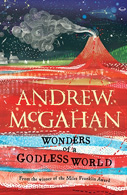
wonders_godless_world.jpg    Andrew McGahan is best known for his Miles Franklin Award-winning novel The White Earth, and for Praise, which won the author the "Australian"/Vogel Award in 1991.

His latest novel, Wonders of a Godless World, has just been released and you can see a promotional trailer for the book here.

From the publisher's page: "The witch, the virgin, the archangel, the duke and an orphan meet in the extraordinary new novel from the award-winning Andrew McGahan -- an electrifying, tumultuous story of inner demons, desire and devastation, a powerful and apocalyptic tale that sweeps the reader from the beginning of time to the end of the earth."

Leading up the release of the book, Jo Case interviewed the author for the "Readings" weblog.
Wonders of a Godless World is heavily reminiscent of myth or fairytale: its population of archetypes, the element of parable, the magic realist or fantastical element. What drew you to using this form? Was it your intention to create a kind of contemporary fable?

Actually, my intention at the very beginning was just to find some way to indulge my schoolboy fascination for unusual natural disasters. Originally, I was trying to come up with a story that involved no human characters at all, instead using only the forces of nature interacting in a kind of wordless planetary drama. I couldn't make that idea work, but then the orphan and the foreigner emerged. The orphan -- a girl freakishly in tune with the planet and its processes, but so out of tune with humanity that she can't talk or even remember her own name. And the foreigner -- a man utterly out of tune with the planet and doomed time and time again to die in natural disasters, and yet whose own outrage always brings him back to life. From there, all the weird and interesting stuff about Earth that I originally wanted to explore could be played out in the relationship between these two.

But having allowed humans into the picture, I was still keen to keep them at a distance. Hence no one is allowed a name or any normal dialogue or even, when it comes to the five or six peripheral characters, much individual personality. So yes, because of that the story takes on an otherworldly or mythic or fairytale tone, and I was happy to go along with it, but it was more of a side-effect than a central purpose.

Currently Reading

the_blade_itself.jpg

 The Blade Itself by Joe Abercrombie
Heroic fantasy in the modern style. A fantasy that is laced through with noirish elements, and excellent characterisations. First book of The First Law trilogy.


where_have_you_been.jpg

 Where Have You Been? by Wendy James
What happens when a sister returns after being missing, presumed dead, for twenty years? James enhances her reputation as one of Australia's rising literary novelists.


Recently Read

wyatt.jpg

 Wyatt by Garry Disher
Disher's anti-hero is back after an absence of ten years with a gritty, fast, noirish struggle for survival. All the best aspects of Disher's work are on display here.


leviathan.jpg

 Leviathan by Scott Westerfeld
A Young Adult steampunk novel set at the start of an alternate history First World War. Fast-paced, intriguing and totally captivating.


do_androids.jpg

 Do Androids Dream of Electric Sheep? by Philip K. Dick
Dick's novel of the near future when the difference between human and android is barely discernible. One of the great all-time sf titles.


american_journeys.jpg

 American Journeys by Don Watson
Watson journeys into the heart of America, by train and car. There he discovers the best, and the worst, of humanity and society.


ghostlines.jpg

 Ghostlines by Nick Gadd
2009 Best First Novel at the Ned Kelly Awards. Murder in the art world involving political intrigue and business corruption in Melbourne.


in_it_to_win_it.jpg

 In It to Win It: The Australian Cricket Supremacy by Peter Roebuck
Roebuck's examination of the rise of Australian cricket post-1987. Some flashes of wonderful insight interspersed with long documentary reportage.


things_we_didnt_see_coming.jpg

 Things We Didn't See Coming by Steven Amsterdam
2009 Age Book of the Year. A post-apocalyptic vision of a country (Australia?) in decline, as seen through the eyes of one man. Told in a series of semi-connected short stories.


moneyball.jpg

 Moneyball: The Art of Winning an Unfair Game by Michael Lewis
Lewis's intriguing look into what makes a good baseball team. It's essentially about sport but should also be read from a people/project management perspective. Fascinating stuff.


against_the_machine.gif

 Against the Machine: Being Human in the Age of the Electronic Mob by Lee Siegel
Reads like a polemic against the dangers of the internet, but with little in the way of guidance towards the second part of the title.


blood_moon.jpg

 Blood Moon by Garry Disher
The fifth of Garry Disher's Challis and Destry series set on the Mornington peninsular. A brutal bashing turns political. But is it related to the murder of a local environment protection officer?


replay.jpg

 Replay by Ken Grimwood
World Fantasy Award winner from 1988. Grimwood's intriguing novel about a man who relives his life over and over. A modern fantasy classic which most readers would not recognise as such.


tango_briefing.jpg

 The Tango Briefing by Adam Hall
The fifth of Adam Hall's Quiller series from 1973 and probably about his best. More physical than McCarry.


tears_of_autumn.jpg

 The Tears of Autumn by Charles McCarry
McCarry's masterful spy thriller from 1974. Paul Christopher investigates the asssassination of John F Kennedy.


About this Entry

This page contains a single entry by Perry Middlemiss published on October 2, 2009 11:31 AM.

Reprint: "The Banjo's" Poems was the previous entry in this blog.

I Wish I Were Blind is the next entry in this blog.

Find recent content on the main index or look in the archives to find all content.

Powered by Movable Type 4.23-en