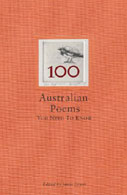
 | 100 Australian Poems You Need to Know Edited by Jamie Grant Hardie Grant Books 2008 |
I recently picked up a copy of this book and, I must say, I'm mightily impressed by just about everything to do with it. It's a good-looking thing from the outset: brightly coloured boards, an inlaid illustration on the front, slightly cream-coloured pages with lots of white space and a good font size, and a number of pencil illustrations throughout the book by Bridget Farmer. Hardie Grant Books has produced a good one here, one that makes you want to pick it up and read.
I say "just about" because there are a few things that irk me a little. I won't detail them now but will aim to cover them as I gradually work my way through the list of poems presented here. They are mostly minor, and probably rather nit-picky, but it's the right of the reader to complain as well as praise. The book is divided into nine sections ("Convict and Stockrider", "The Red Page", "Gundagai to Ironbark", "Bastard and Bushranger", "Drought, Dusk and War", "Country Story", "Melbourne and Sydney", "Beyond Sprawl", and "The Generation of XYZ") most of which will be pretty obvious to most Australian readers. The exception might be "The Red Page", which refers to the literary section of The Bulletin magazine which was printed on the inside pages of the red wrap-around cover the magazine sported for much of its early life, from 1880.
The contents of this volume cover the full range of poems from the earliest distinctly Australian literature to a poem from 2002. So you can fairly state that the contents cover the date range of Australian poetry - in the European style at any rate. But the major question outstanding is "Do you really need to know these poems?", or, for that matter, "any poems?" It depends on your ambitions. If it's to have a general understanding of the development of Australian literature over the past 200 years or so then at least some acquaintance with poetry is a requirement - I'm not one for assuming that verse will be learnt by rote, so a recognition and appreciation level of knowledge should suffice.
So poetry is a requirement, but these ones in particular? Well, that's where the arguments come in. Grant comments on the selection process by stating:
There will inevitably be some other readers' favourites missing, particularly as I have restricted my choice to one poem for each author. If I had attempted to literally present the first one hundred in a list of this country's most popular poems, there might not be many more than a dozen poets included in the collecton, from Henry Lawson to Les Murray. The broader range which results from my self-imposed restriction should enable other readers to make some pleasurable discoveries.So you can understand what Grant is getting at. Even though it does fly in the face of the title to some extent this is a publishing decision which makes about as much sense as any other. It keeps the volume down to a manageable size, and for that we can be grateful. Just taking Banjo Paterson as an example, if you took all his most-loved poems you'd have to include "Waltzing Matilda", "The Man from Snowy River", "Clancy of the Overflow", "Mulga Bill's Bicycle" and "The Man from Ironbark". Too unwieldy. Better to chose one and leave it at that. Anyway, it allows for arguments amongst readers. And arguing about these poems is just what I am going to do on this weblog. I'm aiming to write about one poem here each week: looking at the poem, the author, the context and publishing history. A self-imposed study course on Australian poetry if you like.
"Ah", but I hear you say, "whatever happened to the 'Classic Year' reading program from 2008. That only got through 17 of the 50 odd titles." Which is a good point. I dropped that reading program last year for a number of reasons, and now have every intention of picking it up again in the next week or so. Just have to keep plugging away and doing the best I can. Where possible I'll provide links to web-based editions of the poems in the book, though, for copyright reasons, you'll understand that this will begin to peter out by the time we get to about halfway.
First five poems in the book:
"A Convict's Tour to Hell" by Francis Macnamara
"The Beautiful Squatter" by Charles Harpur
"Taking the Census" by Charles R Thatcher
"The Sick Stockrider" by Adam Lindsay Gordon
"My Other Chinee Cook" by James Brunton Stephens

