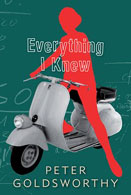
 | Reviews of Everything I Knew Peter Goldsworthy Hamish Hamilton 2008 |
From the publisher's page
It's the year 1964, and fourteen-year-old know-it-all Robbie Burns is about to discover he still has a lot to learn.ReviewsThe world is changing fast, although the news has yet to reach the small South Australian town of Penola. There Robbie leads and idyllic life of rabbiting, backyard science experiments, and hooligan scrapes with his friend Billy. Penola is oblivious even to its minor celebrity as the birthplace of the poet John Shaw Neilson, but poetry means the world to Robbie's new teacher from the city, the stylish Miss Peach, a sixties sophisticate with stirrup pants, Kool cigarettes and Vespa scooter.
Miss Peach's artistic yearnings and modern ways prove too much for the good people of Penola, but they fire Robbie's precocious imagination and burgeoning sexuality, until what begins as a schoolboy fantasy has terrible, real consequences.
Geordie Williamson in "The Australian": "In Maestro, Goldsworthy's first published novel, it was Darwin whose charms were hymned on the page...Written almost two decades later, Everything I Knew plays a similar song in a darker key. It, too, is concerned with a teenage solipsist greedy for pleasure and success: a study in arrogance shaped into regret by time...Fictional accounts of calf-love always teeter above twin abysses: the cringing embarrassment of failure and the destructive potential of success. The best, such as Raymond Radiguet's The Devil in the Flesh and Ivan Turgenev's First Love, rely on the essential amorality of sexuality to undercut mawkish displays of emotion, and Goldsworthy does something similar here. Too much would be given away by following the plot much further. It is enough to say that his pursuit of Pamela Peach ends in a way that will shape the rest of his life. In another nod to Maestro, the final chapters of the book shunt forward four decades to reveal what that shape that is."
Christina Hill in "Australian Book Review": "This is an overwrought, undisciplined novel; it indulges in hyperbole and implausible incidents, and often the dialogue between characters is embarrassingly stilted. Its strength, however, lies in its evocation of how an adolescent boy might think and behave."
Murray Bramwell in "The Adelaide Review": "The everything that the careless, sometimes cruel, Robbie Burns knows, may be a fateful insufficiency -- as, for any adolescent, it is bound to be. But the everything that Peter Goldsworthy brings -- its human vulnerability and foible, its sexual compulsion and foolishness -- is a Chaucerian plenty. It contains multitudes, and, as Terence said in the classics, nothing that is human is alien to it."
Ian McFarlane in "The Canberra Times": "Goldsworthy's nostalgic evocation of the time and place of early experience brings to mind David Malouf's Johnno, with its painful embarrassment and joyful affirmation, although the novel's coda, from a regretful Robbie in old age, introducing doubt concerning the way we see childhood from an adult perspective, seemed unnecessary to me, and weakened the overall impact." He still considered it "Highly recommended."
Peter Pierce in "The Sydney Morning Herald": "Few of his Australian contemporares are so skilled at the narrative arts as Goldsworthy, let alone so fearless in seeking new, rather than familiar, fictional ground to work."
James Ley in "The Age": "What prevents Everything I Knew from succumbing to what are essentially dramatic cliches is its deftness of touch and its humour. Goldsworthy's writing is nimble enough to make the conventional aspects of his plot work for him, rather than the other way round. He is a writer whose work is often less straightforward than it appears, and though Everything I Knew does not quite have the concentrated power of the excellent Three Dog Night (2003), it is a characteristically well-realised novel."
Interviews
"The Book Show" on ABC Radio National - interview by Ramona Koval, 27 October 2008
"The Age" - interview, 3 November 2008
"Brisbane News" - interview by Phil Brown
"East Torrens Messenger" - interview by Des Ryan

