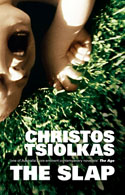
 | Reviews of The Slap Christos Tsiolkas Allen & Unwin 2008 |
From the publisher's page
At a suburban barbecue, a man slaps a child who is not his own.ReviewsThis event has a shocking ricochet effect on a group of people, mostly friends, who are directly or indirectly influenced by the event. In this remarkable novel, Christos Tsiolkas turns his unflinching and all-seeing eye onto that which connects us all: the modern family and domestic life in the twenty-first century. The Slap is told from the points of view of eight people who were present at the barbecue. The slap and its consequences force them all to question their own families and the way they live, their expectations, beliefs and desires.
What unfolds is a powerful, haunting novel about love, sex and marriage, parenting and children, and the fury and intensity - all the passions and conflicting beliefs - that family can arouse. In its clear-eyed and forensic dissection of the ever-growing middle class and its aspirations and fears, The Slap is also a poignant, provocative novel about the nature of loyalty and happiness, compromise and
truth.
James Ley's review of the novel in "Australian Book Review" (not available on the web) is titled "A furious moralist" and Ley bases his review on his explanation of Tsiolkas's political stance: "Tsiolkas considers himself a man of the left, but is impatient with what he sees as the complacency, prim hypocrisy and ineffectual nature of his own side of politics. Much of the energy of his writing is generated by the friction between a frustrated idealism of the left, which sets itself against inequality and exploitation and prejudice, and a tough-minded realism that wants to insist upon the regressive impulses that perpetuate these social evils. More than any other contemporary Australian novelist, he has a powerful sense of humankind's capacity for hatred. His fiction acknowledges its primal allure, its negative validation; his characters often experience a surge of excitement when they allow themselves to think a vicious or bigoted thought...The Slap, a long novel, contains some ragged writing, but its multiple perspectives work together to illuminate the difficulties of the issues it raises, and its length is justified by the breathing space it permits its characters." Ley concludes that this is "an engaging and stimulating book".
Venero Armanno in "The Australian": "Tsiolkas's book will remind many readers of the different forms of violence they might have experienced in growing up: from too-rough discipline in the home, to the bloody battlefields that sports matches can turn into, to the corporal punishment that used to be a mainstay of school discipline...One of the greatest problems faced by a writer attempting such a bold multi-voiced narrative is that so many distinct points of view can, in the end, total a point of view that is nothing at all. The Slap manages to achieve the opposite. Tsiolkas's gallery of characters encompasses not only what Australia is in the early 21st century, but also explores the roots of this latest generation, found back in the 20th. His book is distinctly Australian: from the idiom to the blended families to the multi-multi-multicultural lives of its protagonists."
Gerard Windsor in "The Sydney Morning Herald": "In the first 37 pages of The Slap we're introduced to 31 active characters. In Tolstoy we'd have the chamberlain announcing 'Prince and Princess Oblonsky, Miss Natasha Rostov' and so on as they arrive at the ball. Christos Tsiolkas has his characters swarming through an open front door to a suburban Melbourne barbecue. This loading up is a bit of a scramble, a bit confusing, even a bit flat but once everyone's on board the novel's voyage is a great trip...Tsiolkas made his name as a wild man of Australian fiction but, for all its swearing and bad behaviour, The Slap is a strikingly tender book. No character, not even the brat, is written off. Rapprochement and forgiveness are the abiding subjects of the novel and you might say the author is an exemplar to all his characters. His psychological acumen and sympathy extend liberally across the range of his cast, over women as generously as men."
Genevieve Tucker on the "reeling and writhing" weblog: "The interesting thing about this book was its effortless blend of well-observed local detail ("I shot a man in Vermont, just to watch him die"), with the hyper-realism common to soap opera, but rarely well managed in novel form. Like the folks who wrote the end of Mullet, Tsiolkas knows this story has to be bigger than real life, soap without the bubbles: dirt, blood and a few broken teeth left in the bath when it's emptied. Yes, some silly things happen: but they do not have to be believable to make the book move and live and have its being, and his control of all threads is mesmerising - he never lets go. I don't think I've really explained what I mean there, but let it be."
Short notices
Scott Whitmont on the "Boomerang Books" weblog: "The language issue aside, The Slap works. It would not be inappropriate to describe it as a contemporary Australian masterpiece, reminiscent of Elliot Perlman's Seven Types of Ambiguity."
"A Novel Approach" weblog: "Tsiolkas truly is one of the best novelists this country has at the moment. His ability to be pitch-perfect on so many topics and ideas is astounding, and whether this is because he has such a unique background, or because he's just has an amazing imagination is not important. He manages to create characters that are real, believable, and above all, sympathetic. Each and every chapter, you totally understand what and why these people are thinking, and each truly believes they are totally justified in their actions. And while each reader will take their own side of the debate, this novel touches a part of Australian culture that is often skimmed over."
"Jennysreadingblog": "The title of this book is very apt. It hits you in the face with a sharp sting that seems to linger for days afterwards."
Interviews
"The Book Show" on ABC Radio National.
"Readings" weblog with Belinda Monypenny and Jo Case.
"SlowTV" with Sophie Cunningham.

