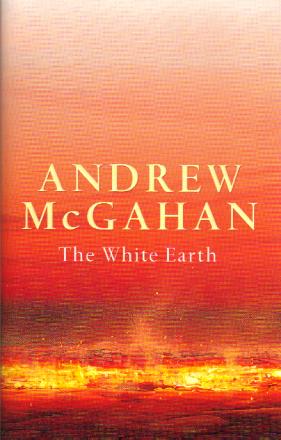
Andrew McGahan
The following novels constitute the shortlist for the 2005 Miles Franklin Award:
|
|
The White Earth Andrew McGahan |
Dustjacket synopsis:
"His father dead by fire and his mother plagued by demons of her own, William is cast upon the charity of his unknown
uncle - an embittered old man encamped in the ruins of a once great station homestead, Kuran House. It's a baffling
and sinister new world for the boy, a place of decay and secret histories. His uncle is obsessed by a long life of decline
and by a dark quest for revival, his mother is desparate for wealth and security she has never known, and all their hopes
it seems come to rest upon William's young shoulders. But as the past and present of Kuran Station unravel and merge
together, the price of that inheritance may prove to be the downfall of them all. The White Earth is a haunting,
disturbing and cautionary tale."
Quotes:
"A major novel of grand design. McGahan's most ambitious work yet." - Alex Miller
First Paragraph:
One spring day in late 1992, when William was halfway between his eighth birthday and his ninth, he looked out from the back verandah and saw, huge in the sky, the mushroom cloud of a nuclear explosion. He stared at it wondering. The thunderhead was dirty black, streaked with billows of grey. It rolled and boiled as it climbed into the clear blue day, casting a vast shadow upon the hills beyond. But there was no sound, no rumble of an explosion. Hot silence lay across the wheat fields, and the air was perfectly still. William said nothing, for there was no one to tell - his mother was in bed with a headache, and he knew better than to wake her. He sat on the edge of the verandah and watched. Ever expanding, the cloud began to drift, caught by some upper breeze. It loomed over the heouse, and great jets were arcing out from the main body, like the trails of slow meteorites. Down below, ash was beginning to fall, small black flecks spiralling in the air. Other particles were bigger, shrivelled and twisted embers, still glowing red as they settled. William was aware of the smell of burning...but it was a good smell, a familiar smell. The smell of grass, of wheat, of the farm itself.
From the Allen and Unwin paperback edition, 2004.
Notes:
You can read more about Andrew McGahan here.
|
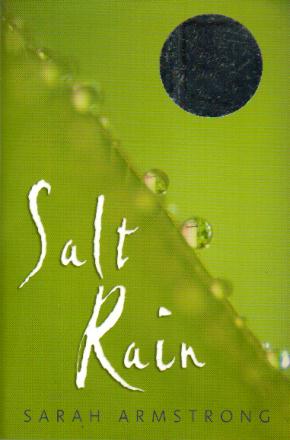
Salt Rain Sarah Armstrong |
Dustjacket synopsis:
"Allie's free-spirited mother, Mae, mysteriously disappears on Sydney Harbour one night, her dinghy found drifting in the
darkness. Fourteen-year-old Allie is whisked away to the north, to a rainforested valley, by Julia, an aunt she barely
knows. On the dilapidated dairy farm where Mae and Julia grew up, Allie waits for her mother to call.
"As these anxious days pass, Allie learns about Mae's childhood and about Mae herself through the eyes of others. Allie watches her aunt, who is determined to return the valley to its natural order, replanting the trees of the forest that her grandfather cleared for grazing. And she watches her mother's first love, who she discovers still lives in the valley. As the heat of the wet season builds, Allie tries to decipher the truth and lies that her mother had told her, and must come to grips with the many secrets held close in the valley.
"Beautifully written, Salt Rain is an extraordinary evocation of the moods of the inexorable rainforest, of families and of the secrets hidden within them."
First Paragraph:
From the Allen & Unwin paperback edition, 2004.
|
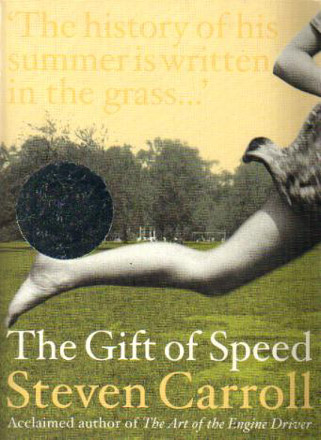
The Gift of Speed Steven Carroll |
Dustjacket synopsis:
"In 1960 the West Indies arrive in Australia, bringing with them a carnival of music, color and possibility. Michael,
who is sixteen, is enthralled. If, like his heroes, he has the gift of speed, he will move beyond his suburb into the
geat world...
First Paragraph:
From the Fourth Estate paperdback edition, 2004.
Notes:
You can read more about xxxxxxxxxxxxx here.
|
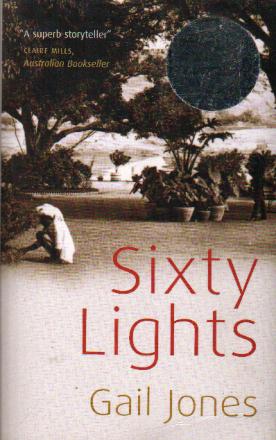
Sixty Lights Gail Jones |
Dustjacket synopsis:
"In 1860 Lucy Strange and her brother Thomas are orphaned, and so begins Lucy's adolescent journey of discovery. It will
take her away from her childhood home in Australia to London and Bombay and, finally, to her death, at the age of
twenty-two. Lucy's is a life abbreviated, but not a life diminished. She is a remarkable character, forthright,
gifted and canny.
"Sixty Lights is the powerful chronicle of a modern and independent young woman's life in the Victorian world. Objects evoke the past and hint at the future in a narrative that flows between pleats in time. Through her observation of such objects Lucy's photographic vision is apparent. Her world is a series of still images which one day, printed on albumen paper, she will leave behind as affecting memories of her own extraordinary life."
First Paragraph:
A voice in the dark: "Lucy?"
It was a humid-sounding whisper. She wanted this, this muffled greatness, swathed in sheets scented and moistened by the hated conjoining of their bodies. This tropic of the bed. This condensation of herself into the folds of a marriage. The late night air was completely still. Insects struck at the mosquito net, which fell, silver and conical, like a bridal garment around them. Lucy watched a pale spotted moth sail slowly towards her face, land on the net, deposit its powder, and lift unevenly away. It was waving like a tiny baby hand in the darkness.
This is what she had seen, earlier that day: An Indian man had been climbing the bamboo scaffolding of one of the high colonial buildings, with a large mirror bound to his body by a piece of cloth. His white dhoti was flapping and his orange turban was atilt, and he hauled himself with confidence from level to prearious level -- altogether a fellow who knew what he was doing -- when some particular gust or alarum that carried the dimension of fate caused him to misjudge his footing and fall through the air. Because he could not release the mirror, but clutched at it as though it was a magic carpet, he landed in the midst of its utter shattering, and was speared through the chest. The quantity of blood was astounding. It spurted everywhere. But what Lucy noticed most -- when she rushed close to offer assistance along with everyone else -- was that the mirror continued its shiny business: its jagged shapes still held the world it existed in, and bits and pieces of sliced India still glanced on its surface. Tiny shocked faces lined along the spear, compressed there, contained, assembled as if for a lens. She simply could not help herself: she thought of a photograph.
From the Harvill Press paperback edition, 2004.
Notes:
Gail Jones teaches literature, cinema and cultural studies at the University of Western Australia. She is the author of
two collections of short stories, Fetish Lives and The House of Breathing, and one previous novel, Black
Mirror, which won the Nita B. Kibble Award.
|
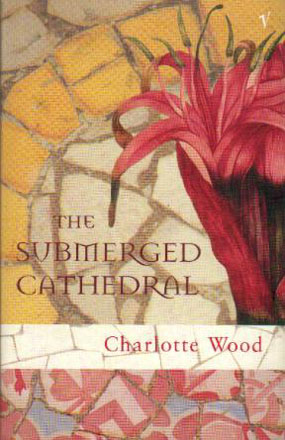
The Submerged Cathedral Charlotte Wood |
Dustjacket synopsis:
"Spanning many years travelling across Australia's vast continent and through some of Europe's great cities, The
Submerged Cathedral is a beguiling, heartbreaking story of paradise and the fall; of faith, sacrifice and atonement;
and of sisterly love and rivalry. Most of all, however, it is about an enduring and sacred love - a love stronger than
death - and the journeys undertaken in its name.
"Written in spare, haunting prose, this novel rings with the power and simplicity of a parable. The release of Charlotte Wood's acclaimed first novel, Pieces of a Girl, marked her as a young writer of great promise; The Submerged Cathedral, with its profound evocations of faith and landscape, thrillingly confirms that promise."
First Paragraph:
One more week and he is waiting, his heart faltering, on her front step. In his hands he holds a fish.
She smokes slowly in the bath, and the slight scent of it fills the house.
Later, she will tell him how impressively the bathwater holds sound, how in her unerwater ears his door knock is suspended for a second, stilled time. This afternoon her half-closed eye has spiked the bathroom light globe into a yellow grevilleal star, and she is all watery conductor of the senses. So when the flyscreen judders and his knuckles strike the frosted glass, the sound of it moves through the fibres of glass and wood and plaster and iron bath claw and water, and it enters her body like a note struck on a bell.
Her hair is wet down her back when she finds him there on her doorstep with electricity rising in him, and holding out to her a fish.
From the Vintage paperback edition, 2004.
This page and its contents are copyright © 2006 by Perry Middlemiss, Melbourne, Victoria, Australia.
Last modified: January 26, 2006.