Shirley Hazzard
The following novels constitute the shortlist for the 2004 Miles Franklin Award:
|
|
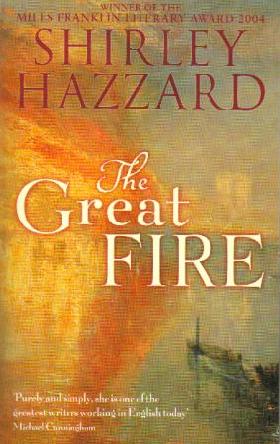
The Great Fire Shirley Hazzard |
Dustjacket synopsis:
"Twenty years in the writing, The Great Fire is a triumphant novel of lives shadowed by war and redeemed by love.
"After the Second World War, in war-torn Asia and stricken Europe, men and women must reinvent their lives and learn, from their past to dream again."
Quotes:
"Purely and simply, she is one of the greatest writers working in English today" - Michael Cunningham
"I wish there were a set of words like 'brilliant' and 'dazzling' that we had saved for the rarest occasions, so that
when I tell you The Great Fire is brilliant and sazzling you would know it is the absolute truth. This is a
book worth a twenty-year wait" - Ann Patchett, author of Bel Canto
"An hypnotic novel that unfolds like a dream: Japan, Southeast Asia, the end of one war and the beginning of another, the
colonial order gone and at the centre of it all, a love story" - Joan Didion
"A brilliant, brave and sublimely written novel...among the most transcendent works I've ever had the pleasure of reading" -
Anita Shreve
First Paragraph
Now they were starting. Finality ran through the train, an exhalation. There were thuds, hoots, whistles, and the shrieks of late arrivals. From a megaphone announcements were incomprehensible in American and Japanese. Before the train had moved at all, the platform faces receded into the expression of those who remain.
Aldred Leith sat by a window, his body submissively chugging as they got under way. He would presently see that rain continued to fall on the charred suburbs of Tokyo, raising, even within the train, a spectral odour of cinders. Meanwhile, he was examining a photograph of his father. Leith was holding a book in his right hand - not reading, but looking at a likeness of his father on the back cover.
It was one of those pictures, the author at his desk. In an enactment of momentary interruption, the man was half-turned to the camera, left elbow on blotter, right hand splayed over knee. Features fine and lined, light eyes, one eyelid drooping. A taut mouth. Forehead full, full crop of longish white hair. The torso broad but spare; the clothes unaffected, old and good. As a boy, Leith had wondered how his father could always have good clothes so seldom renewed - a seeming impossibility, like having a perpetual two days' growth of beard.
From the Virago paperback edition, 2003.
Notes:
This novel was the winner of the USA National Book Award in 2003.
You can read more about Shirley Hazzard here.
|
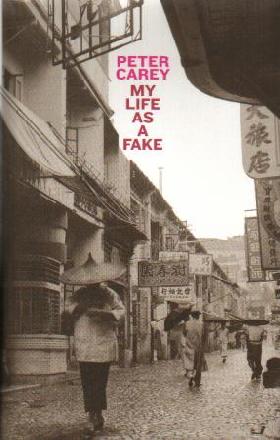
My Life as a Fake Peter Carey |
Dustjacket synopsis:
"In Melbourne in the 1940s, a conservative young poet named Christopher Chubb decides to teach the country a lesson about pretension and authenticity. Choosing as his target the most avant-garde of the literary magazines, he submits for publication the entire oeuvre of one Bob McCorkle, a working-class poet of raw power and sexual frankness, conveniently dead at twenty-four and entirely the product of Chubb's imagination. Not only does the magazine fall for the hoax, but its editor is prosecuted for publishing obscenity. During the trial, someone uncannily resembling the man in the faked photograph of the invented McCorkle leaps to his feet. At this moment a horrified Chubb is confronted by the malevolent being he has himself manufactured.
"Using as a springboard the Ern Malley hoax, Peter Carey wickedly and ruefully explores how the phantom poet taunts, haunts and otherwise destroys his maker, pursuing Chubb from Melbourne to the seedy, sweaty, tropical chaos of Kuala Lumpur.
"A manic, endearing and penetrating ode to fakery at its most truthful and truth at its most fake, My Life as a Fake penetrates to the heart of the alchemy of literature itself."
Quotes:
"Peter Carey's new novel, My Life as a Fake is so confidently brilliant, so economical yet lively in its writing,
so tightly fitted and continuously startling in its plot that something, we feel, must be wrong with it. It ends in a bit
of a rush, and left several questions dangling in this reader's mind. Unfortunately, to spell out those questions would be
to betray too much of an intricate fictional construct where little is as it first seems and fantastic developments unfold
like scenes on a fragile paper fan...Other reviewers of this folded and refolded tale of mental and physical adventure
have claimed its moral to be that everyone depicted is a fake. I don't see this; the characters are as genuine as their
words permit them to be, though all, being characters, are caught up in the business of fiction, which is fakery." - John
Updike, The New Yorker
"No Australian novelist since Patrick White (with the possible exception of Tom Keneally) has done more to place his work,
and the country that inspires it, on a world stage than Peter Carey. We have seen Oscar and Lucinda's take on the
apparitional shape of a modern classic, and we have seen their creator take on, in terms of prestige, the mantle of a
postmodern master of world reputation who is also an excavator of national myths...Carey toys with mythologies in the
process of pursuing his own destiny as a literary artist. He does his best to co-ordinate his creation and re-invention of
myth with his own tendency towards a proliferating magical realism, in which story follows story follows story as a dog
pursues a rabbit wherever it goes, and the narratological free-for-all seems the raison d'etre of literary art...Mythos,
for Aristotle, meant the element of plot, the overarching structure. It does for Carey, too, but he is also on the scent
of the thousand stories his myth may suggest to him. And so it goes with his new work, My Life as a Fake...In the
end, the brooding ruin of Chubb is worth enduring the house of cards that summons him up. My Life as a Fake is a
thwarted and disnatured fable but it does have, however stammeringly, a black magic that is unforgettable." - Peter
Craven, Sydney Morning Herald
First Paragraph:
The Old Rectory, Thornton, Berkshire. August 1985
I have known John Slater all my life. Perhaps you remember the public brawl with Dylan Thomas, or even have a copy of his famous book of 'dirty' poems. If it's an American edition you'll discover, on the inside flap, a photograph of the handsome, fair-haired auhtor in cricket whites. Dewsong was published in 1930. Slater was twenty at the time, very nearly a prodigy.
That same year I was born Sarah Elizabeth Jane to a beautiful, impatient Australian mother and a no less handsome but rather posh English father, Lord William Wode-Douglass, generally known as Boofy.
Slater's own class background was rather ambiguous, though my mother, a dreadful snob, had a tin ear, and I know she thought Slater very grand and therefore permitted him excesses she would not have tolerated from the Chester grammar school boy he really was.
It was Slater who carved my father's thirtieth birthday cake with his bare hands, who rode a horse into the kitchen, who brought Unity Mitford to dinner during the period she was stealing stationery from Buckingham Palace and carrying that nasty little ferret around in her handbag.
I cannot say that I understood his role in my parents' marriage, and only when my mother killed herself - in a spectacularly awful way - did I suspect anything was amiss. In the last minutes of her life I saw John Slater put his arms around her and finally I understood, or thought I did.
From the Knopf hardback edition, 2003.
Notes:
You can read more about Peter Carey here.
|
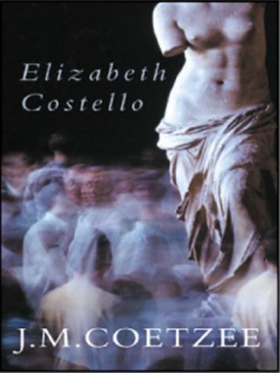
Elizabeth Costello J.M. Coetzee |
Dustjacket synopsis:
"Elizabeth Costello is an Australian writer of international renown; she is fêted, studied, honoured. Famous principally
for an early novel that established her reputation and from which, it seems, she will never escape, she has reached the
stage, late in life, where her remaining function is to be venerated and applauded.
"One of a new breed of intellectual nomads, her life has become a series of engagements in sterile conference rooms throughout the world -- a private consciousness obliged to reveal itself to a curious public: the presentation of a major award at an American college where she is required to deliver a lecture; a sojourn as a writer in residence on a cruise liner during which she encounters a fellow guest lecturer, an African poet also employed to divert the passengers; a visit to her sister, a missionary in Africa, who is receiving an honorary degree, an occasion which both recognise as the final opportunity for effecting some sort of reconciliation; and a disquieting appearance at a writers' conference in Amsterdam where she finds the subject of her talk unexpectedly amongst her audience.
"She has made her life's work the study of other people yet now it is she who is the object of scrutiny. But, for her, what matters is the continuing search for a means of articulating her visions and the verdict of future generations.
"Elizabeth Costello is a humane, moral, and uncompromising creation; J.M. Coetzee's latest work of fiction offers us a profound and delicate vision of literary celebrity, artistry and the private life of the mind."
First Paragraph:
There is first of all the problem of the opening, namely, how to get us from where we are, which is, as yet, nowhere, to the far bank. It is a simple bridging problem, a problem of knocking together a bridge. People solve such problems every day. They solve them, and having solved them push on.
Let us assume that, however it may have been done, it is done. Let us take it that the bridge is built and crossed, that we can put it out of our mind. We have left behind the territory in which we were. We are in the far territory, where we want to be.
Elizabeth Costello is a writer, born in 1928, which makes her sixty-six years old, going on sixty-seven. She has written nine novels, two books of poems, a book on bird life, and a body of journalism. She was born in Melbourne and still lives there, though she spent the years 1951 to 1963 abroad, in England and France. She has been married twice. She has two children, one by each marriage.
From the Knopf hardback edition, 2003.
|
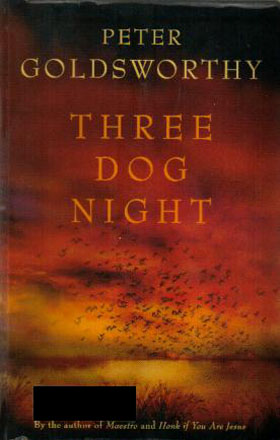
Three Dog Night Peter Goldsworthy |
Dustjacket synopsis:
"Is it possible to be too much in love? After ten years in London, Martin Blackman returns to Adelaide with his wife and
fellow psychiatrist Lucy, blissfully happy. But then he introduces her to his old friend Felix, once a brilliant surgeon,
now barred from practising and changed beyond recognition. In the complex triangle that develops, Martin must decide just
how far he is prepared to go for Felix. So beings the darkest of journeys for all three of them...
"Confronting, unpredictable, richly sexual, Three Dog Night is a lyrical page-turner from one of Australia's finest storyellers."
First Paragraph:
If love is an obsessive-compulsive disorder - same driven behaviour, same altered brain state, same chemistry - then I have been ill for years. But never as sick with bliss, diseased, as now.
Sunday, mid-morning, early summer. My tenth day back in Australia after ten years of work and study overseas, ten years' hard mental labour in London. I am driving Lucy - my compulsion, my obsession - up into the Adelaide Hills for the first time. The day has taken its name to heart: a Sunday from the glory box of Sundays, a luminous morning saturated with sunlight and parrots. Happiness rises in my throat, thick as cud; the world outside the car, wholly blue and gold, seems almost too much for my senses, too tight a squeeze.
'Paradise,' Lucy murmurs, smitten.
Her voice, our common thought. There might be higher mountains on the planet than the Adelaide Hills, but they are no closer to heaven. Each valley is a little deeper and greener than the last, and each ridge, a little higher and bluer, seems another step in some sort of ascension. Even the names of the steps have a heavenly sound; Lucy speaks the words softly as the freeway exits slide past, big-print, white on green. Littlehampton. Oakbank. Aldgate. Bridgewater.
From the Viking paperback edition, 2003.
|
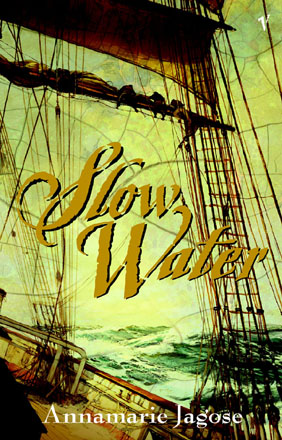
Slow Water Annamarie Jagose |
Dustjacket synopsis:
"The year is 1836. English clergyman William Yate sets sail from London, bound for the mission fields of northern New
Zealand. Caught up in a mesmerising love affair that will test the imagination of everyone on board the Prince
Regent, he is utterly transformed. Against the riveting backdrop of a four-month sea voyage and the vividly
imagined society of the ship, the story of Yate unfolds, drawing together the inarticulate hopes of the cabin passengers,
the immigrant families of steerage, and the raw men and boys of the crew.
"On landfall at Sydney, camaraderie gives way to treachery and the tight world of the ship breaks apart. Everyone is implicated in the scandal that grips the colonial town, yet it is Yate alone who stands to lose not only his reputation but also his life.
"Based on a true story, Slow Water is a poised and elegant novel of the highest order with its commitment to historical accuracy exquisitely balanced by its modern attention to eroticism and narrative suspense."
First Paragraph:
Tera Kopu, ka heke i te pae. See there, the last star on the edge of morning's sky.
Like the sad mamaku, I sit outside the mission fence at Waimate. My sweet-throated bird is gone and nothing remains for me. All the night, from the darkness of my blanket, I watch the dead houses, Mr Clarke's house, Mr Williams's house, Mr Davis's house, all dead. Still dead, in the first curve of daylight. A dream come son me in the heart of the night, a warm spirit visiting me from death. It is yours, Wiremu. I know it at once. Your scent hangs in the ashen night air and in my dream you are laughing again and walking. Oho rawa ake, te hua-kore noa. Awake, sorrow chews me like a hunger. Your horse is dead and lies swelling in the grass, black legs in the air like a blsted harvest. The church roof points at the sky and you are gone from here. Sing, sing on, bird, your true song.
From the Vintage paperback edition, 2003.
Notes:

|
Seven Types of Ambiguity Eliot Perlman |
Dustjacket synopsis:
First Paragraph:
From the Chatto & Windus hardback edition, 1991.
Notes:
You can read more about xxxxxxxxxxxxx here.
This page and its contents are copyright © 2006 by Perry Middlemiss, Melbourne, Victoria, Australia.
Last modified: February 1, 2006.