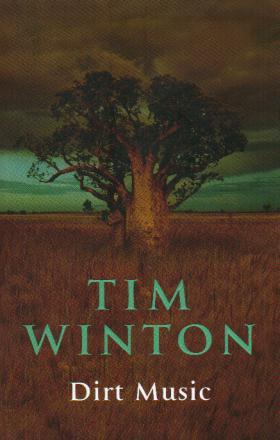
Tim Winton
The following novels constitute the shortlist for the 2002 Miles Franklin Award:
London's "Gilgamesh" is the only first novel on the list, though Scott is better known as a poet than a novelist. "The Art of the Engine Driver" is Carroll's fourth novel but first to be shortlisted for the Miles Franklin Award.
|
|
Dirt Music Tim Winton |
Dustjacket synopsis:
"Georgie Jutland is a mess. At forty, with her career in ruins, she finds herself stranded in White Point with a fisherman
she doesn't love and two kids whose dead mother she can never replace. Her days have fallen into domestic tedium and social
isolation. Her nights are a blur of vodka and pointless loitering in cyberspace. Leached of all confidence, Georgie has
lost her way; she barely recognises herself.
"One morning in the boozy pre-dawn gloom, she looks up from the computer screen to see a shadow lurking on the beach below, and a dangerous new element enters her life. Luther Fox, the local poacher. Jinx. Outcast.
"So begins an unlikely alliance. Set in the wild landscape of Western Australia, this is a novel about the odds of breaking with the past, a love story about people stifled by grief or regret, whose dreams are lost, whose hopes have dried up. It's a journey across landscapes within and without, about the music that sometimes arises from the dust.
"In prose as haunting and beautiful as its western setting, Dirt Music confirms Tim Winton's status as the pre-eminent Australian novelist of his generation."
First Paragraph
One night in November, another that had somehow become morning while she sat there, Georgie Jutland looked up to see her pale and furious face reflected in the window. Only a moment before she'd been perusing the blueprints for a thirty-two-foot Pain Clark from 1913 which a sailing enthusiast from Manila had posted on his website, but she was bumped by the server and was overtaken by such a silly rush of anger that she had to wonder what was happening to her. Neither the boat nor the bloke in Manila meant a damn thing to her; they were of as little consequence as every other site she'd visited in the last six hours. In fact, she had to struggle to remember how she'd spent the time. She had traipsed through the Uffizi without any more attention than a footsore tourist. She'd stared at a live camera image of a mall in the city of Perth, been to the Frank Zappa fan club of Brazil, seen Francis Drake's chamberpot in the Tower of London and stumbled upon a chat group for world citizens who yearned to be amputees.
Logging on - what a laugh. They should have called it stepping off. When Georgie sat down before the terminal she was gone in her seat, like a pensioner at the pokies, gone for all money. Into that welter of useless information night after night to confront people and notions she could do without. She didn't know why she bothered except that it ate time. Still, you had to admit that it was nice to be without a body for a while; there was an addictive thrill in being of no age, no gender, with no past. It was an infinite sequence of opening portals, of menus and corridors that let you into brief, painless encounters, where what passed for life was a listless kind of browsing. World without consequence, amen. And in it she felt light as an angel. Besides, it kept her off the sauce.
From the Picador hardback edition, 2001.
Notes:
You can read more about Tim Winton here.
|
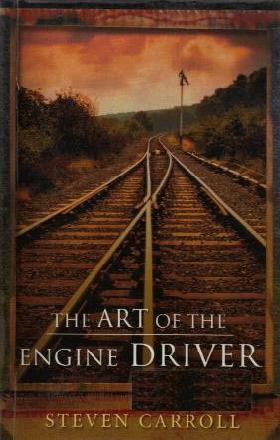
The Art of the Engine Driver Steven Carroll |
Dustjacket synopsis:
"On a hot summer's night, the old and the new, diesel and steam, town and country all collide - and nobody will be left unaffected.
"As a passenger train leaves Spencer Street Station on its haul to Sydney, a family of three - Vic, Rita and their son Michael - are off to a party. George Bedser has invited the whole neighbourhood to celebrate the engagement of his daughter.
"Vic is an engine driver, with dreams of being like his hero Paddy Ryan and becoming the master of the smooth ride.
"As the neighbours walk to the party we are drawn into the lives of a bully, a drunk, a restless girl and a young boy forced to grow up before he is ready.
"The Art of the Engine Driver is a luminous and evocative tale of ordinary suburban lives told with an extraordinary power and depth."
First Paragraph:
They're walking down the old street again, Rita, Vic, and the boy, Michael. It's summer, a warm breezy evening, and they are walking under a cloudless peach sky, ripe and glowing. The sun is low and their shadows almost stretch back to the family house at the golf course end of the street.
They've reached that point in their walk, the halfway mark, where the houses and yards suddenly taper off into Scotch thistle and open, swaying grass. The sun has nearly dropped to earth and the three of them have stopped, staring out across the blades of whispering grass and thistle, across to the flour mills and railway lines, as if expecting a low, distant thud.
Vic's white, open-necked shirt is more in keeping with the late 1940s than the late 1950s. But Rita's dress, yellow and black, with bright flowers and one dark bold strap, is a garment of its times. For this suburb, a garment ahead of its times. Her hair is dyed, with a faint suggestion of red, and bounces occasionally about her neck as she walks. Michael is wearing his best shirt. Short sleeves, short pants. Rita turned thirty-three last autumn, Vic is forty, Michael is twelve. There they are, still as a photograph, listening for the distant thud of the sun as it prepares to drop from the sky, out there, somewhere beyond the railway lines and the flour mills.
From the Flamingo paperback edition, 2001.
|
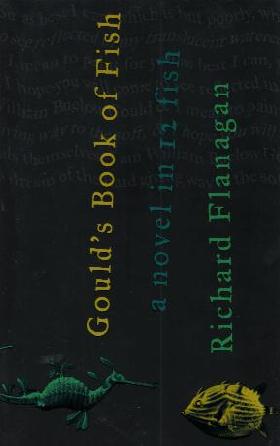
Gould's Book of Fish Richard Flanagan |
Dustjacket synopsis:
"Once upon a time that was called 1828, before all the fishes in the sea and all living things on the land were destroyed, there was a man named William Buelow Gould, a white convict who fell in love with a black woman and discovered too late that to love is not safe. Silly Billy Gould, invader of Australia, liar, murderer & forgerer, condemned to the most feared penal colony in the British Empire and there ordered to paint a book of fish.
"One upon a time there were miracles..."
First Paragraph:
My wonder upon discovering the Book of Fish remains with me yet, luminous as the phosphorescent marbling that seized my eyes that strange morning; glittering as those eerie swirls that coloured my mind and enchanted my soul - which there and then began the process of unravelling my heart and, worse still, my life into the poor, scarggy skein that is this story you are about to read.
What was it about that gentle radiance that would come to make me think I had lived the same life over and over, like some Hindu mystic forever trapped in the Great Wheel? that was to become my fate? that stole my character? that rendered my past and my future one and indivisible?
Was it that mesmeric shimmer spiralling from the unruly manuscript out of which seahorses and seadragons and stargazers were already swimming, bringing dazzling light to a dreary day not long born? Was it that sorry vanity of thought which made me think contained within me was all men and all fish and all things? Or was it something more prosaic - bad company and worse drink - which has led to the monstrous pass in which I now find myself?
From the Picador hardback edition, 2001.
Notes:
You can read more about Richard Flanagan here.
|
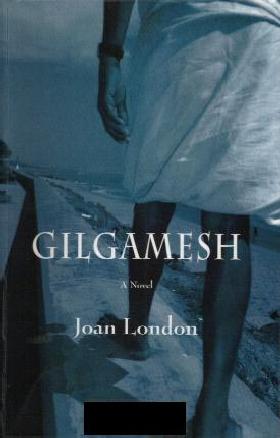
Gilgamesh Joan London |
Dustjacket synopsis:
"There were two of them, two young men, dressed alike in narrow-brimmed black hats and black coats, longer and blacker than those Australians wore.
"Edith and Frances, living with their mother on a tiny farm in the south-west of Australia, are visited by their cousin Leopold and his Armenian friend Aram. The two young men are taking the long way home after working on an archaeological dig in Iraq. It is 1937. The modern world, they say, is waiting to erupt. Among the tales they tell is the story of Gilgamesh, the legendary king of Uruk in ancient Mesopotamia. Gilgamesh's great journey of mourning after the death of his friend Enkidu, and his search for the secret of eternal life, is to resonate through all their lives.
"In 1939 Edith and her young child set off on an impossible journey of their own, to find themselves trapped by the outbreak of war. The story of this journey is the story of encounters and escapes, of friendship and love, of loss and acceptance.
"Moving between rural Australia, London, the Caucasus and the Middle East, from the last days of the First World War to the years following the Second, Joan London's stunning novel examines what happens when we strike out into the world, and how, like Gilgamesh, we find our way home."
First Paragraph:
Frank met Ada when she came to the hospital to visit the soldiers.
It didn't suit her. She was supposed to chat and join in sing-songs and pour tea. But she was clumsy and offhand and didn't smile enough. She lacked the sense of charity that lit the faces of the other young women. That afternoon they were all wearing a white gardenia pinned to their coats and, as they entered, a nun-like sweetness filled the vast draughts of the room.
It was a convalescent hospital south of London, a gloomy country house requisitioned for the duration, where the soldiers, patched-up, jumpy, bitter, tottered and prowled like ancient temperamental guests. Frank shared a room with another Australian, an artilleryman from Melbourne, who wept like a baby in his sleep. Frank suffered from insomnia so it didn't disturb him too much. He didn't tell the doctors about the insomnia. Some were kind. but for some reason he found himself infuriated by kindness. He craved isolation. In isolation he would cure himself. They were days away from Armistice. On the afternoon that Ada came, Frank had expected to be discharged, on the train to London. His leg was officially healed: he'd been waiting all week for the order. Only boredom made him come downstairs for tea.
They should really never have met.
From the Picador paperback edition, 2001.
|
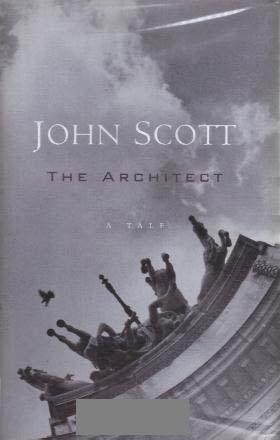
The Architect John Scott |
Dustjacket synopsis:
"Martin stared at the brief letter and the signature below. To the young architect, Von Ruhland had long been an
object of fascinaton.
"Two architects: Andrew Martin, a fęted young Australian whose success has come early, and Johannes Von Ruhland, an aging genius who draws with the hand of God but whose work has never been realised. When Martin finally meets the mythic Von Ruhland on a trip to Berlin, it is a dream fulfilled, but once that dream is brought back to Australia, it jeopardises his marriage and divides his friends.
"Martin returns to Berlin where he is increasingly drawn into the labyrinth of Von Ruhland's world. And when the master architect proposes a daring collaboraton, the consequences are as profound as they are unforeseeable...
"From the author of the acclaimed Before I Wake, The Architect is a deceptively simple story that explores some of the oldest questions of all - faith, loyalty, and the enigma of human suffering."
First Paragraph:
Johannes Von Ruhland approached the long mirror at the passageway's end. He smiled to himself.
'Where have you been?' he asked.
'Walking through the streets.'
'Did you see him? How unique is he? How perfect?'
'Yes, I saw him.'
'How loving.'
'You are certain?'
'Yes. Völlig.'
'Totally?'
'Meaning?'
'He has everything. I wonder, though, if you should somehow touch his life...'
Von Ruhland paused a moment. A brief flash of doubt crossed his face, then he added decisively:
'Touch him.'
From the Viking hardback edition, 2001.
Notes:
You can read more about John Scott here.
This page and its contents are copyright © 2006 by Perry Middlemiss, Melbourne, Victoria, Australia.
Last modified: January 30, 2006.