Frank Moorhouse
The following novels constitute the shortlist for the 2001 Miles Franklin Award:
|
|
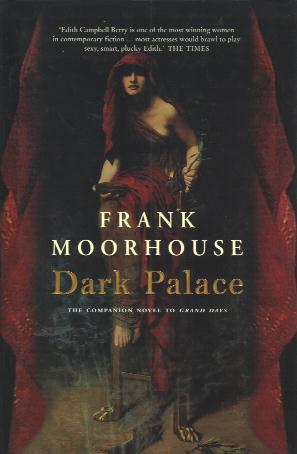
Dark Palace Frank Moorhouse |
Dustjacket synopsis:
"On an October night in 1931, in the elegant dining room of the Hôtel des Bergues, Edith Campbell Berry is celebrating the
renewal of her contract as an officer of the League of Nations. Five years have passed since Edith's triumphant arrival in
Geneva, and the idealism of those early grand days has been eroded by a sense of foreboding as the world moves ever closer
to another war.
"Beneath her diplomatic poise, Edith is having misgivings about the marriage she thought would steady and satisfy her. As her certainties crumble, she is once again joined by Ambrose Westwood, her old friend and lover. Their reunion is joyful, and her old anxiety about their unconventional relationship is replaced by a feeling that all things are possible - at least in her private life. With Ambrose once more her guide, Edith is coaxed back into the dark, glamorous and oddly comforting demimonde of her past.
"The personal and professional strains of being a citizen of the world are beginning to show, however. On leave in Australia for the first time in ten years, Edith feels an unsettling alienation from her native land which raises troubling questions about herself and the world.
"The League, created in optimism after 'the war to end all wars', struggles valiantly against the inexorable advance of World War II; back in Geneva, Edith and her fellow officers must come to terms with the knowledge that their best efforts - and those of the well-meaning world - are simply useless against the forces of the day.
"Moving, wise and utterly engrossing, Dark Palace is a profound and enriching novel. This eagerly awaited companion volume to his internationally acclaimed tour de force, Grand Days, confirms Frank Moorhouse as one of our greatest writers - a master of tone and timing, an elegant and exuberant stylist, and an unerring chronicler of the human spirit."
First Paragraph:
Geneva, on the night of October 15, in the year of 1931...
Edith and her friend, Jeanne found themselves in the dining room of the Hôtel des Bergues - Geneva's best - wining and dining in a grand, exuberant, and stately manner.
Not, perhaps, so stately a manner.
More two young ladies indulging themselves.
Two young ladies laughing together like maids, actually.
Laugh thy girlish laughter;
Then, the moment after,
Weep thy girlish tears!
Too old now for girlish tears, Edith thought, but there was still some girlish laughter left, even though she was in her thirties.
There they were, two young ladies laughing like maids, in the dining room of the Hôtel des Bergues surrounded by men going about the business of war.
The League's first very serious war.
From the Knopf hardback edition, 2000.
Notes:
You can read more about Frank Moorhouse here.
|
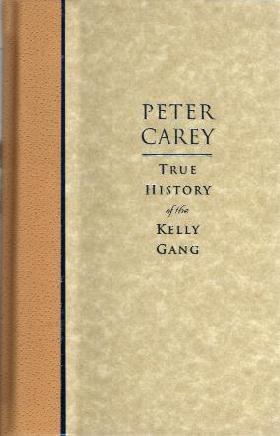
True History of the Kelly Gang Peter Carey |
First Paragraph:
By dawn at least half of the members of the Kelly gang were badly wounded and it was then that the creature appeared from behind police lines. It was nothing human, that much was evident. It had no head but a very long thick neck and an immense chest and it walked with a slow ungainly gait directly into the hail of bullets. Shot after shot was fired without effect and the figure continued to advance on the police, stopping every now and then to move its headless neck slowly and mechanically around.
I am the b----y Monitor, my boys.
The police had modern Martini-Henry rifles yet the bullets bounced off the creature's skin. It responded to this attack, sometimes with a pistol shot, but more often by hammering the butt of its revolver against its neck, the blows ringing with the clearness and distinctiveness of a blacksmith's hammer in the morning air.
You shoot children, you f-----g dogs. You can't shoot me.
As the figure moved towards a dip in the ground near to some white dead timber, the police intensified their attack. Still the figure remained erect, continuing the queer hammering on its neck. Now it paused and as its mechanical turret rotated to the left the creature's attention was taken by a small round figure in a tweed hat standing quietly beside a tree. The creature raised its pistol and shot, and the man in the tweed hat cooly kneeled before it. He then raised his shotgun and fired two shots in quick succession.
My legs, you mongrel.
The figure reeled and staggered like a drunken man and in a few moments fell near the dead timber. Moments later a crude steel helmet like a bucket was ripped from the shoulders of a fallen man. It was Ned Kelly, a wild beast bought to bay. He was shivering and ghastly white, his face and hands were smeared with blood, his chest and loins were clad in solid steel-plate armour one quarter of an inch thick.
Meanwhile the man responsible for this event had drawn his curtains and was affecting to have no interest in either the gunshots or the cries of the wounded.
At dark a party of police escorted him and his wife directly from his cottage to the Special Train and so he neither witnessed nor took part in the wholesale souveniring of armour and guns and hair and cartridges that occurred at Glenrowan on June 28th 1880. And yet this man also had a keepsake of the Kelly Outrage, and on the evening of the 28th, thirteen parcels of stained and dog-eared papers, every one of them in Ned Kelly's distinctive hand, were transported to Melbourne inside a metal trunk.
Undated, unsigned, handwritten account in the collection of the Melbourne Public Library. (V.L. 10453)
From the UQP hardback edition, 2000.
Notes:
This novel won the 2001 Man Booker prize.
You can read more about Peter Carey here.
|
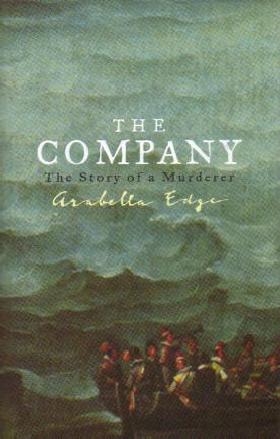
The Company Arabella Edge |
Dustjacket synopsis:
"'I, Jeronimus, am a man of phials, a measurer of powders on bronze scales, a potion brewer, an opium and arsenic
merchant. The primped and perfumed Amsterdam burghers came to me in droves requiring cures for fevers, love balms, the
miscarriage of a bastard child and, of course, poisons. Ah, poisons...'
"So speaks Jeronimus Cornelisz, thirty-year-old apothecary and undermerchant...and seriously deranged man.
"The Company is a novel based on the true story of the Dutch East India flagship, the Batavia, which foundered off the coast of Western Australia in 1629. Jeronimus Cornelisz, a man with mutiny, murder, rape and torture on his mind, assumes comand of the survivors, who all thought they were lucky to be alive. With Cornelisz in control, however, an extraordinary reign of terror begins, leaving those who survived wishing they had gone down with the ship."
First Paragraph:
My childhood echoed with tbe sound of whispering. The servants believed that I was conceived by tbe moon, born in the thirteenth lunar mouth. How the wet-nurses feared me. Crossing themselves, garlic cloves pinned to their aprons, they would watch me creep about my cot, eyes still closed, mewling like a newborn pup.
During her confinement, the servants said, my mother filled the rooms with armfuls of lilies and white lilac. She craved ewe's milk, warm and frothing straight from the teat, and took to gazing at the full moon through latticed windows.
Some explained she was frightened in her fourth month by the luminous reactions in the eyes of a white cat, others remembered the occasion of the bats, circling and swooping the terrace with red and flaming eyes.
My mother became distant, distracted, silent. At last refused to leave her room at all. Her harpsichord remained unplayed by the window and spiders wove intricate looms between the curled pages of her open music book.
They said that, teeth clenched, twisting her silk shawl into tourniquets, sweat beading her brow, my mother clung to the midwife. A sulphur-yellow moon rose outside the window and turned my mother's skin a deadly white.
From the Picador hardback edition, 2000.
About the Author:
Arabella Edge read English Literature at Bristol University in the UK and came out to Australia in 1992. She lives in
Sydney with her husband Nick Gaze and his daughter Zoe. She has worked as a journalist on numerous business and consumer
magazines, and her short stories have appeared in the literary magazines Westerly and Ulitarra. The
Company is her first novel.
|
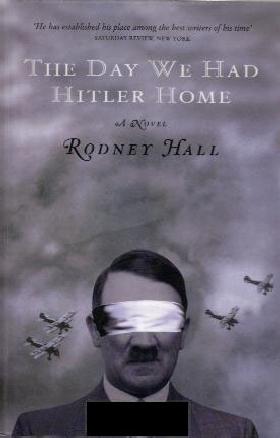
The Day We Had Hitler Home Rodney Hall |
Dustjacket synopsis:
"The Great war ends, as it began, with military blunders. A field ambulance station is being evacuated when a
young soldier, blinded by gas during the fighting, joins the wrong queue. Gas blisters in his throat prevent him
from telling anyone that his name is Adolf Hitler, private first-class, of the Sixteenth Bavarian Infantry, Reserve
Division, or that he is headed for Germany.
"The year is 1919. At Versailles, Australia has just signed a peace treaty destined to ruin Germany and create the conditions in which Nazism would thrive. Meanwhile, amid the celebrations at a remote fishing port in New South Wales, the steamer bringing Australian war heroes home also delivers the blinded Hitler. Here he meets Audrey McNeil, aspiring filmmaker and desparate opponent of her sister Sybil. Brief though his visit is, he changes Audrey's life.
"But is the stranger really who he claims to be?
"The Day We Had Hitler Home as much verbal cinema as a novel - is an audacious and intriguing story of a young woman's awakening to politics, to love, and to a new age sweeping across the world like a maelstrom."
First Paragraph
In the hush of early light the girl stirs. A man watches her. Ready to swoop, poised and focused, he inspects every languorous detail..In silence. The grey veil of daylight strengthens resolving itself into shadows and glossy surfaces, at one stroke defining the clear-cut edge of wardrobe and the silver sheen on a mirror's history of darkness. She shivers in her sleep. The predator reduces these factors to a decision. His moment has come. Never taking his eye off her, he raises the movie camera he has brought with him. The camera lifts slower than the welling light. He himself is silent in the silent morning while settling it in position on his shoulder. So, we watch him. And he watches her, transfixed by the female body (troubled head, outflung arm on a script of rumpled sheets, her rucked up nightie revealing one smooth thigh), a miracle to be preserved in timelessness. His camera, an oblong of varnished wood, holds steady. Its shiny, owl's-eye lens intent.
The faint, surreptitious spooling of secrets begins.
From the Macmillan paperback edition, 1996.
Notes:
You can read more about Rodney Hall here.

|
English Passengers Matthew Kneale |
Dustjacket synopsis:
"Full of dangerous humour English Passengers combines wit, adventure and harrowing historical detal in a mesmerizing display of storytelling.
"Determined to prove the literal truth of the Bible against atheist gelogists, the Reverend Geoffrey Wilson sets out from England, in the summer of 1857, with an expedition to find the Garden of Eden, which he is convinced lies on the island of Tasmania, Unknown to him, others in the party have very different agendas, notably the surgeon, Dr Potter, who is developing a revolutionary and sinister thesis of his own on the races of man. To complicate matters further, the ship Wilson has hurriedly chartered, crewed by Captain Kewley and his secretive Manxmen, is in fact an ill-starred smuggling vessel, its hidden compartments filled with contraband brandy and tobacco.
"As the vessel journeys haplessly southwards, in Tasmania itself an Aboriginal named Peevay recounts his people's struggle against the invading British, who prove as lethal in their good intentions as in their cruelty. This is no Eden but a world of hunting parties and colonial ethnic cleansing. As the Englsih passengers near Peevay's land, their bizarre notions ever more painfully at odds with reality, it grows clear that a mighty collision is approaching.
"English Passengers is narrated by over twenty different characters, each so distinct that the effect is of a story not so much told as peopled. In a storm of hugely entertaining voices it brings a past age to vivid and memorable life."
Quotes:
"I was compelled from first to last...It's a triumph" - Nicholas Shakespeare
"I am hugely impressed by English Passengers. The construction is masterly - multiple voices contributing to a
compelling narrative. This is writing of the first order" - Penelope Lively
"Matthew Kneale's new novel is a
fine piece of historical fiction that reminds us that men of science and men of God were both agents of genocidal
imperialism...The book is narrated by a host of characters, most notably Peevay, the child of a fearsome female aborigine
warrior and the white convict who raped her. His descriptions of the white settlers' cruelties, and his own confusions as
his world vanishes, counterbalance the arrogance of the governors, farmers, soldiers and missionaries...For all its
grimness - and the decline of the Tasmanian aborigines in Christian 'villages' is movingly rendered - this is a pleasantly
witty book. Kewley turns out to be a decent cove, and his accounts, shot through with Manx cuss-words, show Reverend
Wilson and Dr Potter at their very worst. Not that the two men do themselves any favours; Wilson's mincing English, all
circumlocution and false piety, never fails to betray his selfishness and weakness, while Potter's notebook bigotry is
short on prepositions and heavy on underlining, the style of lunatic letter-writers through history. All of this makes for
a more intelligent and fulfilling book than the subject matter might suggest." - Robert Potts, Observer
First Paragraph:
Say a man catches a bullet through his skull in somebody's war, so where's the beginning of that? You might say that's easy. That little moment has its start the day our hero goes marching off to fight with his new soldier friends, all clever and smirking and waving at the girls. But does it, though? Why not the moment he first takes the shilling, his mouth hanging wide open like a harvest frog as he listens to the sergeant's flatterings? Or how about that bright sunny morning when he's just turned six and sees soldiers striding down the village street, fierce and jangling? But then why not go right back, all the way, to that long, still night when a little baby is born, staring and new, with tiniest little hands? Hands you'd never think would grow strong enough one day to lift a heavy gun, and put a bullet through our poor dead friend's brain.
If I had to choose a beginning for all these little curiosities that have been happening themselves at me, well, I'd probably pick that morning when we were journeying northwards from a certain discreet French port, where tobacco and brandy were as cheap as could be. Not that it seemed much like the beginning of anything at the time, but almost the end, or so I was hoping. The wind was steady, the ship was taking her weather nicely, and as we went about our work I dare say every man aboard was having a fine time dreaming money he hadn't yet got, and what pleasures it might buy him. Some will have been spending it faster than a piss over the side, dreaming themselves a rush of drink and smoke, then perhaps a loan of a sulky female's body. A few might have dreamed every penny on a new jacket or boots, to dazzle Peel City with fashion for a day or two. Others would have kept cautious, dreaming it on rent paid and wives quieted.
And Illiam Quillian Kewley?
From the Hamish Hamilton hardback edition, 2000.
Notes:
This novel was shortlisted for the 2000 Man Booker prize.
|
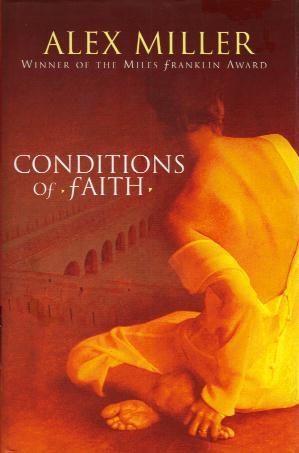
Conditions of Faith Alex Miller |
Dustjacket synopsis:
"Conditions of Faith is the long-awaited major new work by one of Australia's leading novelists.
"When Alex Miller's mother died she left him her fragmentary journal from the 1920s. Inspired by her exotic tales as a young woman living in Paris and this entree into her emotional life, Miller has written Conditions of Faith.
"With university behind her, Emily Stanton finds herself on the threshold of life. Introduced to a Scottish engineer, the exoticism of his life in Paris beckons, and she leaves her family home in twenties Melbourne to become his wife. But far from providing answers, her conventional marriage awakens in her an ardent desire to find a reason for living beyond that of simply wife and mother, a desire that leads her to flirt with risk, passion and unorthodox friendships, and carries her to Tunisia on a journey of self-questioning and intellectual reawakening.
"Conditions of Faith is a provocative romance, but it is also an elegant and intellectually abundant meditation on a timeless dilemma. Impetuous yet entirely sympathetic, Emily Stanton, like Henry James' Isabel Archer, is in search of a reason for living in a society where motherhood is deemed reason enough. This mesmerising and thought-provoking story of dreams, obsessions and destiny will hold you in thrall."
Quotes:
"My private acid test of a literary work is whether, having read it, it lingers in my mind afterward Conditions of
Faith fulfils that criterion; I am still thinking about Emily." - Colleen McCullough
First Paragraph
When Emily reached the warm shallows she stood up and waded to the edge of the sand where she had left her towel. As she came to the shore through the soft lapping of the water she reached and pulled off her bathing cap and shook out her long brown hair. At the sand she bent and picked up her towel then turned and stood looking back out to sea, her hand raised shielding her eyes from the glare off the water. Two hundred yards offshore her father was stroking a steady overarm toward the partly submerged wreck, his solitary advance breaking the silvery membrane of the sea. The air was still and hot, the bay luminous and flat in the afternoon sunlight. Farther down the beach toward the yacht club with its thicket of bare masts, isolated bathers stood about listlessly in the shallows gazing out to sea or toward the beach. Far out a white-hulled passenger liner was steaming slowly toward the port past anchored cargo vessels; the grey smoke from its twin funnels was pencilled against the white of the sky and stretched behind it over the horizon. The sharp cries of children at play carried to Emily and somewhere behind her in the tea-trees that grew thickly along the slope below the road a dog barked repeatedly. Already the cooling effect of her swim was wearing off and the heat beginning to press down on her. She watched until her father reached the wreck, waiting until he turned and began the return swim, then she started up the beach toward the tea-trees and the line of gaily painted bathing boxes.
From the Allen and Unwin hardback edition, 2000.
Notes:
You can read more about Alex Miller here.
|
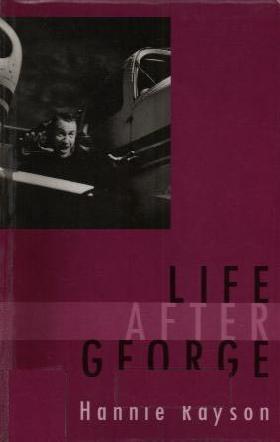
Life After George Hannie Rayson |
Dustjacket synopsis:
"The play that broke box office records during its Melbourne premiere season.
"Peter George, charistmatic academic, idealist, lover of life, is dead. His wife, two ex-wives and daughter gather for his funeral. As the true nature of the man and his life unfolds, so these women discover much about themselves and the lives they have lived both within and outside his shadow.
"Life After George is a moving and perceptive insight into social change across three decaides told through individual experiences. From the barricades the student movements of the late 1960s to the new century with his demands for different educational strategies, the university has been central to change. And it is on this stage that George played out his brilliant, tempestuous career.
"Written with passion and dangerous wit, Life After George is a compelling new drama from the author of Hotel Sorrento."
First Paragraph from the Introduction by Peter Craven:
It's been clear for a few years now (at least since the time of Hotel Sorrento) that Hannie Rayson was one of the great white hopes of the Australian theatre. She has an ability to speak directly to her audience about common experiences - and ideas, if need be - but her 'common touch' is never that of a boulevardier.
Rayson has always been a dramatist of the intimately personal with whatever politics might trail behind doing just that (though sometimes with a spikey and uncompromising quality of reality picked fresh). She is a kind of Helen Garner of the Australian stage with something of the same transcriptive verbal brilliance and perhaps with something of the same fear of the centrality that could so easily be hers. She is also a structural wizard, a master of ensemble and of swooping dramatic reversals and epiphanies that can cause a lump in the driest throat and tears in eyes unused to flow.
Among other things Life After George is an attack on the modern corporate university which many fear is selling our children's heritage for a mess of potage. It wobbles in and out of a hundred different foci - parts of it are more intellectually sure than others or more emotionally coherent - but notwithstanding it is one of the best Australian plays we have seen in years.
At play's start Peter George, a left-wing academic, has just died, suddenly and shockingly while flying his plane. The action of the play explores what sense can be made of George and his life by his old mate Duffy, a doctor who flew planes with him; by his 'unsuccessful' daughter Ana and - with the richest of counterpoints and contrasts - by his three wives. The first wife, Beatrix, a painter and mother of his children is bohemian and cultivated; Lindsay, the bright student radical girl has risen to be an academic administrator of formidable rationalising bent; and Poppy, the apparent dolly bird, a 'geek girl with attitude' uses her youth and postmodern affectlessness to disguise the fierceness of her feelings.
First Paragraph from the Director's Note by Kate Cherry:
I taught him to fly. Did you know? I taught him. But George, mate, George. You taught me to live.
So says Duffy, a Carlton Doctor, to Peter George his recently deceased friend. Life After George begins at Peter George's funeral. Through a series of flashbacks which range over the last quarter of the 20th Century, Life After George follows George's personal and political journey. Peter George, a brilliant academic who was a flawed, energetic and complicated man, lived his life with passion and gusto. He was magnificent, careless and sometimes cruel, but he sever failed to revel in life's offerings and to celebrate the importance of the life of the mind.
When George is killed in a freak plane crash, his two ex-wives, current wife and daughter must gather together to bury him. In our initial conversations, Rayson spoke of an image which became a primary impulse for the Melbourne production: the three wives sit around the coffin, each wife the 'it girl' of her generation. I imagined them united in their grief but divided by their generational differences, each woman completely isolated by her own private losses. They have all come together to mourn a man who was a life-eater.
Beatrix, George's first wife, an artist who emigrated from England to Australia with George in the late sixties, mourns the passing of her own youthful love. At the same time she watches her daughter Ana make that elusive shift from troubled youth to a woman of understanding. Lindsay, George's second wife, an ex-student whose brilliant career in academia soon eclipsed George's, is left with the knowledge that she chose to pursue ambition over the impulses of her own heart, and in doing so has nearly lost her own humanity, and has certainly lost the love of her life. Poppy, George's third wife and ex-student, works in publishing. She faces an uncertain future as her contact with George has instilled in her a politics that is unconnected to her own generation. She is left with a determination to honour the ideals George has taught her to live by, but with an uncertainty as to how to do that. At the funeral it is Ana, George's daughter, who is best able to give voice to each woman's grief and to celebrate George's life because she has learnt how to understand George's contradictions and to embrace his humanity. Despite their uneasy, painful relationship, it is Ana's gifts and passion which embody Pete George's.
From the Currency Press paperback edition, 2000.
About the Author
Hannie Rayson is a graduate of Melbourne University and the Victorian College of the Arts (VCA) and has an Honorary
Doctorate of Letters from La Trobe University. A co-founder of Theatreworks, she has served as Writer-in-Residence to the
Mill Theatre, Playbox Theatre, La Trobe University, Monash University and VCA. Her theatre credits include Please
Return to Sender (1980) and Mary (1981), each premiering at Theatreworks; and Leave It Till Monday (1984),
which was first produced by the Mill Theatre. Room to Move (1985) won the Australian Writers' Guild
AWGIE Award for Best Original Stage Play. Her next play, Hotel Sorrento (1990), a Playbox/Theatreworks
co-production, also won an AWGIE Award as well as a NSW Premier's Literary Award and Green Room Award for Best Play of
1990. It has since had over 50 productions throughout Australia and overseas and has been translated into French, Japanese
and Swedish. Her next two plays premiered at Playbox - Falling From Grace (1994), winning a NSW Premier's Literary
Award, The Age Performing Arts Award, and touring to Japan in 1998; and Competitive Tenderness (1996).
Hannie's television scripts include Sloth (ABC, Seven Deadly Sins) and co-writing two episodes of SeaChange (ABC/Artists Services). A feature film of Hotel Sorrento, produced in 1995, was nominated for ten Australian Film Institute Awards. In 1999 she received the Magazine Publishers' Society of Australia's Columnist of the Year Award for her regular contributions to HQ magazine.
This page and its contents are copyright © 2006 by Perry Middlemiss, Melbourne, Victoria, Australia.
Last modified: January 30, 2006.