
Murray Bail
The following novels constitute the shortlist for the 1999 Miles Franklin Award:
|
|
Eucalyptus Murray Bail |
Dustjacket synopsis:
"On a property in western New South Wales a man named Holland lives with his daughter Ellen.
Over the years, as she grows into a beautiful young woman, he plants hundreds of different gum
trees on his land. When Ellen is nineteen her father announces his decision: she will marry the
man who can name all his species of eucalypt, down to the last tree.
"Suitors emerge for all corners, including the formidable, straight-backed Mr Cave, world expert on the varieties of eucalypt. And then walking among her father's trees, Ellen chances on a strange young man who in the days that follow tells her dozens of stories set in cities, deserts, faraway countries...
"Eucalyptus is Bail's best and most moving novel. It is both a modern fairy tale and an unpredictable love story played out against the spearing light and broken shadows of country Australia. Its intricate narrative is interwoven with ideas about art, feminine beauty, landscape and language. Haunting and mesmeric, Eucalyptus illuminates the nature of story-telling itself."
First Paragraph
We could begin with desertorum, common name Hooked Mallee. Its leaf tapers into a slender hook, and is normally found in semi-arid parts of the interior.
But desertorum (to begin with) is only one of several hundred eucalypts; there is no precise number. And anyway, the very word, desert-or-um, harks back to a stale version of the national landscape and from there in a more or less straight line onto the national character, all those linings of the soul and the larynx, which have their origins in the bush, so it is said, the poetic virtues (can you believe it?) of being belted about by droughts, bushfires, smelly sheep and so on; and let's not forget the isolation, the exhausted shapeless women, the crude language, the always wide horizon, and the flies.
It is these circumstances which have been responsible for all those extremely dry (dun-coloured - can we say that?) hard-luck stories which have been told around fires and on the page. All that was once upon a time, interesting for a while, but largely irrelevant here.
From the Text Publishing hardback edition, 1998.
Notes:
You can read more about Murray Bail here.
This novel won the 1999 Commonwealth Writers' Prize.
|
|
Red Shoes Carmel Bird |
Dustjacket synopsis:
"The beautiful, charismatic Petra Penfold-Knight, accustomed to her own way from birth, grows up to lead a religious
cult whose devotess wear red shoes. The cult attracts members through Petra's magnetism, as well as by more
sinister means, such as stealing children born to unmarried girls.
"Imbued with ancient narrative myths, music and dance, Red Shoes is told by Petra's guardian angel, who has a unique slant on the nature of reality and on the darker side of female sexuality. The angel's perception is subversive, playful and sublimely witty, and illuminates Petra's surface allure, which disguises a complex yet brutal personality and a moral vacuum."
First Paragraph:
This story concerns three women: Petra, Sylvie and Colette. To avoid any chance of mystification, I want to explain that Sylvie was Colette's mother, and that Petra adopted Colette and renamed her Celeste. Petra was the leader of a religious community of which Celeste was a member from birth. The group marked its singularity by the wearing of red shoes or sandals, like fairyfolk. Sylvie did not belong to the community.
When Petra was a child in the forties living with her large family in a decaying old house in a small town in Tasmania, she liked to spend her time in a room at the back of the house. This was a large dark room where there were old books and magazines left behind by people who had lived in the house before. Petra liked to read and dream and imagine. In one of the magazines Petra found a tinted photograph of a very small and fragile girl. The girl was sitting on a nimble rattan chair which was placed on the leaf of a giant lily pad in the middle of a pool in southern India. The edges of the leaf, which was six feet across, were turned up like the rim of a platter. It was a miracle the way the girl could sit there in a chair on the surface of the water, as if the liquid had turned to ice. Perhaps there was a thin sheet of glass below the surface? Perhaps it was just what it seemed, a marvellous trick of nature where lily leaves were so strong that they could support the weight of a child on a chair. The name of the plant, Victoria regia, was supplied with the picture; the child was anonymous. The wonderful image of the child lodged in Petra's heart. Petra carried with her forever a belief that in some way she was that child, that princess in the frothy white dress, the white stockings, the button boots made from the soft skins of young goats, dyed red. The colours were subtle, faded.
That child, Petra told herself, is me.
From the Viking paperback edition, 1998.
Notes:
You can read more about Carmel Bird here.
|
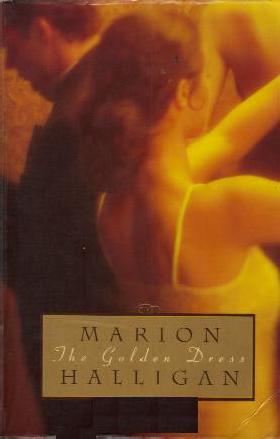
The Golden Dress Marion Halligan |
Dustjacket synopsis:
"The image of Molly in her dazzling golden dress haunts three generations. Ivy, who helps Molly sew the dress from a
scrap of fabric; Frank, whose love is forbidden; and Ray, who loses himself in the memories of his mother.
"When Ray disappears on the streets of Paris, his lover Martine embarks upon a search for him that takes them to unexpected places. Thread by thread, the secrets of his family unravel.
"Weaving together the past and present against a backdrop of seascapes, Sydney and Paris, The Golden Dress is a rich novel of love and secrets, memories and stories."
Quotes:
"Marion Halligan's magical work pictures have the serene intensity that is now her hallmark." - Richard Dessaix
First Paragraph:
When Matine went the handyman came and took away her bed. So there was no longer a double bed, literally a double bed it had been, made of two single ones pushed together and their legs tied. She'd used plastic bags cut open and plaited several times into ropes that had stretched and stretched as she bound them round the bed frames, but held tight. There should be a device, she said. I should invent one. A piece of metal with two right angles, and you could simply fit it over the bed frames and they'd hold fast. Then you could just take them off when you wanted to move the beds, to tidy them, or whatever. Martine was full of neat ingenious ideas like that, but they never got made; she had no idea how to fashion a metal device with two right angles. She sowed her ideas into the air, as if somebody else might catch one drifting past and act upon it. When the handyman came he had to cut through the plaits of plastic bags with scissors; no chance of undoing the stretched and tightened knots. Ooh la la, he muttered in a grumpy voice, and banged the frame against the door jamb as he carried it out. So Ray was back to the narrow lying in a single bed that belonged with his childhood, for ever since he'd been a young man he'd slept in big beds - double or queen or king sized - like a king had spread and sprawled and looped his body, alone or with women. Now Martine was gone he was reduced to a chaste single bed. Lying in it he felt like a pillar. Tumbled and horizontal. He lay on his back and crossed his arms over his chest like a person on a tomb. An effigy. His folded arms brought one of Granma's verses back to him, not easily, but kick-started by the machinery of the rhymes and metre that were still in his head, all these years later. Granma spoke such things not really as a believer but more, he came to think later, as a witch. A white witch of course, reciting spells, not particularly expecting them to ward off harms but at least she'd done her bit. And familiar words were themselves, familiar. Whatever they said.
From the Viking paperback edition, 1998.
About the Author:
Marion Halligan was born in Newcastle, New South Wales, and grew up by the sea. She has published four collections
of short stories, The Living Hothouse, The Hanged Man in the Garden, The Worry Box and Collected
Stories. She is the author of four novels, Self-Possession, Spider Cup, the award- winning Lovers'
Knots, and Wishbone. She has also written two nonfiction books, Eat My Words and Cockles of the
Heart.
|
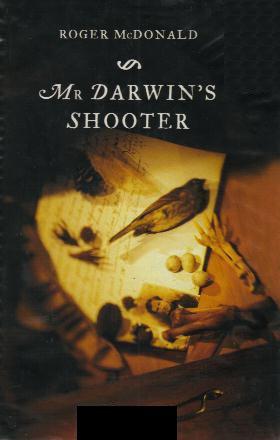
Mr Darwin’s Shooter Roger McDonald |
Dustjacket synopsis:
"I was smart as a carrot new-scraped and that was the best of me. I loved my scriptures and I lived my happiness to the
full...
"Based on the true story of Syms Covington, manservant to Charles Darwin on the famous voyage of the Beagle, this is a novel of scientific discovery, religious faith, masters and servants, ambition and adventure, and the endless wonder of the natural world.
"As a boy, Covington looked up at the beckoning figure of yellow-haired Christian in the stained-glass window of his Bedord chapel and sought to follow. When he meets Darwon, fifteen-year-old Covington is already an old Patagonia hand. In the course of their voyage together he shoots and collects hundreds of specimens for his 'gent', specimens which become fundamental to the formulation of Darwin's theory of evolution by natural selection.
"But what do these discoveries mean for a man's soul? Darwin's work challenges Biblical creation. In assisting him, has Covington committed a crime against God and his own nature?
"In beset middle age, Covington awaits the arrival of the first copy of Darwin's The Origin of Species in Sydney's Watson's Bay. What part of his life might be in it? What truths may it contain? "Earthly, insightful and beautifully written, Mr Darwin's Shooter is a novel from a writer at the height of his powers."
First Paragraph
The day was hot and dusty with scattered leaves of poplars lining a towpath. A boy went swimming in green canal water, rolling himself belly-over, gulping and thrashing in pleasure. He beat the slowly moving water with the flat of his hand and floating face-down blew noisy bubbles.
Syms Covington was naked as a bulb, white and hairless except for a slicked-down tuft of red curls across the dome of his conspicuous head. At twelve years of age he was sturdy as a man and soon would become one, stretching in his bones until he reached a height of just six feet, and getting a strength across his shoulders and in his arms like a house beam squared from timber. Yet when Covington floated on his back between corridors of puffy summer clouds he felt small as a flea, and imagined he looked down on the earth. It made a field of blue for him to hop around in. He laughed and squeaked, never minding how cold the water was, and went swimming any time of year to win wagers or for the joy of it alone. Other times he took bread and cheese in a sack and wandered the fields. On summer nights he slept with a stone for his pillow like Jacob, waking in the moonlight and hearing a badger grunt and watching a hare strip bark from a sapling. He fought his fears on such nights and saw them come to nothing in the early light.
From the Knopf hardback edition, 1998.
Notes:
You can read more about Roger McDonald here.
|
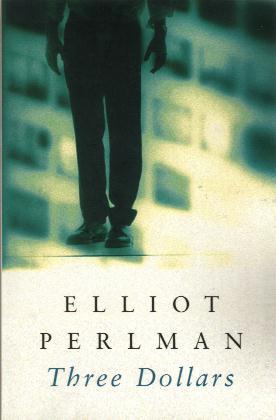
Three Dollars Eliot Perlman |
Dustjacket synopsis:
"Three Dollars is a brilliantly deft portrait of a man attempting to retain his senseof humour in grim and pitiless times: times of downsizing, outsourcing and privatising. It is about the legacy of Thatcherism and its effects on people and their relatonships.
"It is about us, now."
Quotes:
"Its anger and its passion mark the arrival of a writer of genuine ability." - Sydney Morning Herald
"...[Three Dollars] gradually builds into a study of a whole generation, a sad, angry, disconcertingly funny
reflection of the way we live now." - Times Literary Supplement
"Perlman is a marvellous storyteller" - Observer
"A brilliant fictional commentary on the human consequences of economic rationalism. Verdict: Encore! Bravo! More
please" - Sunday Herald Sun
"It is impossible not to care what happens to Eddie, Tanya his wide, and Abby, their adorable daughter...Perlman is
echoing Auden's cry, 'We must love one another or die'" - Time Out
"A compelling story, a great drama, even a great tragedy" - Sunday Age
"Few novels ever dare to fuse emotional and economic life with the passionate intelligence of this one" -
Independent
First Paragraph:
Every nine and a half years I see Amanda. This is not a rule. It does not have to happen but it does. It has happened four times that I have seen her every nine and a half years which tends to make it more of a rule than an exception. But each time it is always and everywhere exceptional. Most recently was today. I had three dollars.
As children we were put in the same class at school although she was a year younger than me, and has been ever since. It was part of a pilot programme to have the brightest children from the year below put into a composite class with the brightest children of the year above and me. I don't know how I got into that class because I had not demonstrated a particular capacity for anything much. It was not that I was not interested in things but rather that I was interested in too many things. This interest in everything was completely internal to me, without external manifestations, and so went unnoticed by all adults except my parents, who were worried by it. I would just sit around and think; at least that's the way I remember it. Perhaps Amanda remembers it differently. I couldn't be bothered running around or even making much trouble. There were too many things to contemplate for me to be tempted into running at speed from A to B in order to get there sooner. While we were being taught about trains or mammals, I was wondering how it was the teacher managed to have the same smell every day, a musky smell that announced him long after he had gone and always would.
From the Picador paperback edition, 2000.
This page and its contents are copyright © 2006 by Perry Middlemiss, Melbourne, Victoria, Australia.
Last modified: January 26, 2006.