David Foster
The following novels constitute the shortlist for the 1997 Miles Franklin Award:
|
|
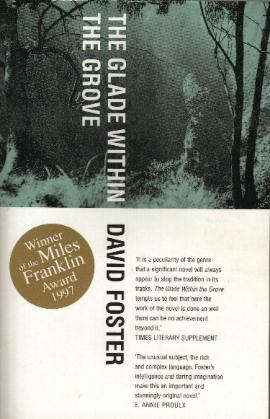
The Glade Within the Grove David Foster |
Quotes:
"It is a peculiarity of the genre that a significant novel will always appear to stop the tradition in its tracks.
The Glade Within the Grove tempts us to feel that here the work of the novel is done so well that there can be no
achievement beyond it." - Times Literary Supplement
"The unusual subject, the rich and complex language, Foster's intelligence and daring imaginaton make this an important
and stunningly original novel." - E. Annie Proulx
"An extraordinary achievement. At once comic and bloody, colloquial and erudite, prolix and single-minded, there has
been nothing like it since Such is Life." - Rodney Hall
"Here's a novel for those who like their fiction packed, rotund, and fluent without being florid, who relish a snappish
turn and tone, plus a writer in utter control conveying a feeling of rampant intellectual energy and sensory
delight...I kept postponing its final few pages, wanting to hold the novel's last breath, yet Foster compels the
rush to completion. His book is a marvel. It filled me with envy." - Tom Adair, Scotland on Sunday
"The Glade Within the Grove asks the deepest questions, of love and life and where the gods have gone. It is a
novel of great importance, by any standards." - Geoffrey Dutton, Australian Book Review
"Foster is one of Australia's boldest and most inventive novelists and The Glade Within the Grove is, in many
ways, the novel of our millenial times - and, at its best, a literary marvel." - Helen Daniel, The Age
"Foster's prose is as funny as an overturned lorry-load of laughing gas - and equally disabling. The language of this
novel is rich and complex, but never deliberately obscure. There are echoes here of Saul Bellow's Herzog." -
Yorkshire Post
"Foster reveals a wonderful mixture of the satiric and the visionary, or of the scabrous and the near-lyrical, that I
find exhilarating." - Andrew Reimer, Sydney Morning Herald
"magic realism from the land of Oz...intelligent and intriguing...Foster's brilliant re-creation of his secret
landscape is an elegy for a vanished piece of Australia." - The Sunday Times
First Paragraph:
You find some funny stuff in old mailbags. False teeth, British Empire medals. Always worth a look though, you never know when you might happen on a valuable stamp, a five-shilling bridge. As it happens, my vocation lent itself to rummaging through old mailbags. You might even say it was part of the job.
Each mailbag, once it is emptied of mail, is supposed to be inverted before reutilisation, but many a young, long-haired postman finds he has better things to do, apparently. How else to account for those piles of surplus, all-but-uninverted mailbags, often to be found in the corners of rural bike sheds, the careful inversion of which can provide a mature relief postman - who may not wish to spend all his off-duty hours in the pub - with a carefree half-hour.
Towards the end of my working life with Australia Post, concerning which the less said the better, I found myself on a two-week stint at a small town in Far Eastern Gippsland -- New South Wales, actually, but Far Eastern Gippsland to my mind, far Far Eastern Gippsland -- Obliqua Creek. Border country. The place functioned as the local postcode, which meant that all mail dispatched from the various hamlets hereabouts was dumped in the bike shed, under lock and key, before being picked up by road lorry to be taken to the nearest mail centre. I had the lock and key and I don’t think I ever saw such a heap of old mailbags as what I found in that bike shed. It was a treasure trove of old mailbags. There were old-fashioned blue ones, new-fangled yellow ones, everything in between. Most, of course, were those grubby, off-white linen jobs, manufactured in prison workshops, and big enough for burials at sea, that loom large in your nightmares when you wake in a sweat, as so often I do these days. Something to do with my current chemotherapy.
From the Vintage paperback edition, 1996.
Notes:
You can read more about David Foster here.
|
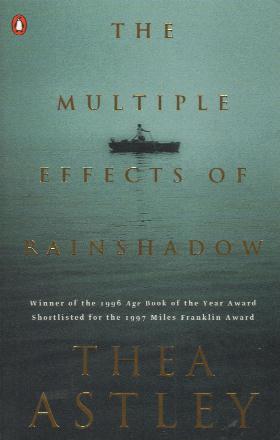
The Multiple Effects of Rainshadow Thea Astley |
Dustjacket synopsis:
"In the little hours of a January morning in 1930, on an island off the Queensland coast, a man
goes berserk with a rifle and a box of gelignite. Is he evil? Or crazy? His violence is
in fact a mirror for the brutality of Australian life - and is a dim reflection at that, in a
country where atrocities by whites against blacks are so ingrained few question them.
"The effects of the rampage ripple out from the island to link the fates of those who witnessed it, across the north and down through the decades. It is a time when silence in the face of tyranny is at its loudest. When allegiance to English niceties is confounded by the landscape and by the weather. And change is a slow wind that brings little real difference."
Quotes:
"Rainshadow is Astley at her best - witty, acerbic, psychologically prceptive
and tough - and is a good yarn as well." - Sun Herald
"There has never been a better moment for this book." - The Age
"Astley is formidable...uniquely provocative, acerbic and glittering. Not an easy ride, but
the dangerous rides offer the greatest rewards." - The Australian
"Astley has rarely left us so moved." - Adelaide Advertiser
"The Multiple Effects of Rainshadow - Astley at her best." - Australian Book Review
"The Multiple Effects of Rainshadow throbs with as much passion, brilliance and
originality as the best of her previous work." - Sydney Morning Herald
First paragraph:
The blue fire, he said. The blue. Burn my heart it jump like fish jumpin straight down sky. Marl-gan! Sky-fire! Cum-oo, he said. He yelled. Go-ah go-ah go-ah! Rain! Talking Gugganyji. Talking language. Talking migaloo, whiteman talk. Made talk migaloo after the big wind at the Heads. Shacks blew down. All shacks. In the mornin after they creep out from behind the rocks where they shelter all night, the bodies. Mumma, he whimper, mumma, stickin his pink and brown paw into hers. Uncles killed. Tribal cousins. Even the big boss house scatter along rain-soaked grass and the rain still comin and no one to tell them what to do.
From the Penguin paperback edition, 1997.
Notes:
You can read more about Thea Astley here.

|
Nightletters Robert Dessaix |
Dustjacket synopsis:
"Every night for twenty nights in a hotel room in Venice, an Australian man recently diagnosed with an incurable disease
writes a letter home to a friend. In these twenty letters he describes not only the kaleidoscope journey he has just made
from Switzerland across northern Italy to Venice, but reflects on questions of mortality, seduction and the search for
paradise in deeply life-enhancing ways. Interweaving incidents from an actual journey with stories of enchantment and
passion set in a variety of lands and centuries, Robert Dessaix leaps from twelfth-century India to Lygon Street, Melbourne,
from the tale of a bogus Russian baroness to a diatribe against St Anthony of Padua, from a bizarre interpretation of
Casanova's exploits to a meditation on Dante's idea of heaven.
"Against a rich background of earlier journeys in literature, Robert Dessaix weaves a compelling and ultimately exhilarating tale of a life lived with a heightened sense of mortality."
First Paragraph:
Venice, April 1st
Streaking through the jungle on a gaudy leopard, cape billowing out behind me as if I were aflame, I have on my head (my greying pate) - and this is vital - a hat, a black, gargantuan fedora with a drooping brhn, and streaming from one side of it is a cassowary feather (of all things). A flash of red and blue - and I am gone! Should I explain? Perhaps I should, because of all the things I want to tell you, why I'm now astride a leopard is, to me at least, the most important.
I never know where to start when I explain. Where should I dive in? Begin with the first sentence, was Sterne's advice, and trust to Almighty God for the second. Sterne was an inspired buttonholer, but even he had to begin somewhere. I could begin, for instance, right here in blue-veined Venice, with her glassy sky and blotched façades recalling old brocade. I can smell her rotting in the night outside my window. I've been here almost a week now. On the first night I couldn't resist following that zigzagging route from the station across to the Rialto Bridge and then on to St Mark's Square. Do you know what it reminded me of at night? Those enchanted mazes I used to be taken to at Christmas as a child in one or other of the big department stores - all those brightly coloured displays of dolls and masks, everything glinting and gleaming in the beautiful, menacing darkness, I couldn't bear to come out. Then, with the wave of some wand - boom! you're out of the maze and in St Mark's Square, vast and magnificent to the point of absudity. And glaring at me from the pinnacle of St Mark's façade across the square - the golden winged lion of the saint and the city. No other city in the world gathers you to itself, to its very heart, quite so abruptly, surely. Ever since that first moment I've actually found myself skirting St Mark'ss Square, preferring to make my way around the city along more intimate alleyways, through passageways beneath the houses and across those bare little campielli. I don't mind getting lost.
From the Macmillan hardback edition, 1996.
About the Author:
For many years presenter of ABC's 'Books and Writing' program, Robert Dessaix is well known as an essayist, translator
and literary commentator. In 1994 he edited Australian Gay and Lesbian Writing: An Anthology for Oxford University
Press and in the same year published to critical acclaim A Mother's Disgrace, an autobiographical account of his
life as an adopted child and his eventual meeting with his natural mother. He lives in Melbourne.
|
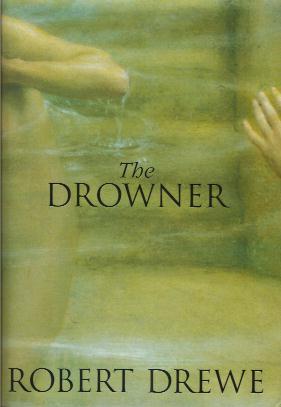
The Drowner Robert Drewe |
Dustjacket synopsis:
"In the warm alkaline waters of the public bath, a naive and headstrong young engineer accidentally collides with a
breathtaking actress. From this innocent collision of flesh begins a passion that will take them from the Wiltshire
Downs to the mythical source of life in Africa - and to the most elemental choices of life and death in the Australian
desert.
"While the intense love story of William Dance and Angelica Lloyd is at the heart of The Drowner, it is but a part of the daring story that unfolds. By irresistibly mingling history, myth and technology with a modern cinematic and poetic imagination, Robert Drewe has reached beyond the traditions of the romance and annexed new territory.
"Such is the grand scale and original texture of The Drowner that it is at once a fable of European ambitions in an alien landscape, a magnificently sustained metaphor of water as the life and death force and, above all, an intimate and ambitious portrayal - of great resonance and haunting sensuality - of the essence of the differences between men and women.
"Lyrical and astringent, vibrant and tender, The Drowner has all the mysterious powers of a dream. Robert Drewe's seventh work of fiction shows an author at the peak of his powers demonstrating the full vigour of his artistic vision."
First Paragraph
They met first in the bath.
This is the feeling, the smell, the sound, of their bodies colliding in the bathwater.
The water is ten degrees over blood temperature. Mysterious, flattering light falls from above. Their heads swim in alkaline gurgle and babble. Then her yelp and his spluttering apology echo off the pillars and ceiling while billowing bodies titter and flirt around them.
Experience it again, this portentous warm accident. His innocent blind lunge, only half-swimming stroke, half-stretch, but too vigorous and vulgar for these languid, ghostly wits.
Plat!, he strikes female flesh, soft yet resilient, jumps up too fast, hair streaming in his eyes, and overbalances against her, the second, inexcusable, slithery bump causing her indignant gasp.
From the Macmillan hardback edition, 1996.
Notes:
You can read more about Robert Drewe here.

|
Oyster Janette Turner Hospital |
Dustjacket synopsis:
"Stories do insist on being told. Even the stories of hidden lives and towns and opal reefs.
"By cunning intention, and sometimes by discreet bribery (or other dispatch) of government surveyors, Outer Maroo has kept itself off maps.
"And yet people do stumble into town, because the seduction of nowhere is hard to resist. All of those who find the place are lost.
"Opal brings most of them. The word itself is like a charm. You can stroke a word like opal. You can taste it. You can swallow it whole, raw and silky, like an oyster, and then Oyster can reel you in.
"There is opal and then there is Oyster.
"Two strangers reach an opal mining town in outback Queensland, searching for a stepdaughter and a son who have mysteriously disappeared. There is a heavy, guilty feel to the hot, parched-dry town. Mercy Given and Old Jess (everyone calls her Old Silence) watch from Ma and Bill Beresford's store. On the verandah of Bernie's Last Chance, the drinkers wait to take stock of the foreigners, before they return to their cattle properties or their sheep stations or to their stake-outs in the opalfields. Dukke Prophet crosses the street from The Living Word Gospel Hall. Young Alice Godwin whimpers.
"Outer Maroo. Population 87. Here two opposing cultures - the rough-diamond, boozing, fiercely individualistic bush folk and the teetotaller, church-going fundamentalists - used to co-exist peaceably.
"Until the arrival of the cult messiah Oyster.
"Janette Turner Hospital has never been stronger, more sensuous or more dangerous than in this magnificent novel."
First Paragraph
If rain had come, things might have turned out differently, that is what I think now; but there were children in Outer Maroo who had never seen rain. We prayed. We cursed. We studied the hot empty sky and imagined clouds. We waited. We waited for something to happen, for anything to happen, we were avid for some event to unfold itself out of the burning nothing to save us. We were waiting, as the desperate do, for a miracle.
Unfortunately, we got it.
Then, within the space of a few months, there were more transients than there were locals, and the imbalance seemed morally wrong. There were too many foreigners in Outer Maroo.
There was also, and still, the drought. More than that, perhaps the worst thing. was a sort of mephitic fog, moistureless and invisible, that came and went like an exhalation of the arid earth itself. We gave it a name. We thought, I suppose, in some primitive way, that if we mocked it, it might decamp and leave us alone. Old Fuckatoo, we called it.
From the Knopf hardback edition, 1996.
Notes:
You can read more about Janette Turner Hospital here.
 |
The Conversations at Curlow Creek David Malouf |
Dustjacket synopsis:
"The year is 1827. In a remote hut on the high plains of New South Wales, two strangers spend the
night in talk. One, Carney, an illiterate Irishman, ex-convict and bushranger, is to be
hanged at dawn. The other, Adair, is the officer of the polce who has been sent out to
supervise the hanging. As the night wears on, the two men share memories and uncover unlikely
connections in their lives. Outside the hut, Adair's troopers sit uneasily, waiting for the
dawn to come.
"Carney questions the accidents of birth and fortune that have brought him to this point. Adair looks back to Ellersley, the household in the west of Ireland into which he was adopted; to his relationship with his young foster-brother, Fergus, and the imperious and mercurial Virgilia, daughter of a neighbouring landowner. What has brought Adair all the way to Australia? And why is Carney, and what Carney knows, so important to his future? Delicately, in prose of precise and evocative power, David Malouf's new novel reveals a web of relationships that embraces Carney and his past, and the deep ties that underscore Adair's mission.
"The Conversations at Curlow Creek is a luminously rich and moving novel. In a narrative of growing intensity, it explores questions of nature and justice, reason and un-reason, the workings of fate, the force of love, as it dares an ever more dangerous intimacy, and of compassion, as it challenges duty. Continually opening up new levels of perception on its characters and their world, the novel finally gives us a powerful sense both of our isolation and of the experiences that are silently shared between us. It will confirm David Malouf as one of the greatest novelists in the language."
First Paragraph:
The only light in the hut came from the doorway behind him. Streaming in off the moon-struck plain, it cast his shadow across the packed earth floor and at an angle up the slab wall opposite but revealed nothing more in the stifling gloom than a stub of candle in the neck of a bootle and the rim of a wooden slop-bucket. Adair's first thought was, There is no one here, he has escaped, the bird is flown. It surprised him, after his two-day ride, and considering all that depended for him on what the man might have to tell, that he felt relieved. What is it in us, what is it in me, he thought, that we should be so divided against ourselves, wanting our life and at the same time afraid of it? He stepped in under the lintel. Behind him it was the trooper now whose bulk filled the doorway and broke its light.
From the Chatto & Windus hardback edition, 1996.
Notes:
You can read more about David Malouf here.
|
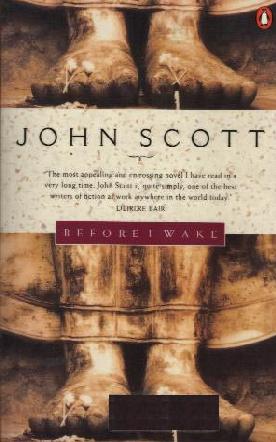
Before I Wake John Scott |
Dustjacket synopsis:
"With evening, cloud begins to close down the sky. Blanket upon blanket. As if it wished to hatch some unnatural thing
from this town.
"I will tell you what these clouds, what this incessant humidity, have hatched. In me. They have hatched the past.
"Jonathan Ford, childless at 43, moves restlessly through other people's lives. From Australia to Europe he pursues a series of ill-fated relationships with the vulnerable and the insecure. In turn he is pursued by his past, whose echoes he finds all around him: in Danielle, a young French poet condemned to perpetual childhood. In the ageing Violet, wickedly irreverent even as she struggles through her days alone in a council flat. In the flawed genius of the painter Malcolm Richardson. In many lives, ordinary and extraordinary, that he changes in the profoundest ways. It is through two sisters, themselves once hostage to the past, that Ford finally awakens to the present.
"This is a story to treasure, a journey through what it means to be human, told with exquisite feeling by the award-winning author of What I Have Written."
First Paragraph:
The day will come. First trace of dawn bleaching the sky to bone-pallor. The sun, still liquid, bulging at the ocean's rim, tearing itself upwards - horizon dragging at its underbelly - a sheer elasticity of light, rising, breaking free into a perfect blinding globe.
And with it, all the sudden rustling and twittering of earth will sweep a meridian of petty noise across this place at the speed of bird-flock. That, and the after-rush of heat, filling the town, careering through its tin-roofed cottages, hugging and enveloping the contours of every object - step and chair and lamp - rising like the swollen waters of flood, until we drown.
But not yet...
In my bedroom, in the still-remaining dark, I listen to the constant fall of Donna's breath, shot through with its whistling pitches of asthma, wave upon wave, as thought the moisture of the air were somehow straining through her throat. Our bodies wound in the dampened linen, the flesh scarcely touching and yet seared together in a glistening weld. A heat as might be generated by decay.
From the Penguin paperback edition, 1996.
Notes:
You can read more about John Scott here.
This page and its contents are copyright © 2006 by Perry Middlemiss, Melbourne, Victoria, Australia.
Last modified: January 26, 2006.