Christopher Koch
The following novels constitute the shortlist for the 1996 Miles Franklin Award:
|
|
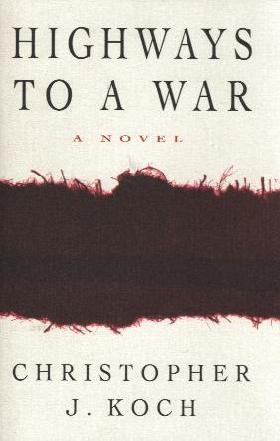
Highways to a War Christopher Koch |
Dustjacket synopsis:
"'Pick any highway, I was told: all of them go to the war.' For three combat photographers,
friendship, comradeship and love are intensified to an ultimate degree by a decade of covering
war in Indo-China, a decade which culminates in the fall of Saigon.
"Highways to a War is the story of a search - a search for Mike Langford, a war photographer with a reputation for risk-taking, who disappears inside Cambodia after its fall to the Khmer Rouge. It explores the personal highways that have led Langford to war, and to his ultimate fate. By nature drawn to lost causes, he gives his emotional allegiance to the badly-led South Vietnamese and Cambodian troops whose dangers he shares. His obsession with their plight drives him to eventually to putting down the camera and picking up the gun; and his love for Ly Keang, a young Cambodian, leads him into a fateful commitment to her country's struggle. Missing, but perhaps still alive, Langford exerts a fascination over everyone who knows him, and his contemporaries invest this essentially ordinary, country-bred Australian with the qualities of a hero from myth.
"Koch also depicts a wartime Indo-China which itself seems semi-mythical: deceptively tranquil paddy fields of the Vietnam delta, where the figures of the Viet Cong appear like black ghosts; the pink and cream city of Phnom Penh, locked in a long colonial dream - a dream that will turn to nightmare.
"With his new novel, Highways to a War, Christopher Koch, author of The Year of Living Dangerously, establishes himself as one of the most important Australian writers of the last thirty years."
First Paragraph:
In April 1976, my friend Michael Langford disappeared inside Cambodia. Twelve months earlier the Khmer Rouge had taken power, erasing the past and restarting the world from the beginning. We were now at the end of Year Zero.
Langford was forty years old, and at the height of his reputation as a war photographer. He'd first left Australia at the age of twenty-nine, and had spent the rest of his life in Asia. Now, it seemed, Asia had swallowed him.
The story was carried by the international media on the evening of Thursday, April 8th. I got it in advance from Rex Lockhart, who phoned me from the Launceston Courier in midafternoon.
‘Mike Langford’s missing,’ he said. His tone made it sound like my responsibility; but Lockhart was like that. I asked him for details, but he didn’t want to given them on the phone.
‘We’ll be running it tomorrow morning,’ he said. ‘But I think we should discuss this tonight. Come over for dinner.’
From the William Heineman Australia hardback edition, 1995.
Notes:
You can read more about Christopher Koch here.
|
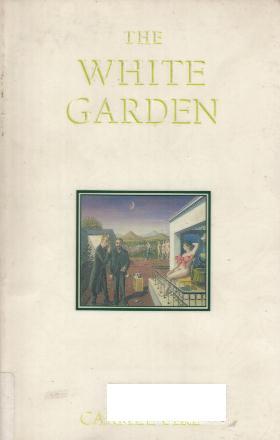
The White Garden Carmel Bird |
Dustjacket synopsis:
"Seven people die in deep sleep therapy. A woman dies from a bee-sting in the grounds of a psychiatric clinic where
inmates are encouraged to live out their delusions.
"The doctor rapes his patients in the Sleeping Beauty ward.
"Carmel Bird's examination of the secrets of the human mind is a chronicle of tragedy that is inadvertently revealed in the search for a lost library book. It is also a compelling portrait of a doctor whose lust for power is a form of madness."
First Paragraph:
I have always, for as long as I can recall, identified myself with the elephant. This is not something I readily admit because in my profession friends and colleagues are only too ready to leap in with an analysis, to place a facile interpretation on this most intimate, personal and colourful of facts. You will occasionally find me throwing people off the scent (supposing they are on the scent) by making reference in a light-hearted way to 'a herd of elephants' or to the fact that the elephant never forgets.
Certain African tribes believe that after death the chief of the tribe becomes an elephant matriarch, respected and honoured, and an ally when members of the tribe are hunting elephants. As I feel myself falling asleep at night I experience myself as the elephant matriarch, appearing in silence from a swirling mist, roaming hugely among thick greenery and large, colourful flowers, and then I drift back into the mist, fade, and, with soft lilac cloud-forms drawn across my eyes, I sleep. The feeling is profound and satisfying to me, and I have all my life sought to understand it. It is an element of the beauty of sleep itself, and is perhaps partly what has brought me to study the function of sleep in the life of the mind, the health of the mind, and to apply the science of what I have learned of sleep to my patients.
It was with fear and dread that I learned, when I was in my early teens, of John Merrick, the so-called Elephant Man. For a time my own elephant feelings had to be suppressed as I felt myself in danger of succumbing to the disease from which Merrick suffered. Consequently, my sleep was, for some months - it could have been a year, I'm not too sure - severely disturbed. Such are the fears that children suffer, unspoken. How could I, a healthy Australian boy, mad about cricket and football and science and even Shakespeare, how could I confide in anyone the reasons for my insomnia?
From the UQP paperback edition, 1995.
Notes:
You can read more about Carmel Bird here.

|
The House in the Light Beverley Farmer |
Dustjacket synopsis:
"An Australian woman returns alone to the Greek village house where she was once welcomed as a bride. Unsure
of her reception after a divorce and an absence of many years, she has come to mourn the old man's death and to
take part in the age-old traditions of Easter weekend. Bell is still bound, by her son and by the past, to this
family and its matriarch Kyria Sofia. The old warmth between the two women is quick to surface, but so too
are old grievances and misunderstandings. Brimming with dreams and memories, the house reasserts its claim
on Bell. As the family gathers for the Resurrection, she is fighting for her soul.
"Readers of Milk and Home Time will welcome the return of Bell to the fold of rural Greece with all its riches and austerities of culture and tradition."
First Paragraph:
The grey green turbulence of leaves is the first new thing Bell will see when the bus goes lumbering over the bridge, the stony river. Even before the roofs crammed with television aerials and glass frames for solar heating, the enamelled cars crammed in under the vine-arbours, she will take in a new thick looseness and flicker of olive leaves in front yards all over the village, slender and flimsy, sparse in the wind, like gum leaves. This, when everyone laughed when she first came here. Kalé, nýfi, the old man said who is dead now, who died last year: you come this far inland and you expect to find olive trees? How would they live through a winter here in the north? And once she had a winter here she understood why: the ringing frost, and the village snowbound; the stream frozen solid, and the trees, iron boughs hung with glass.
Two hours and nothing to see out the window in the smoky damp but a slick of wet, a white blur of plums and cherries in flower. Now and then the bus sways through a village of shops with blank windows framed in blue, houses, the hump of a dim church. Greek churches have domes, for the most part, never spires, blue domes of heaven, in the islands, or of green slate; but here most of them are brick, like ovens, like bells, and have cupolas with a braiding of brick around their owl eyes. Another town, another village, a graveyard of blue cots and cypresses, coils of black flame. Valley after valley full of mist and sodden land and houses not like island houses, white though they are, foursquare and squat under red roofs. Not here the flow of land and sea, dome and arm of wall, niches, arches, of whitewash and grey stone in the sun. It is ánoixi, spring, meaning opening: of buds, of wombs, and this is all around; and of the sky, the weather, but of that there is little sign. The further north she goes,the more it looks as if the snow has barely melted; the land still has that tamped, discoloured and draggled llok, like a mended leg when the plaster is taken off.
From the UQP paperback edition, 1995.
About the Author:
Beverley Farmer was born in Melbourne in 1941. A graduate of Melbourne University, she married a Greek migrant in
1965 and for some years lived in the village with his family. During this time she wrote her first book, Alone
(1980). The short story collections Milk (1983) and Home Time (1985) draw upon her experience of Greece.
Her more recent works are A Body of Water (1990), part fiction, part writer's note-book, and the novel The Seal
Woman (1992).

|
Bracelet Honeymyrtle Judith Fox |
Dustjacket synopsis:
"Born into a strict Christian family in Sydney at the start of the century, Annie contends with an overbearing
mother and a harsh religion. Kept at home, partially deafened by illness and mistreatment, she clings to her
mother and her dominating religious certainties. Yet something stirs under the starch of faith. Annie finds a
friend late in life and discovers a passion for living to equal her passion for gardening. In her sixties, Annie
confronts her mother.
"This is the story of one woman's struggle to lay claim to her own life. And within the seemingly narrow contours of family and church and garden, Annie discovers that it is, after all, a big life."
Quotes:
"a splendid, moving book" - Andrew Riemer
First Paragraph:
I rise with the sun. I place my slippers by the bed at night, alongside my dressing-gown draped over the bedroom chair. It is the delicate chair my father gave my mother in their first year of marriage. As a child I would slip into my parents' bedroom to sit on that chair. Our weights felt compatible. I would sit on that pretty chair and tell myself I was pretty too. I don't trust my weight on it now.
In the near darkness my hands and feet are sure as homing pigeons and I am slippered and gowned before I switch on the light. I sit at my dressing-table and plait my hair. Certain stretches are very difficult these days but this weaving of hair is a lifetime habit and it remains untouched by age. Deborah attends a gym and can do amazing contortions with her body. A bit like a circus act really. She put on a leotard and went through some routines for me once, for us, since I was holding Kimberley and we were the audience. Deborah had cleared a space in the middle of the living room and I perched myself in a corner, baby on my lap, both of us alert and attentive. Kimberley and I are not always so coordinated. Deborah put her body into positions I've only ever seen cats in. That thing that cats do, when they lean right back without support, stick a leg in the air then twist their heads around, all in the name of a good clean; well when cats do it, it looks graceful, but with Deborah it looked painful. The tendons in her neck were standing out and her breath was coming in sharp puffs. I was so taken aback I made some particularly asinine remark such as, Goodness aren't you a clever girl. No wonder she dislikes me at times.
From the Allen and Unwin paperback edition, 1995.
Notes:
This novel was shortlisted for the Australian/Vogel award in 1994.
About the Author:
Judith Fox was born and raised in Newcastle, by the sea. After living in Europe for one year, Judith moved to
Sydney where she studied Communications at the University of Technology.
She has worked as a barmaid, a film and television researcher and reviewer, a doctor's receptionist, a lecturer and now works in publishing. Bracelet Honeymyrtle is her first novel.
|
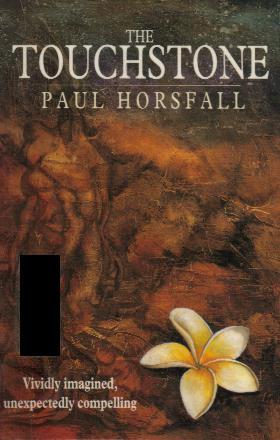
The Touchstone Paul Horsfall |
Dustjacket synopsis:
"For nearly one hundred years Seymour Bazett has bene burying 'treasures' in his backyard. His garden is full of
mementoes, keepsakes, trophies, expereinces and sufferings that have made up his life. Now there is only one bit of
gardening left to do - Seymour is about to bury itself. I digging his grave, however, he has unearthed some of his
earlier burials. It is these objects that now conspire to tell the strange stories of how they came to be preserved.
"Horsfall's prose is vital, earthy and vividly enaging in this magical first novel of humour and savagery. The Touchstone is peopled with eccentric charcaters and unlikely happenings tackling the minutiae of life, the grand passions of love and murder and the eternal issues of sex and death."
First Paragraph:
The stones have asked me to say a few words before they begin. Provided I keep it short they are agreed it could not do any harm. Beyond that, in every sense, the matter has been taken out of my hands.
Oh, my story will still be told, but I have been relieved of the responsibility for it. The stones have promised me as much. No it is not my imagination, not just an old man's feeble-mindedness. I tell you there is a voice stirring in the earth this evening. A kind of voice. A rasping like the rubbing together of pieces of sandstone. A dry tongue drawn across granular lips. A stridulous whispering along the lines of fault, most grievous fault. Mea culpa, mea maxima culpa.
There, can't you hear it? The stones-I call them stones but in fact they are much more than that-are conversing among themselves, bent upon unearthing the stratum of Truth. They have decided it is time to set the record straight, at long last. You will note: it is their decision, not mine. They are discussing the best way to begin, whether with the umbilicus or the teacher's gaze, the pocketless wanderers or the buried handkerchief, the marching umbrella stands or the last living cell. Each eolith is vying with its neighbour for the right to testify first.
From the Allen and Unwin paperback edition, 1995.
About the Author:
Paul Horsfall lives with his partner, their daughter and two cats in the inner-westem suburbs of Sydney. He
is a collector of the popular music of the 1920s and 1930s, as well as contemporary jazz and fusion. He has
never seen snow.
The Touchstone is his first novel.
|
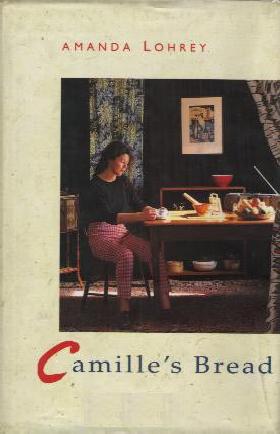
Camille's Bread Amanda Lohrey |
Dustjacket synopsis:
"Here is her small front garden; its tall lemon palm, its fragrant frangipani tree, a border of
unruly flowers, two giant monstera plants darkening one corner of the fence. He's late, and they've been
waiting for him. He sits at the kitchen table feeling uncomfortably like a husband. Marita begins to serve
dinner, banging pots and plates in that distracted way she has ... Soon, when Camille has accepted him here,
he'll take over in the kitchen and then the energy in the house will begin to change for the better. He will bring
calm. He is confident of this.
"Camille glares at her plate. 'Yuk brown rice again,' she says. 'Why can't we have chips?'
"After too many nights of take-away pizzas, Marita wants just one year off to look after her daughter, Camille. Then she meets Stephen, a public servant in the complex process of reinventing himself - rejecting his European heritage and seeking salvation in a dojo in Japan. As their relationship grows, so does the drama of parenting Camille, in this elegantly crafted, warmly appealing novel of contemporary life by acclaimed novelist Amanda Lohrey."
First Paragraph:
In the kitchen of a small house in Leichhardt, a young woman is dancing with her eight-year-old daughter. It's winter, and dark outside. A dish of lentil burgers sits warming on the hotplate and the strains of some exotic Latin tango strum insistently from a large black tape deck that stands on top of the fridge. Mother is clasping daughter in a parody of adult coupledom, each awkward and jolting with laughter as they stride, with exaggerated poise, up and down the skillion kitchen, sweeping across the black and white chequerboard tiles, heads tilted back, arms outstretched stiffly in the arch and demonic thrust of the tango. Dum dum, da da! da-da-da,da dah, dum dum da da! The mother is chanting time, pouting with mock seriousness, her cropped black hair standing upright in silky spikes of dishevelment and impatience. In her arms, her slight, fey, fair,haired daughter, hair drawn back in a French plait, her thin legs in dark green stockings and black lace-up school shoes, alternately mimicking the fierce concentration of her mother and erupting into loud, raucous schoolgirl laughter. For a moment, she breaks away to perform a dizzy pirouette on her own. 'See this step,' she says. 'You go, one two three four ... and then you go ... '
The telephone rings.
'Don't answer it,' says her mother. 'I'm sick of the phone. It's no-one we want to talk to. People shouldn't ring at mealtime. Mealtimes are for dancing.' But on these last words she is drowned out by a loud droning thunder as a low-flying 747 roars directly over the kitchen roof, its blinking tail lights creating a flash of momentary illumination in the small courtyard outside. The windows shudder and rattle in their frames but the two figures go on dancing, breaking off now into an improvised jive before the mother falls, feigning exhaustion, into a chair.
From the Angus and Robertson hardback edition, 1995.

|
The Sitters Alex Miller |
Dustjacket synopsis:
"a narrow, vertical painting, tightly enclosing the scene. Her pale arm and her pale thigh. Viewed at a diagonal
through an exceedingly tall doorway ... just a glimpse of something ...
"An ageing portrait artist meets a woman who unsettles him, yet inspires him to paint her. Reluctantly, at first, they are drawn together.
"The ambiguity of the relationship between painter and subject is revealed through Alex Miller's subtle, sensuous narrative. The artist must watch and wait to trap the shy beast. For the skil of portraiture is in seeing beyond the face, beyond the likeness."
First Paragraph
When I was old and could no longer hope for new friendships, one of the saddest episodes of my life began to come back to me and to offer me my greatest joy. Under the influence of this memory, revisiting me in its new disguise, I was able to paint again. For the gift had left me. I don't believe I'll ever suffer such a paralysis of my will again. Now I'll go on painting until the end. Which must be the hope of every artist. Simply to work.
And that is what she gave me, Jessica Keal, the subject of this altered memory, a memory entangled with certain family likenesses and forgotten moments of my childhood; her roots and mine mysteriously grown together. That entire episode is contained for me in a single image. And although there's only one figure in this image - for it's my portrait of Jessica that I'm talking about - it's an image in which I'm content, for once, to recognise myself. As I remember her, I remember myself and am able to approach the last enigma of my life - my family and my childhood. That cold legacy of silence and absence.
From the Viking paperback edition, 1995.
Notes:
You can read more about Alex Miller here.
This page and its contents are copyright © 2006 by Perry Middlemiss, Melbourne, Victoria, Australia.
Last modified: January 26, 2006.