Helen Demidenko
The following novels constitute the shortlist for the 1995 Miles Franklin Award:
Notes:
Peter Carey's novel The Unusual Life of Tristan Smith
was deemed ineligible for the award.
|
|
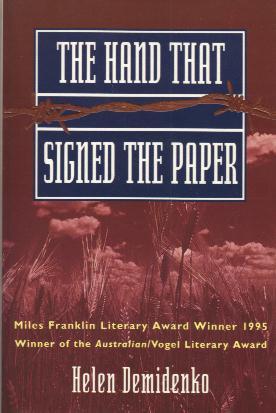
The Hand that Signed the Paper Helen Demidenko |
Dustjacket synopsis:
"The Hand that Signed the Paper tells the story of Vitaly, a Urkranian peasant, who endures the destruction of his village and family by Stalin's communists. He welcomes the Nazi invasion in 1941 and willingly enlists in the SS Death Squads to take a horrifying revenge against those he perceives to be his persecutors.
"This remarkable novel, a shocking story of the hatred that gives evil life, is also an eloquent plea for peace and justice."
Quotes:
"astonishingly talented...with the true novelist's gift of entering into the imagination of those she is writing about." -
David Marr
"A searingly truthful account of terrible wartime deeds that is also an imaginative work of extraordinary redemptive
power." - Jill Kitson
First Paragraph:
As I drive down the Pacific Highway, the French are busy dropping bombs into the waters in which my nieces swim, the Americans and Iraqis are engaged in a bizarre competition to see who can destroy the world many times over most, and my uncle will soon be on trial for war crimes and crimes against humanity. I wonder casually, as I turn off the main road to fill up with petrol, if Eichmann had a daughter and is she felt the same way as I do now. It is an idle question, but I toy with it as the light and darkness at sunset plays over the glittering Ampol sign. This is one petrol station where they still serve you while you sit in your car. A pimply boy walks towards me across the asphalt and asks 'how much?' and I say 'twenty dollars'. I sit in the cockpit of my car, and look at my watch. The boy takes my keys. The key ring has a cheap plastic figurine of 'Expo Oz' attached. I've had it for four years, and Expo Oz's platypus bill has very little paint left on it.
Right now, I am missing my Set Theory and Logic lecture, and will soon miss my Modern Political Ideologies lecture. I left home earlier this morning, giving Cathe a week’s rent and telling her that I was ‘going to drive down the coast to see about my uncle’. Cathe -- and a few other of my close friends -- know that I am related to the Kovalenko who has recently been charged with war crimes. That in itself is no guarantee of a trial, but the fear is real. I have confirmed to Cathe that the charges are true, and that the family is in the process of engaging a lawyer.
From the Allen and Unwin paperback edition, 1995.
Notes:
This novel was the winner of the Australian/Vogel Award for 1993.
To say that this novel caused something of an uproar would be to utter one of the greatest understatements in Australian literary history. It basically split the Australian literary scene down the middle - on the one hand it was defended from the point of view of freedom to write whatever one wants; and on the other it was accused of being anti-semitic, racist and downright fascist. It subsequently came out that Demidenko was not the author's real name and she was villified for that as well.
|
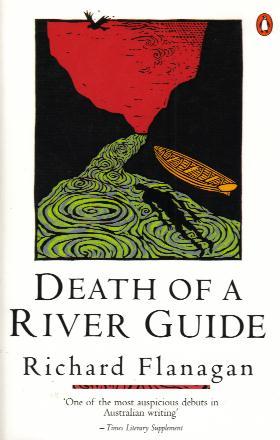
Death of a River Guide Richard Flanagan |
Dustjacket synopsis:
"He feels himself tumbled by water, then suddenly slammed to a halt, feels rocks grip round his hips and his chest like
tightening vices. Feels the water that was for a few seconds benign change its character immediately to that of a mad,
rushing sadist, forcing his head and body forward and down and under.
"And he knows this moment has been a long time coming.
"Beneath a waterfall on the Franklin, Aljaz Cosini, river guide, lies drowning. Beset by visions at once horrible and fabulous, he relives not just his own life but that of his family and forebears. In the rainforest waters that rush over him he sees those lives stripped of their surface realities, and finds a world where dreaming reasserts its power over thinking. As the river rises his visions growm more turbulent, and in the flood of the past Aljaz discovers the soul history of his country.
"Widely acclaimed, Death of a River Guide is an inspired novel; a lyrical torrent of love and redemption, of rage and pain and laughter tempered by the inevitability of loss."
Quotes:
"Flanagan, with his acute sense of the physical overlaid with an appreciation of the mystical, gets to the heart of
things. . . For serious environmentalists this could be the novel." - Helen Elliott, Sunday Age
First Paragraph:
As I was born the umbilical cord tangled around my neck and I came into the world both arms flailing, unable to scream and thereby take in the air necessary to begin life outside the womb, being garrotted by the very thing that had until that time succoured me and given me life.
Such a sight you never clapped eyes upon!
And not only because I was being half strangled. For I was born in the caul, that translucent egg in which I had grown within the womb. Long before my damp rusty head was crowned between my mother's heaving flesh as I was painfully pushed out into this world, the caul should have ruptured. But I miraculously emerged from my mother still enclosed in that elastic globe of life, arriving in the world not dissimilarly to how I now depart it. I swam within a milky blue sac of amniotic fluid, my limbs jerking awkwardly, pushing with futile gestures at the membranes, my head obscured outside the sac by the wreath of umbilical cord. I made strange, desperate movements as if condemned always to see life through a thin mucousy film, separated from the rest of the world and the rest of my life by the things that had until then protected me. It was and is a curious sight, my birth.
From the Penguin paperback edition, 1996.
Notes:
You can read more about Richard Flanagan here.
|
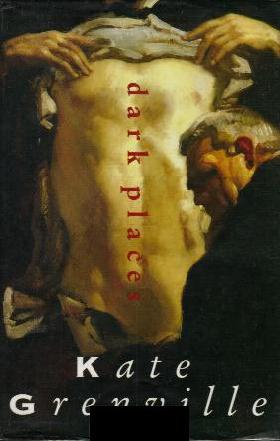
Dark Places Kate Grenville |
Dustjacket synopsis:
"Albion Gidley Singer inhabits the shell of an entirely proper man of the world: husband, father, pillar of the community.
But within him are frightened and frightening dark places from which spring fear and loathing of the flesh of females.
And finally, the kind of violence that might call itself love.
"It is through the eyes of Albion Gidley Singer that the world is seen and in his voice that the story is told, and it is a voice that never suffers from self doubt. He can never know, as the reader does, that what he sees is horribly wrong and what he thinks about the world around him is distorted by his damaged self.
"Kate Grenville has written a disturbing, shocking and grotesquely funny novel that resonates in the mind with the truth of great writing. Dark Places sets a new benchmark in Australian fiction."
First Paragraph
This is Albion Gidley Singer at the pen, a man with a weakness for a good fact. The first fact is always the hardest: you have to begin somewhere, and such is the nature of this intractable universe that the only thing you can start with is yourself. If I am nothing else, 1 am at least a link in the endless chain of proof which stretches back to a time when Albion Gidley Singer cannot even be imagined.
Mirrors show me a tall man with a splendid head, and a mouth that would never weaken. That person in the mirror has been so many solid things. He has always been a gentleman, and in addition he has been a son, a husband, and a father. He has been a customer in shops where long yellow gloves were laid out before him on glass, he has been a drinker on sawdust, and in the hushed leathery air of the best clubs. He has been a man in plus-fours, a man in a wing collar, a man in a nightshirt, a man in a striped bathing-suit. He has even been a praying man, staring at the dust between his knees and looking forward to lunch. He has been all these things with exceptional completeness, and has convinced the world, and himself.
From the MacMillan hardback edition, 1994.
Notes:
You can read more about Kate Grenville here.
|
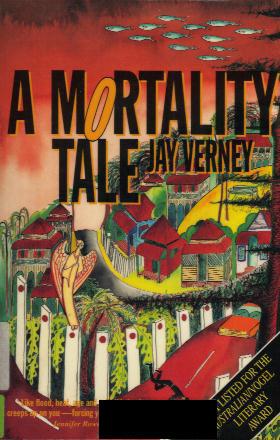
The Mortality Tale Jay Verney |
Dustjacket synopsis:
"So you drove home drunk?
"So you killed someone on the way?
"So what do you do next?
"So...
"You read A Mortality Tale."
First Paragraph:
I know it's July because it's as cold as Walt Disney's head, especially at night. I haven't lived here for thirty years and that was a brief holiday because we were too poor to go to the beach. My memory of the holiday is of waking up to voices outside my room, the one I'm sleeping in now - I like to think it's the same one - the angles look right, down East Street, up to the hospital, the facade of Mrs Dempsey's Rainbow Cafe in Morgan Street, no view at all of Uncle Martin's place). I walked out to the verandah and stood with the dark shadows that were my mother, father and brother. We watched the Crown Hotel go up in flames. It was past Uncle Frank's butcher shop in East Street, just over the old bridge on the Dee River. That's what I remember: a cold, dry night in Mt Morgan in the early 1960s, listening to fire and men yelling. I was wearing red slippers and floral-patterned flannelette pyjamas; Mama wrapped me in my pink and white chenille dressing-gown.
We had only one holiday here. We used to drive up on Sundays sometimes for a couple of hours between sessions, so Mama could visit her sister, Ruth. She'd sit us, my brother Peter and me, on high stools with thin, steel legs and fill us with potato chips and cordial. We were allowed to go exploring occasionally, out the back through the big piano room and the kitchen and laundry. If there was time on our way home,we'd call at Uncle Martin's and play with his dogs and try to teach the cockatoo to talk. All it did was swear at us. 'Bloody coot.' 'Jesus Christ.' 'Stupid bugger.'
From the Allen and Unwin paperback edition, 1994.
Notes:
This novel was shortlisted for the Australian/Vogel Award in 1993.
This page and its contents are copyright © 2006 by Perry Middlemiss, Melbourne, Victoria, Australia.
Last modified: January 26, 2006.