Rodney Hall
The following novels constitute the shortlist for the 1994 Miles Franklin Award:
Notes
Three other novels, described as outstanding by the judges, did not qualify for the list. These were:
"The Georges' Wife" by
Elizabeth Jolley, "Fury" by Maurilia Meehan, and
"Grand Days" by
Frank Moorhouse.
|
|
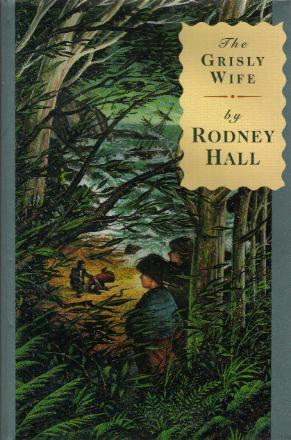
The Grisly Wife Rodney Hall |
Dustjacket synopsis:
"In this stunning new novel, Rodney Hall tells the story of Catherine Byrne, a nineteenth-century English missionary who
travels to remotest Australia with her prophetic husband and his band of women disciples, the Household of Hidden Stars.
Named Muley Moloch after the famous Irish lay preacher whose soul he is determined to save, he is a man of miraculous
powers who leads his followers through severe hardship - shipwreck, disease and death - in their millenarian quest.
"Set in 1863 at the dawn of the modern era (with photography, steam power and domestic machines such as the lawn mower revolutionizing people's understanding of their world) The Grisly Wife resonates with echoes and presentiments just beneath the surface of colonial Australia.
"The Grisly Wife is the keystone to Hall's trilogy which begins with The Second Bridegroom and ends with Captivity Captive - surely destined to become one of the great works of Australian fiction."
First Paragraph
Queer thing -- but yes -- we do mourn for the England we lost -- maybe because the darkness of the tragedy awaiting us in New South Wales has left the memories of our youth bathed by contrast in clear simple light -- and after so many years of exile one's gentler adventures tend to rise to the surface more and more appealingly --
But the day we set sail from Bristol I doubt if a tear was shed for home -- England being so given to licence in those days and ourselves so out of step -- I believe I speak for everyone including the prophet -- this was to be our adventure in self-sacrifice and despite the fact that we were never exactly missionaries in the usual sense we did speak of this place as a mission right from the beginning -- just as we accepted that we were the Chosen Few --
Being the Chosen Few meant we had a great deal more to look forward to than we had to look back on! -- but you will never understand -- no one born over here can have the least notion how desperate people were to escape the smut and futility of England then --
From the Macmillan hardback edition, 1993.
Notes:
You can read more about Rodney Hall here.
A summary of, and commentary on, this novel is available from the New York University's
Literature, Arts and Medicine
Database.
|
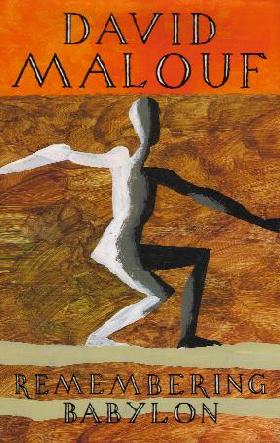
Remembering Babylon David Malouf |
Dustjacket synopsis:
"In the mid-1840s, a thirteen-year-old boy, Gemmy Fairley, is cast ashore in the far north of
Australia and taken in by aboriginies. Sixteen years later, when settlers reach the area, he
moves back into the world of Europeans, men and women who are staking out their small patch of
home in an alien place, hopeful and yet terrified of what it might do to them.
"Given shelter by the McIvors, the family of the children who originally made contact with him, Gemmy seems at first to be guaranteed a secure role in the settlement, but there are currents of fear and mistrust in the air. To everyone he meets - from George Abbot, the romantically aspiring young teacher, to Mr Frazer, the minister, whose days are spent with Gemmy recording the local flora; from Janet McIvor, just coming to adulthood and discovering new versions of the world, to the eccentric Governor of Queensland himself - Gemmy stands as a different kind of challenge, as a force which both fascinates and repels. And Gemmy himself finds his own whiteness as unsettling in this new world as the knowledge he brings with him of the savage, the aboriginal.
"A magnificent portrait of a continent and a searing account of the ordeals of settlement and first contact with the unknown, Remembering Babylon has the poetic intensity that marked Malouf's An Imaginary Life. The result is a rich and compelling novel, written in language of astonishing poise and resonance, and immensely powerful in its vision of human differences and eternal divisions."
First Paragraph:
One day in the middle of the nineteenth centrury, when settlement in Queensland had advanced little more than halfway up the coast, three children were playing at the edge of a paddock when they saw something extraordinary. They were two little girls in patched gingham and a boy, their cousin, in short pants and braces, all three barefooted farm children not easily scared.
They had little opportunity for play but had been engaged for the past hour in a game of the boy's devising: the paddock, all clay-packed stones and ant trails, was a forest in Russia - they were hunters on the track of wolves.
The boy had elaborated this scrap of make-believe out of a story in the fourth grade Reader; he was lost in it. Cold air burned his nostrils, snow squeaked underfoot; the gun he carried, a good sized stick, hung heavy on his arm. But the girls, especially Janet, who was older than he was and half a head taller, were bored. They had no experience of snow, and wolves did not interest them. They complained and dawdled and he had to exert all his gift for fantasy, his will too, which was stubborn, to keep them in the game.
From the Chatto & Windus hardback edition, 1993.
Notes:
You can read more about David Malouf here.
This book was the winner of the NSW Premier's Literary Award in 1993, and the first
International IMPAC Dublin
Literary Award. It was also shortlisted for the 1994 Booker Prize and
the National Book Council's Banjo Award.
Other WWW Mentions:
This novel is reviewed on the Web by:
|
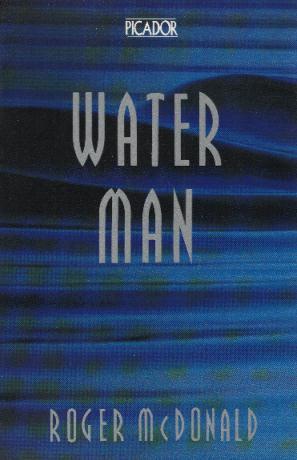
Water Man Roger McDonald |
Dustjacket synopsis:
"Gunner Fitch, a near-legendary water diviner, has been dead for over fifty years, but people in the town of Logan's
Reef are still trying to escape his strange legacy.
"His son Mal, a famous Sydney theatre director, returns every year to the drought-stricken town for reasons he is only beginning to understand. An old story of rivalry and passions rules his blood, involving an unkept promise and 'a chain of hurt raching down from a cruel, courageous action taken by a barely remembered woman in the name of love.'
"When Ida, Mal's actress lover, writes a play based on the life there, matters left unfinished in one generation begin to clamour for attention in the next.
"It takes three men in Gunner's old truck, one of them an uncanny fit-throwing outcast with a nose for hidden water, to finish what Gunner had set in motion all those years before. To allow the past to break through and the circle to close. And, in so doing, to reveal to those lost in their lives a simple truth: 'The thing about change is it shows you who you were all along. It brings you to yourself.'
"Water Man is a moving and wise novel resonating with quiet power and extraordinary clarity of vision. Once read, it will never be forgotten."
Quotes:
"Roger McDonald uses language with the precision of a diamond cutter." - US Publishers Weekly
First Paragraph
Gunner Fitch arrived at Croppdale with his new wife and left her alone for the day, headed away from the road, across the dry river and up into the hills on foot, with only a limping black dog for company. He carried a canvas knapsack holding a long-handled tin torch, a Vest Pocket Kodak camera, corned beef sandwiches, a bottle of cold milky tea, wax matches, and a packet of gelignite and fuses.
His wife Rosan sat on the verandah of the men's quarters and watched him disappear into the sun with a tired wave. If only he wouldn't just dump her like this, then she wouldn't just drift.
He wouldn’t return until nightfall; it was always the same. He needed a whole day to find what he could never see, but could feel in his nerves and stomach tension -- fissures in rock under his bootsoles and lakes of underground water that would rise with a lapping rush through iron bore casing when he called in the drill. Sometimes he’d light dynamite sticks and drop them into cracks in the ground, put his ear to the earth after the blast, and listen for echoes. Rage was in him as much as patience. When he smiled, a prominent gold molar invited murder. His work exhausted him like a fever: his divining gave him fits, it struck so deep. When he returned at nightfall he would spread sheets of graph paper on the bonnet of the car, and while Rosan held the torch the Gunner would explain his findings to the landowner. So much water here, so many feet under, at such a rate of flow. He would never be wrong. Rosan would have to do the driving afterwards while Gunner slumped in the passneger seat smoking roll-your-owns down to wet slugs and thinking his own thoughts.
From the Picador paperback edition, 1993.
Notes:
You can read more about Roger McDonald here.
This page and its contents are copyright © 2006 by Perry Middlemiss, Melbourne, Victoria, Australia.
Last modified: January 26, 2006.