Alex Miller
The following novels constitute the shortlist for the 1993 Miles Franklin Award:
|
|
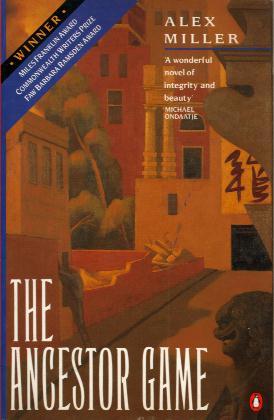
The Ancestor Game Alex Miller |
Dustjacket synopsis:
"For certain people exile is the only tolerable copndition. For these people, to be in exile is to be at home.
"What mysteries relate the past to the present? What is the alchemy of myth-making?
"From a dilapidated mansion in Melbourne, to an ancestral home in Hangzhou, near Shanghai, a mystery is being unravelled. It is a mystery that links the life of one human being to another, connecting the past to the present, entwining history with fiction.
"Piecing together the puzzle of exiled artist Lang Tzu, last of a wealthy Chinese lineage, writer Steven Muir finds himself caught in a strange and haunted landscape. Both men know the solitude of the only child, and the exquisite poignancy of the relationship with parents. But beneath the familiar are the twisted threads of Lang's past - the sweep of ancestry and its lingering inheritance.
"The Ancestor Game is an irrestible adventure story, a mysterious and beautiful novel of pursuit, of longing and wondering, of intimacy with the past, and disorientation in the present."
Quotes:
"A wonderful novel of integrity and beauty" - Michael Ondaatje
"The Ancestor Game takes the historical novel to new frontiers...It is fabulous in the fullest sense of the
word." - Commonwealth Writers Prize Judges
"Extraordinary fictional portraits of China and Australia..." - New York Times Book Review
First Paragraph
In a wintry field in Dorset less than a year ago, I enquired of my mother, You don't want me to stay in England with you then? She, clipping her words as if she were trying out a new set of shears on a privet, replied, No thank you dear. I waited a minute or two before venturing the merely dutiful alternative, You could come out to Australia and live with me? Thank you dear, I think not.
We resumed watching a pair of swans. Their pale forms merged with the river and the flat fields and the sky, then emerged again mysteriously, as if propelled by the unseen hands of giant children at play. Nothing else moved. Everything around us was grey, luminously grey, and very cold. We were closed in by fog. There was only the rushing sound from the motorway a mile off. As I stood beside my mother I realised I'd arrived at a moment of decision. Ill-defined anxieties flickered in my mind. I remembered the Chinese refer to these moments as dangerous opportunities.
We watched the swans glissade into and out of our view, on the river that was indistinguishable form the sky, and we waited until the bruised sun had dissolved. Our cold vigil in the field at sunset was our homage to the memory of her husband and my father. There was to be no lasting memorial. There had been no service. There was no patch of ground to remain sacred to his memory. He probably would have liked there to have been: a headstone set among others’ headstones and incised with a couplet from Burns: Nae man can tether time or tide; The hour approaches Tam maun ride.
From the Penguin paperback edition, 1992.
Notes:
This novel won the 1993 Commonwealth Writers Award and the 1993 Barbara Ramsden Award for best novel.
You can read more about Alex Miller here.
|
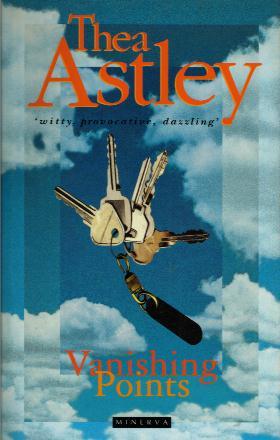
Vanishing Points Thea Astley |
Dustjacket synopsis:
"Thea Astley, Australia's most acclaimed and awarded writer, presents two novellas which
sweep the reader on sentimental journeys towards an ending rather than a beginning.
"Julie Truscott, a seemingly ordinary housewife, and Macintosh Hope, a disenchanted academic, each flee from lives they cannot control. The balance of their flight is destroyed by Clifford Truscott - Julie's real estate husband and the rapacious developer of Mac's neighbouring island.
"In Vanishing Points Thea Astley is at her best."
Quotes:
"Vanishing Points is an immensely important book, witty, provocative, dazzling." - Lucy
Frost, Age
"Thea Astley's new novel is temptingly tactile - like a cat's back. It ripples and flows
with experience and wit." - Rosemary Sorenson, Sydney Morning Herald
First Paragraph:
From where he sat on the terrace outside Laforgue's escape hatch, he noted how the uphill sweep of paddock became a rough wedge of unslashed grass between eucalypt hedgings and moved to an unnatural vanishing point as if landscape had taken over and exaggerated the principles of perspetive. He found this jarring, as he was sure he would find almost everything else about this weekend gathering. Already, after barely an hour, he was beginning to wonder why he had come, as he weighed up the value of slipping quietly back to the pigpen (not that he wasn't used to the primitive) room allotted, repacking his bag and driving off into coastal blue to the fleshpots of Surfers Paradise. 'Interpretation of the art,' the brochure had said, badly typed, occasionally misspelled but urgent with Kulturgeist, 'must be in those surroundings that supplement the art itself'. Jee--sus! 'The dynamics of the written word understood in a setting where nature enhances symbol and metaphor.'
From the Minerva paperback edition, 1993.
Notes:
You can read more about Thea Astley here.
|
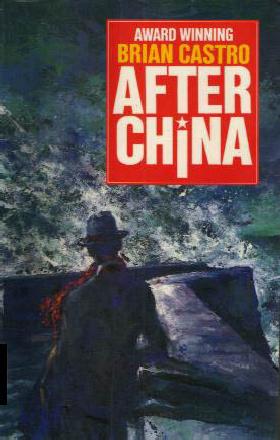
After China Brian Castro |
Dustjacket synopsis:
"After China, is a novel which offers lasting pleasures through its rich combination of consummate story-telling,
playfulness and wisdom.
"An architect meets a writer on a beach. He has escaped from China. She is dying of cancer.
"Attracted to her, yet infinitely cautious, he spins ties between them with near-magical stories of ancient China.
"Without knowing that she is ill, that she is dying, his stories derive from Taoist manuals which prescribe sexual control in order to attain immortality.
"In time he comes to understand the urgency of her predicament and the irony of his drive to save her.
"As the novel unfolds, and as the strangely labyrinthine hotel he has designed threatens to merge with the ocean over which it is so precariously built, we understand with him that if illness is totally time-bound, then only story-telling can being to exorcise time.
"After China has all the power and lasting beauty of a contemporary Arabian Nights.
"The idea of China - as a measure of difference from the West - is freshly explored through robust, life-affirming story-telling. And, in turn, magnificently counterpoints the delicate hesitancies of this most contemporary of roamnces, allowing the reader to think anew about issues no less weighty than love and survival."
First Paragraph
'During winter,' Lao-tzu said, 'one should not ejaculate at all.' The venerable philosopher, reputed to be a hundred and eighty years old, had already surpassed becoming an Immortal. Ten partners in the hour before midnight. Almost twelve hundred copulations without emission so far this year (c. 499 BC). With each, an aphorism had come to mind.
But it had not been a good year, though the reclusive author of the Tao Te Ching had prodigiously staved off rumours that he was dying. He was banking on the hope that his aphorisms would restore him from those previous pronouncements on health which had been stale and technical. An example:
To build up yang essence, one must have sexual relations with many different women as often as possible without emission. Reinforced by the female yin ... the longer one can do this, the more yin essence will be absorbed, thereby increasing and strengthening one's vitality . . . man's yang essence will flow upwards along his spinal column, delivering an awesome power to his brain and to his entire system. This will render him immortal. Time will then be suspended and exorcised. Et cetera.
These were not the words of a divinity. They weren't even the words of an aphorist.
From the Allen and Unwin paperback edition, 1992.
Notes:
You can read more about Brian Castro here.
|
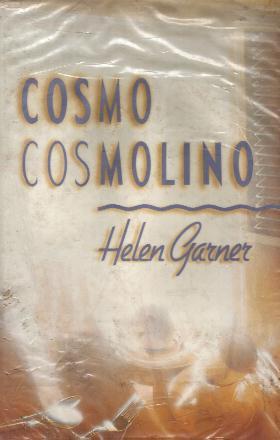
Cosmo Cosmolino Helen Garner |
Dustjacket synopsis:
"Have you ever wished that someone you loved would die? So that the record of all your crimes and failures would be
obliterated?
"The big communal households of the seventies collapsed years ago. Lovers have died. Friends have quarrelled and parted forever. Children have grown up and gone out into the world.
"Can anything useful be salvaged from such a history? Janet retreats to her run-down house and labours at forgetting the past. Ray hides from it in the pages of his gold-edged book, and waits for his more worldly brother to reconnect him to life. But Maxine, urgent, batty, ecstatic about auras and angels, comes crashing on to the territory of their regrets. In her crazy innocence she bursts the barricade that separates dream from reality, and hacks a path for all of them, into the future.
"A stunning new book by Helen Garner."
First Paragraph:
Soon after the collapse of my last attempt at marriage, when it did not appear to matter much which city I was in, I passed through Sydney and called as always on my old friend Patrick, to tell him, among other things, that my Auntie Dot had died.
'Ah yes,' he said. 'The bottle blonde.'
'I thought you'd like to know,' I said, 'seeing you danced with her at my wedding.'
'And you were fond of her,' stated Patrick.
'Her hairdos,' I said, 'were Wagnerian.'
'Oh, come off it.'
'They were! She had all that hair piled up, and a big smiling mouth, and a great big beautiful bosom.'
'All the things you lack,' said Patrick, pulling out a chair for me. 'What did she die of?'
'The usual,' I said. 'Cancer.'
From the McPhee Gribble hardback edition, 1992.
Notes:
You can read more about Helen Garner here.
|
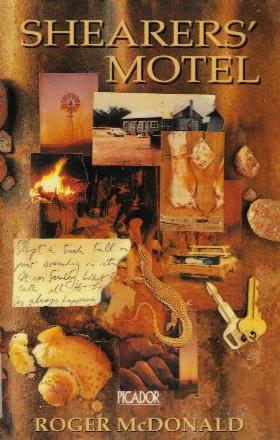
Shearers' Motel Roger McDonald |
Dustjacket synopsis:
"Another shed coming up on the horizon ... a low, wide roof of galvanised iron the only landmark in a million square miles
of flatness and glare.
"Into the hard-living world of travelling shearers in the Australian outback comes acclaimed writer Roger McDonald, driving an old truck rattling with cooking gear. He has abandoned writing for a time and found work as a cook for a team of New Zealand shearers travelling through New South Wales, South Australia and Victoria. He is determined to find a sense of belonging: somehow to join his life with the landscape, the places and the people he meets along the way.
"Shearers' Motel is the record of that quest, of its triumphs and its failures - a story told with a heartfelt sense of the profundity of ordinary lives.
"Written with an insider's affection and familiarity sharpened by an outsider's perception, this moving account of working life in a classic Australian industry gives a new twist to a long tradition of outback travel writing. It confirms Roger McDonald as one of our finest and most lyrical chroniclers of the land."
Quotes:
"Roger McDonald uses language with the precision of a diamond cutter." - US Publishers Weekly
First Paragraph
He wanted to say no to melons like Bertram Junior had. He wanted to lie all day on a mattress, chin on his hands like Louella. He wanted to be hard like Lenny, drinking everyone under the table and still be pulling another West End from the fridge when the breakfast bell rang. He wanted to name who liked work, and who was afraid of work. He wanted to give Betty the lowdown on unions, and withstand the glare of her husband, who only needed to shift sideways to crush him.
He wanted to be a nondrinker and a Christian. He wanted to sit on his throne of clouds like Harold. He wanted to let go, laugh, and be like a child. He wanted to tip buckets of water on Bradshaw, and walk in at lunch, look around, make that his meal, as Rocco had. Felled by labour, he wanted the solitude of his pride in the smoko room, speaking to no one. He wanted to put coloured beads in his hair like Jules, and wanted to say, 'A man of forty-five should know better'.
At the root of the work-ladder he wanted to be foul as Wade arriving from Charleville, tattered and snarling, beard singed by cigarette ash and full of sandwich crumbs. He wanted his T-shirt moth-eaten by waste. He wanted to declare: 'Write about me, but only write the truth'. He wanted his hopelessness strewn at the feet of mentors, male and female, mother and dad, uncle, cousin, big brother, teacher-substitutes awaiting his betrayal. He wanted to beat them all at chess. He wanted to be taken under the wing of people whose wisdom was a revelation and whose friendship was love, whose exasperation he could badmouth as know-nothingness. He wanted to journey inwards in destruction. He wanted to finish the year hated by all, Christlike in his truculence, ready to throw in the towel. He wanted to break into a stock agent's office, take the typewriters and computers, a load of unsaleable junk in a stolen van, that he would sell to a passer-by, and get what he wanted, be put under arrest, taken care of at last, a sort of paradise, a kind of death.
He wanted rest - to be the cook who could take no more, who served breakfast and shot through, like Hazel who wanted her life to consume her, leaving nothing else, no trace.
He wanted to find his own story.
From the Picador paperback edition, 1992.
Notes:
You can read more about Roger McDonald here.
|
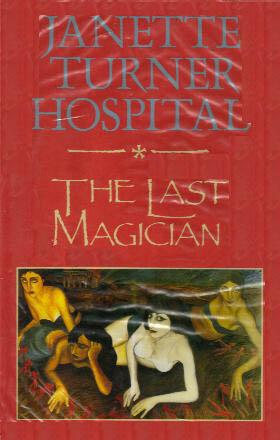
The Last Magician Janette Turner Hospital |
Dustjacket synopsis:
"Cat, Chadie, Robbie and Catherine once shared a childhood summer in a Queensland rainforest.
But a death intruded on their charmed circle, binding them to complicity and silence.
"Decades later the past continues to fester. Memories leach through to the present, in the same way as the desperate underside of a corrupt Sydney breaks through into tidy lives and well-kept streets. Charlie, the Chinese-Australian photographer, is the last magician. It is he who monitors and records everything, who seeks the silent Cat through physical and emotional infernos.
"With its startling and seamless conjunctions of the erudite and demotic, this dazzling novel is richly textured and intellectually challenging, a tour de force from our most elegantly seductive writer."
Quotes:
"Her prose crackles with energy and imaginative excitement." - Ron Loewinsohn, New York Times Book Review
"This is one author who was a class act right from the start, with prose and plot line as strong and sinuous as a jungle
vine." - Kate Veitch, Sydney Morning Herald
"There is an extraordinary intelligence at work here." - Eileen Barrett, San Francisco Chronicle
"Hospital . . . is a masterly stylist, accomplishing intellectual complexity and mimetic
sensuality with dazzling ease. [Her writing] is pungent with anger, telling, with bitterly precise insights of experienced
suffering, what it is like to be alive today ... What makes Janette Turner Hospital much more than an
angry young stylist, however, is the dimension of her vision, which looks past anger towards a difficult compassion." -
Alison Croggon, Melbourne Sunday Herald
First Paragraph
In the middle of the journey, I came to myself in a dark wood where the straight way was lost.
No. That is not the way to put it. In the middle of darkness, I came to the black fact that there was no straight way - no way on, no way out. This knowledge engulfed me, a thick sack over the head. Suffocation was the least of it.
Ah, how hard a thing it is to tell of that wood.
Do you see the two boulders where the rapids make a sort of courteous ruffle of detour? That was where the bones were found. They were wedged deep down, pushed, prodded under the rocks with the blunt end of something far more complex and disturbing than hate, and they might have been missed for another ten years.
But I mustn't think of that now. I cannot start there.
The wood is dark, and full of the soft rot and manic growth we call rainforest. The rainforest has always spawned secrets. Light itself is clandestine here. Under the matted canopy the sun becomes furtive, it flickers, it advances by stealth, it hides, it is coy, it sneaks down through the tangle of treetops, creepers, leggy bird's-nest ferns, lianas, orchids, battling its way earthwards through layers of aerial clamour, slithering below ground fungi to breed green yeast. The rainforest smells of seduction and fermentation and death. It smells of Queensland.
From the UQP hardback edition, 1992.
Notes:
You can read more about Janette Turner Hospital here.
This page and its contents are copyright © 2006 by Perry Middlemiss, Melbourne, Victoria, Australia.
Last modified: January 26, 2006.