Tim Winton
The following novels constitute the shortlist for the 1992 Miles Franklin Award:
|
|
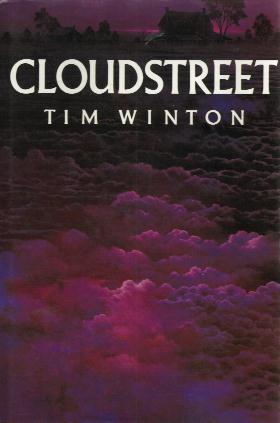
Cloudstreet Tim Winton |
Dustjacket synopsis:
"Cloudstreet a broken down house of former glories on the wrong side of the tracks, a
place teeming with memories of its own, a place of shudders, shadows and spirits.
"From separate catastrophes, two rural families flee to the city and find themselves sharing this great breathing, sighing, muttering structure and begin their lives again from scratch.
"There are the industrious Lambs, who wait and wait on the God of Miracles who seems to have foresaken them, and the gambling Pickleses, who prefer to deal with the mysteries of Lady Luck and her henchmen. Both aghast at the fates which have delivered them to Cloudstreet, and the baffling realisation that they will always remain there.
"Together they roister and rankle in a divided house that begins as a roof over their heads and becomes a home for their hearts.
"In this fresh, funny novel, full of wonder and dreams, brilliant young Australian author, Tim Winton, weaves the threads of lifetimes, of 20 years of shouting and fighting, laughing and grafting, into a story about acceptance and belonging."
Quotes:
"It is, I suspect, a masterpiece" - Veronica Brady, West Australian
"Nothing short of magnificent...a wonderful read" - Andrew Yule, Time Out
First Paragraph
Will you look at us by the river! The whole restless mob of us on spread blankets in the dreamy briny sunshine skylarking and chiacking about for one day, one clear, clean, sweet day in a good world in the midst of our living. Yachts run before an unfelt gust with bagnecked pelicans riding above them, the city their twitching backdrop, all blocks and points of mirror light down to the water's edge.
Twenty years, they all say, sprawling and drinking. There's ginger beer, staggerjuice and hot flasks of tea. There pasties, a ham, chickenlegs and a basket of oranges, potato salad and dried figs. There are things spilling from jars and bags.
The speech is silenced by a meodious belch which gets big applause. Someone blurts on a baby's belly and a song strikes up. Unless you knew, you'd think they were a whole group, an earthly vision. Because, look, even the missing are there, the gone and taken are with them in the shade pools of the peppermints by the beautiful, the beautiful the river. And even now, one of the here is leaving.
From the Picador hardback edition, 1991.
Notes:
You can read more about Tim Winton here.
|
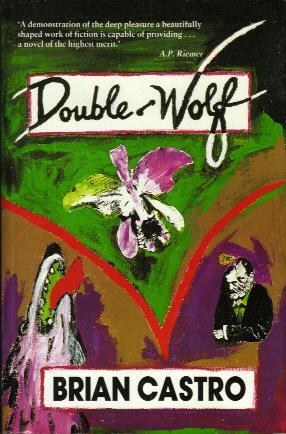
Double Wolf Brian Castro |
Dustjacket synopsis:
"Double-Wolf, Brian Castro's third novel, is a brilliant fictional creation whihc succeeds also in being humane,
utterly readable and sometimes very funny.
"It takes as its starting point the life of Wolf-Man, Freud's most famous patient who inspired his work on infant sexuality, a life revealed in counterpoint to that of Artie Catacomb, con-man, psychoanalyst and archivist, who ends his days in the Blue Mountains, relegating the Wolf-Man to the world of myth even as he avoids the baleful glare of the shop assistant who would prevent him from entirely reconstructing the Wolf-Man's story."
Quotes:
"A demonstration of the deep pleasure a beautifully shaped work of fiction is capable of providing...a novel of the
highest merit." - A. P. Riemer
First Paragraph
KATOOMA
Winter, 1978
A misty rain is falling.
It smears the glass like somebody's spit. Somebody talking too loud, too fast.
It is cold, but not cold enough. Not yet. In the late afternoon when it is almost dark there will be rumours of snow. Perhaps one of the last snowfalls here for all time. The eucalypts brood in the chasms, as black as the shelf of rocks worn and wet on the other side. Far better than trying to outrun fires roaring up the gorges in those mad summers. Wet black rocks fired from the bowels of another millenia.
This used to be a coal siding. 'The Crushers' it was called then, subsiding escarpments and waterfalls crushing the breath out of you a thousand metres above sea level on an uplifted plateau outside of Sydney. Nowadays Katoomba is littered with hotels, hospitals, mental institutions.
From the Allen and Unwin paperback edition, 1991.
Notes:
You can read more about Brian Castro here.
|
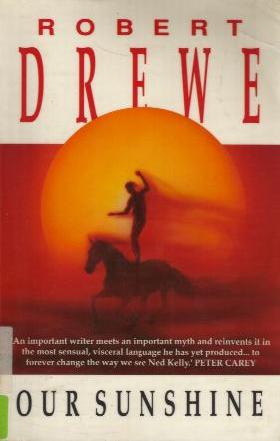
Our Sunshine Robert Drewe |
Dustjacket synopsis:
"Robbing the first bank is like the silkiest good dream. Hovering above myself, watching me do it, hearing this half-
stranger's sharp voice ring out. Me but not me inside, here and there but not entirely here or there. There I am
pointing the bloody gun and giving the orders. Here I am looking into the worst fears realised in those clerkish eyes.
There I aim - hello! - suddenly the man in charge of Death and Money.
"Our Sunshine is the tale of a man whose story outgrew his life. Robert Drewe, whose fiction is acclaimed for holding a mirror to contemporary suburban Australia, has now taken the country's greatest mythological character and created his own imaginary life for him. He presents an unsentimental, compassionate and sensual portrait of the boy and killer who became both the National Hero and the Devil Incarnate of the Antipodes.
"Succeeding in turning myth to funny, savage, commonplace and back again, Drewe portrays Ned Kelly and his adolescent gang both as young Horsemen of the Apocalypse - riding through Fire and Flood, Sex and Death - and as the psychologically displaced victims of the casually brutal human wilderness.
"Drewe not only gets inside the boy and man who thereafter embodied Australians' best and worst perceptions of themselves, but shows the crazy instability of the early days which created the Australian legend. The stunning clarity of his prose carries us into a dreamworld of astonishing and violent revelation, an entrancing and frightening landscape of murder, prejudice, sexuality, persecution, robbery, vanity, religion, greed, politics and corruption ... a world which we must finally recognise as our own."
Quotes:
"An important writer meets an important myth and reinvents it in the most sensual, visceral language he has yet
produced...to forever change the way we see Ned Kelly." - Peter Carey
First Paragraph
The lion is out of sorts. It's probably the smoke more than the human hubbub or the seesawing concertina music making it bark that deep and chilling moan and scrape its ribs along the bars of its wagon. You have to step close to see it - then hold your breath and heart still. Against every instinct, press your face up to the bars and peer into the ferocious meaty shadows. The bars are chipped and jungle-coloured, far too fragile-looking, with damp lion-fluff sticking to them. Balls of dusty lion-moult drift over the floor, too, among the odd bullock shin and lion dropping, and the lion pads through this muck with a fierce thin-hipped precision. Controlled panic. It hacks its moaning cough, it paces, it rubs its skin raw, but its paws never touch bone or turd.
From the pub's verandah he can catch a glimpse of the lion each time they throw another branch on the bonfire.
Now its tension has spread to the camel and four circus ponies. And to Mirth, dear Mirth, twitching and stamping on her tether in the saplings behind the inn. A mangy old lion, but not often seen in these parts-rare enough to keep Jane jones giggling at the idea of it all the way through their polka. Giggling, and prodding him to see if he's real. Pulling his beard.
From the Picador paperback edition, 1991.
Notes:
You can read more about Robert Drewe here.
|
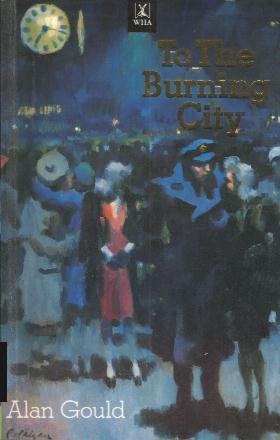
To the Burning City Alan Gould |
Dustjacket synopsis:
To the Burning City is an absorbing drama that tells of the bewildering relationship between two half-brothers,
Jeb and Len, and their involvement with the past; with Len's father, Crispin Heagelow, a bomb-aimer in the 1943 Hamburg
raids.
Jeb's early awareness that Len is somehow different from other people's brothers deepens as he grows older. Gradually he comes to see Len as one of the hidden, terrible casualties of war. But what of himself?
Set in England, Germany and Australia over a forty-year period, this is a passionate and emotionally powerful novel of family ties and filial relationships.
First Paragraph:
You can remember. he thought, a place or a time being full of light, yet it can feel dark.
He woke and found himself staring past the white mound of his pillow toward the window. Somewhere he could hear a cuckoo. His eyes were watering, as they sometimes did when he first awoke, so he remained still, allowing a droplet to form at the corner of his eye and roll onto his cheek. Then he turned his head and allowed it to flow back floodingly into the eye. The sensation was mildly enjoyable. He was hungry, particularly so, even though he had become used to the vague sensation in his tummy that he had never eaten quite as much as he wanted. But he also had a sense of joyful anticipation, all the more delicious for not being able to remember immediately what it was that was due to happen today.
The other boys appeared to be still asleep, though the sun was streaming almost horizontally through the dormitory's one tall window, and making the crisscrossing of the stickytape shine with a yellow translucency. The stickytape, Len knew, was in case of bombs.
From the William Heinemann Australia paperback edition, 1991.
About the author:
Alan Gould was born in London in 1949 of English-Icelandic parents and lived on Armed Forces camps
in England, Northern Ireland, Germany and Singapore before coming to Australia in 1966. He holds an Arts
degree from The Australian National University and has worked in various short term positions including
nuclear physics technician and agricultural labourer. Since 1975 he has written poetry and fiction as fulltime
as resources allow, augmenting his income with literary journalism and relief teaching. Of his five
volumes of poetry, the second, Astral Sea, won the 1981 NSW Premier's Prize for Poetry, while his first
novel, The Man Who Stayed Below, received the Foundation of Australian Studies Award for Best Book
of the Year in 1985. His most recent books have been a collection of novellas, The Enduring Disguises, and
a volume of poetry, Years Found In Likeness.
|
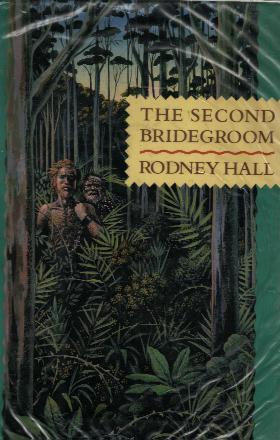
The Second Bridegroom Rodney Hall |
Dustjacket synopsis:
"Hauntingly lyrical and visually stunning, The Second Bridegroom is the spellbinding tale of one man's exile -
from family, country, and religion. Set in the early nineteenth century, it tells the story of a young convict
transported to Australia, where he escapes into the bush and becomes the centre of a ceremonial journey which he has no
means of understanding.
"In exquisitely crafted prose, Hall subtly - sometimes ironically - explores the boundaries of art and illusion, magic and religion, innocence and guilt, savagery and civilization.
"The first novel in a trilogy that concludes with Captivity Captive, The Second Bridegroom is a work of mythic resonance - intensely magical and shimmering with insight. It will confirm Miles Franklin Award winner Rodney Hall's stature as one of our most inspired contemporary writers."
First Paragraph
I must face the fact that you will have forgotten who I am. So if you have the patience I shall tell you. And for my part, of course, I must at last get to know you too.
I am near-sighted. My impressions of you have been those of a man who sees no details at a distance. I am given little enough to go on at the best of times. I see a blurred world of large simple shapes; as with my first view of the new land we reached at the end of our voyage south from Sydney. Looking back on it, I try to guess how this wilderness might have appeared to you.
Let me call the scene to mind. Sunshine blazes across a sea so amazing calm we hold our breath. We are in an untouched place. Stunned by sheer light-by the glare of bleached sand and the brilliant sea breaking as a white crust - I peer into the water but I don't like to mention what I think I see down there. Surely those with long sight could not fail to notice? The water is clear as air. We all look. No one speaks. Yet I would swear I can make out a sunken ship, a brig like our own or a barque. Squinting to get it more definite, I see masts and spars. Also a hull wedged among undersea rocks. Who has been here before us? What hopes are already drowned? Wind ruffles the light and the wreck is gone. Still no one speaks. They look. And I look. I glimpse a mast again and a crow's-nest. Yet they are the ones who can see - and I only think I can see. But how vivid this ocean is, with a lick of satin parallel to the coast a quarter of a mile out, like a wake and yet too broad to be left by any vessel: it is as if our whole future had already come, swept past, and gone before we even arrived. Meanwhile the past has been scuttled. A slight swell lifts that sleek ribbon and passes beneath without breaking it, like a muscle under skin. A minute later, when the swell reaches us, riding here at anchor, we rise to its gentle authority. We also subside.
From the McPhee Gribble hardback edition, 1991.
Notes:
You can read more about Rodney Hall here.
This page and its contents are copyright © 2006 by Perry Middlemiss, Melbourne, Victoria, Australia.
Last modified: December 26, 2006.