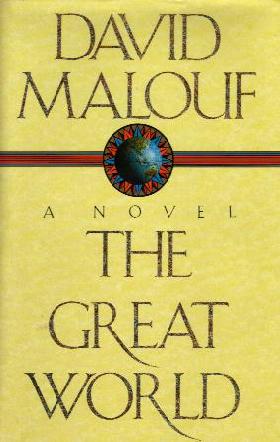
David Malouf
The following novels constitute the shortlist for the 1991 Miles Franklin Award:
|
|
The Great World David Malouf |
Dustjacket synopsis:
"Every city, town and village has its memorial to war. Nowhere are these monuments more
eloquent than in Australia, generations of whose young men have enlisted to fight other
people's battles - from Gallipoli and the Somme to Malaya and Vietnam. In The Great World,
his finest novel yet, David Malouf gives a voice to that experience.
"For the two very different men at the centre of this book, war was supposed to be a soldierly theatre, a testing-ground of virtues too obvious to name. Instead, it was to prove an ordeal of an entirely different kind, laying bare the painful reality which lies behind a nation's myth of itself.
"But The Great World is more than a novel of war. Ranging over seventy years of Australian life, from Sydney's teeming King's Cross to the tranquil backwaters of the Hawkesbury River, it is remarkable novel of self-knowledge and lost innocence, of survival and witness. It is destined to become a classic."
Quotes:
"A thrilling and a moving novel - epic in its grasp of a 'great world' of military force and
economic ambition, lyrical in its sympathy with the small private worlds of dream and desire
inside that grand scheme. Malouf understands the complexity of simple people and the 'little
sacraments of daily existence' better than anyone since Patrick White in The Tree of
Man - and there's no higher praise than that." - Peter Conrad
First Paragraph:
People are not always kind, but the kind thing to say of Jenny was that she was simple.
Children whose mothers were cooking and found they were short of something, breadcrumbs or a kilo of flour, would set up a wail at the thought of having to go down to Keen's and fetch it. 'Aw no, mum! Why me? It's Brett's turn. Make Brett do it!'
It wasn't the walk they objected to, though it was far enough, down the hill and off the main road to the river, or even the interruption to their favourite programme on TV. It was the odd feeling you got when you stood on the doorstep with the bead curtain still clattering behind you and saw the old woman half-sprawled on the counter there, breathing like a big fish that had just been hauled out of the river and stranded. Sometimes she was asleep. You would have to poke a finger into the wool of her cardigan and she would start up and look around in a wild sort of way, then, when she saw that she knew you, gave a wet smile.
But simple was the wrong word for her, or so smaller kids thought, because the real thing about Jenny, as she flopped about with her thick arms and shuffly slippers, was that she was likely to say things and do things too, that you weren't expecting and could make neither head nor tail of.
From the Chatto & Windus hardback edition, 1990.
Notes:
This novel won the 1991 Commonwealth Writers Prize and the Prix Fémina Etranger in 1991.
You can read more about David Malouf here.
|
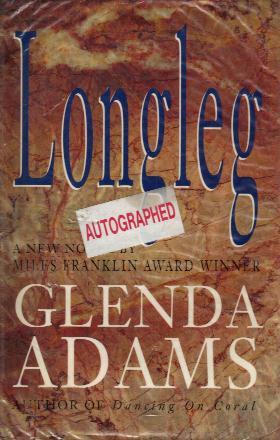
Longleg Glenda Adams |
Dustjacket synopsis
"It took William Badger some time to understand that he was going to be left behind, deliberately abandoned, what seemed
like a thousand miles from home. His mother had simply asked if he would like a nice seaside holiday, and he had said yes.
"When William Badger is ten years old his mother Rose takes him to a boarding house in Manly - Seven Miles from Sydney, and a Thousand Miles from Care. Left there, abandoned by the glorious Rose, who once danced and twirled on her little pointy shoes, William sits in the hedge and waits for her return. But the Rose he longs for never returns; the mother sho comes back is much too angry to twirl.
"The only clue William has to this bewildering change is the name on a document he sees in the dining room sideboard: Longleg, the perfect name for an imaginery friend, or an alter ego...
"In this imaginative Tour de force, Miles Franklin award winner Gelnda Adams explores with tenderness and grace the life of a man who seems destined to find his mother in all other women."
Quotes:
"There is no other Australian novelist writing at present with such a finely judged mixture of zany wit and
unforced wisdom, with such a control of character and material, such urbanity and exuberance." - Barbara Jeffries,
The Australian
First Paragraph
It took William Badger some time to understand that he was going to be left behind, deliberately abandoned, what seemed like a thousand miles from home. His mother had simply asked if he would like a nice seaside holiday, and he had said yes.
His father was in the corner of the kitchen at the time, his back to William, mixing stale bread and raisins and milk, making something they called heavy (because it was indeed very heavy), which they pretended was real cake. William was eating his Vita Brits, Vita British he secretly called them, British submarines surfacing through the milk, so that when he swallowed them he felt he was acquiring strength, the steel and the courage of the navy at war with the enemy, even though the war had been won several years before.
William was still searching for an appropriate name for his inseparable companion and best mate. Dash, perhaps. William Dash. Billy Dash. They would share the same first name. Williams Badger and Dash.
Rose Badger pulled out a chair and sat opposite William, her elbows on the table, her chin in her hands. 'Wouldn't that be simply super? A lovely, delicious, adorable exquisite seaside holiday?'
William looked carefully at his yellow-haired mother, the youngest, loveliest mother in the world, then over at his father, at the counter next to the sink, a tea towel tucked into his trousers as an apron, the oldest father in the world, with grey, creased elbows and a back that bent so that the shoulder blades protruded, fin-like, and caused the shirt to fall loosely like the skirt of a dress, down his back, the oldest father with a back now curved over a cracked mixing bowl and hands whose skin looked like old work gloves, squeezing the bread and dried fruit and milk together.
From the Angus & Robertson hardback edition, 1990.
Notes:
You can read more about Glenda Adams here.
|
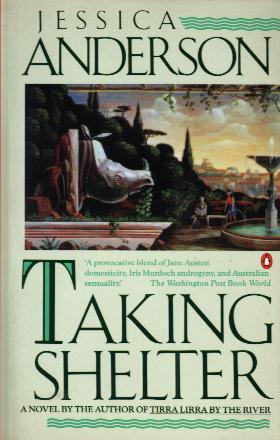
Taking Shelter Jessica Anderson |
Dustjacket synopsis:
"Beth is intrigued by the witty and charming Miles, but perplexed by his reluctance to make
love to her. When she meets Marcus - the very antithesis of Miles - they embark on a passionate
and uneasy relationship. Surrounding Beth are Kyrie, her brash, sexually adventurous cousin;
Nita, Marcus's mother, mourning the defection of her man; and Juliet, who continually ponders
her own dreams while making everyone else's come true.
"Here are people drawn together in their tentative quests for permanence, tenderness and love in an era when there are no rules about the age, gender, or faithfulness of lovers. Their story is told with the keen perception, the wit, and emotional honesty that characterise all of Jessica Anderson's work."
Quotes:
"A provocative blend of Jane Austen domesticity, Iris Murdoch androgyny, and Australian
sensuality." - The Washington Post Book World
"Taking Shelter is a challenging book, bold, sensitive and uncompromising..." -
Rosemary Sorensen, The Age
"Style and savvy characterise Jessica Anderson's writing. In a novel about and across the
generations Taking Shelter has our attention from page one." - Janet
Chimonyo, Australian Bookseller and Publisher
First Paragraph:
'Scraps,' said Juliet McCracken. 'Debris from the day before.'
'Oh, I don't know,' said Miles, lazy on one of Juliet's sofas, stretched out straight from his propped head to his propped feet.
Beth said, 'Mine just melt away.'
'You have to be quick-quick,' said Juliet, 'and capture them.'
'Capture debris?' asked Miles, his top lip curling from his teeth, as it did when poised for laughter.'
'To show it up for what it is,' said Juliet. 'I wrote all mine down for a while. In an old notebook. At Cable House. Before they fixed the reception.'
'Some research supports Juliet,' said Beth. In one of her little spasms, she twisted an ankle round the leg of her chair. Miles glanced at it. She untwisted it and said, 'According to these people, while we sleep, our brain processes the experiences of the day. It stores some, maybe for future use, and dumps the rest.'
From the Penguin paperback edition, 1989.
Notes:
You can read more about Jessica Anderson here.

|
Reaching Tin River Thea Astley |
Dustjacket synopsis:
"Belle's mother was a drummer in an all-women's group before she turned vegetarian and went to live in a shack in the
hills. Her father was a trumpeter Belle met for the first time in a Manhattan jazz bar. She had a husband too, briefly -
an upwardly mobile deputy librarian searching for the perfect sauce. Belle even had a best friend once, whose
ebullience was finally subdued in vermouth and leather sofas.
"Their selves were their centres, and Belle realised she'd have to research much further to find her own. If it were not in the music of memory, perhaps she'd find it in the backblocks, where her blow-up sepia dream lover might be conjured out of the past into the ugly circumference of her present.
"Perhaps at Tin River?"
First Paragraph:
I am looking for a one-storey town
with trees
river
hills
and a population of under two thousand
one of whome must be called Gaden Lockyer.
Or
Mother was a drummer in her own all-women group, a throbbr of a ladt with midlife zest and an off-centre smile.
Or
I have decided to make a list of all the convent girls who leanrt to play 'The Rustle of Spring' by Christian Sinding between 1945 and 1960.
From the William Heinemann hardback edition, 1990.
Notes:
You can read more about Thea Astley here.
|
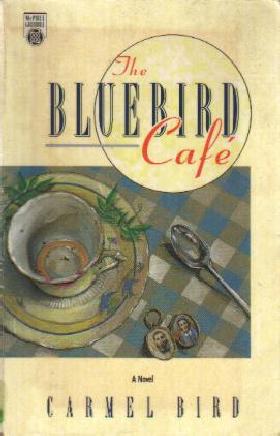
The Bluebird Café Carmel Bird |
Dustjacket synopsis:
"The Bluebird Café steps into the Tasmanian wilderness. Do vestiges of lost tribes and species flicker in the
horizontal forest? Does the forest itself suck small children in and swallow them forever? What happened to Lovelygod,
the daughter of Carillo and Bedrock Mean?"
First Paragraph:
Cataract Hill
The best way to get a good view of the Historic Museum Village of Copperfield is to hire a Fly-By-Nite helicopter. From the night sky you see that Copperfield is covered by a gigantic glass dome through which shine the millions of lights that line the edges and decorate the surfaces of the buildings. People who have seen an oil refinery at night nearly always say Coppeffield looks like an oil refinery trapped under glass. Or is that plastic, they say. It must be plastic. They see a monstrous dome, like a snow dome in which the models of people have come to life and where trees and flowers really grow. The surface of the dome is cleaned inside and out every morning by a system of detergent jets and hot-water hoses and fans. The ventilation system of the dome has been described as the ultimate miracle of modern engineering.
Coppeffield is on top of Cataract Hill which overlooks the Gorge where the South Esk meets the North Esk to form the Tamar River at the city of Launceston in northern Tasmania. The Gorge is a huge rift between cliffs of black volcanic rock. The sides of the rift are almost vertical, and between them, four hundred feet below, the water froths across a barrier of rock, forming a cataract. In former times Cataract Hill was occupied by a suburb called Trevallyn where steep streets wound through a forest of English and Tasmanian trees and where prosperous families lived in large houses made from timber and stone. The timber houses were tall and rambling and decorated with verandahs and fretwork: the stone houses were built from blocks of golden sandstone and resembled Georgian dolls' houses. The suburb of Trevallyn had to be removed to make way for Coppefield.
From the McPhee Gribble paperback edition, 1990.
Notes:
You can read more about Carmel Bird here.
|
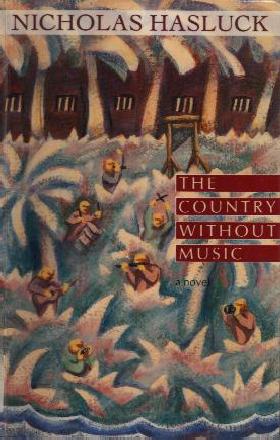
The Country Without Music Nicholas Hasluck |
Dustjacket synopsis:
"The bone flute she wore at her neck.
"He touched the crescent-shaped curio. 'You are Ilois,' he siad. It was the first time she had ever heard him use the word. 'You are Ilois.'
"The islands once known as the strangest penal colonies on earth are now seething with discontent; and Jacqueline Villiers, caught at the centre of the turmoil, is torn between her uncle's determiation to stay in power and the attraction of her Ilios friends.
"Who was the adminstrator's neice? And what was the significance of the bone flute?
"In his compelling new novel, Nicholas Hasluck reveals how half-truths and deceptions can lead to a country bedevilled by its past - a country without music."
First Paragraph
My uncle used to play a game with important people from the mainland. After they had finished their business, he took them for a drive around the island and the last stop on the tour was always a visit to the old gaol. 'This may be of interest to you,' he would say, as though the thought had just popped into his head. He brought the car to a halt by touching the driver's sleeve, the same finger pointing to a thicket of flax plants and pampas grass.
The site forms part of a housing estate for the Ilois now, but at that time, a season when I was still supposed to be my uncle's dutiful niece, a fresh young face to brighten up the touring party (which is what he always said when he dragged me along to meet the visitors), the gaol was little more than a dead end near the bus depot - ruins dismembered by trees and vines and tropical undergrowth. The roofless cell-blocks looked like the last place on earth to be of interest to anyone. Tant pis! But appearances didn't matter much at that stage of the game, I suppose, since it was almost impossible to pick out what exactly my uncle was pointing at.
From the Viking paperback edition, 1990.
Notes:
You can read more about Nicholas Hasluck here.
This page and its contents are copyright © 2006 by Perry Middlemiss, Melbourne, Victoria, Australia.
Last modified: January 26, 2006.