Peter Carey
The following novels constitute the shortlist for the 1989 Miles Franklin Award:
|
|
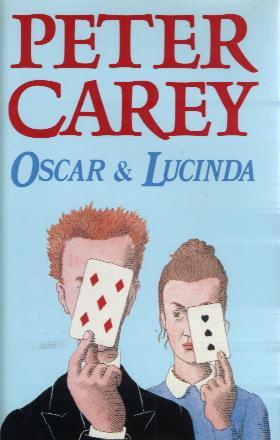
Oscar and Lucinda Peter Carey |
Dustjacket Synopsis:
"Peter Carey's eargerly awaited new novel imagines Australia's youth, before its dynamic passions became dangerous habits. It is also a startling and unusual love story.
"Oscar is a young English clergyman who has broken with his past and developed a disturbing talent for gambling. A country girl of singular ambition, Lucinda moves to Sydney, driven by dreams of self-reliance and the building of an industrial Utopia. Together this unlikely pair create and are created by the spectacle of mid-nineteenth century Australia.
"Peter Carey's visionary brilliance, and his capacity to delight and surprise, propel this story to its stunning conclusion."
Quotes:
"Luminous and magical, Oscar and Lucinda dances with a shimmer of light and dark as
its two noble gamblers play out dreams of God and glass. A spectacular achievement." - Helen Daniel
"Oscar and Lucinda are two of the most perfectly realised characters in modern fiction. An
immensely skilful and absorbing juxtaposition of a gently comic, obliquely ironic, and
deeply compassionate vision of human existence." - David Williamson
"The most audacious and rewarding of all Carey's novels." - Geoffrey Dutton
"Peter Carey is a complete writer. He has all the skills, and knows all the tricks. He can combine a genius for stark,
under-stated comedy, with a nearly Dickensian generosity of description; the result is that hardly a character passes
through this novel without Carey enlightening us to the peculiarities of physiognomy, psychology and personal history
that establish that character's unique and lasting patent over a portion of the reader's memory." - Aravind Adiga,
Second Circle
First Paragraph:
If there was a bishop, my mother would have him to tea. She would sit him, not where you would imagine, not at the head of the big oval table, but in the middle of the long side, where, with his back to the view of the Bellinger River, he might gaze at the wall which held the sacred glass dageurreotype of my great-grandfather, the Reverend Oscar Hopkins (1841-66).
These bishops were, for the most part, bishops of Grafton. Once there was a bishop of Wollongong, travelling through. There was also a canon, and various other visiting or relieving reverends. Sometimes they were short-sighted or inattentive and had to have the dageurreotype handed to them across the table. My mother crooked her finger as she picked up her tea-cup. She would not tell the bishops that my great-grandfather's dog-collar was an act of rebellion. They would look at a Victorian clergyman. They would see the ramrod back, the tight lips, the pinched nose, the long stretched neck and never once, you can bet, guess, that this was caused by Oscar Hopkins holding his breath, trying to stay still for two minutes when normally - what a fidgeter - he could not manage a tenth of a second without scratching his ankle or crossing his leg.
From the UQP hardback edition, 1988.
Notes:
You can read more about Peter Carey here.
Oscar and Lucinda won the 1988 Booker Prize,
and the National Book Council's Banjo Award for 1989.
Brown University in the USA has an extensive
site
dedicated to the novel.
In 1997 Oscar and Lucinda was adapted for film with a script by Laura Jones.
The film was directed by Gillian Armstrong and featured Ralph Fiennes and Cate Blanchett.
|
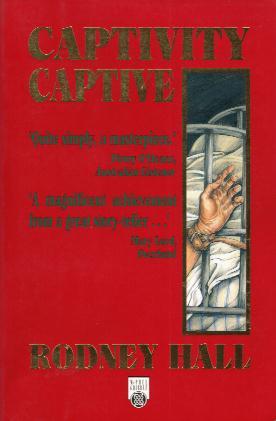
Captivity Captive Rodney Hall |
Dustjacket synopsis:
"Two sisters and a brother are found bludgeoned and shot to death in a paddock in 1898. The case is never solved - until
Patrick Malone, more than half a century later, decides the time has come to sift the truth from the lies.
"What rises up to haunt us is a huge tribe of a family turned in upon itself, locked in its ignorance of anything else.
"This is a deeply disturbing novel with all the tension of a thriller - about the dark side of the lives and memories of pioneers who carved small farms from the ancient Australian forest."
Quotes:
"Quite simply, a masterpiece." - Dinny O'Hearn, Australian Listener
"A magnificent achievement from a great story-teller..." - Mary Lord, Overland
"Wise...wonderful...harrowing...brave...beautiful. This is a book that makes demands on the reader's soul." - New
York Times Book Review
"...a brilliant psychological investigation." - Age
First Paragraph
There were crows in his eyes when he came right out with it, confessing that he had been the murderer. You could see them flapping in there. And now and again the glint of a beak. You can't tell me anything about crows I don't already know at eighty. Nor about him, either.
It's no good saying, like Norah used to, that I'm the one who always lets his imagination run riot. You ought to have seen the hungry fluttering in that look of his, those scavengers working away at the rotten flesh of corpses long dead and mostly forgotten.
Poor old bloke, the dill. Dismal is what you'd call him. Dismal the whole of his life. I can be sure of this because I knew him for all but the first couple of years of it.
From the McPhee Gribble paperback edition, 1989.
Notes:
You can read more about Rodney Hall here.
|
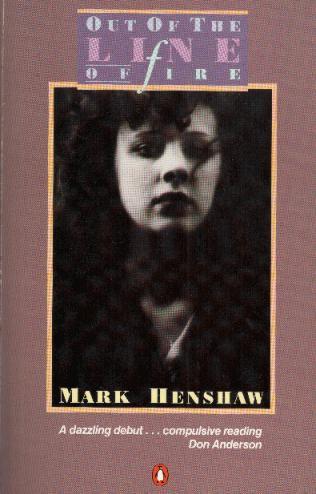
Out of the Line of Fire Mark Henshaw |
Dustjacket synopsis:
"To an Australian writer visiting Heidelberg, the brilliant young philosophy student Wolfi is a compelling character. From the start, the details of Wolfi's life are curious - from his inquisitorial father and passionate mother to the grandmother who pays for his sexual initiation with a prostitute and to his connections with the outlandish rogue Karl.
"As we are lured by Wolfi's obsession into the mysterious and erotic maze of this novel, we find nothing is as it appears.
"What in fact is fact and what in fiction is fiction?"
Quotes:
"A dazzling debut. A tour de force. This book is imaginative, virtuosic, and awesomely assured. It is
compulsive reading. One thinks of Walter Abish, Italo Calvino, Peter Handke." - Don Anderson
First Paragraph:
You are about to begin reading Italo Calvino's new novel, If on a winter's night a traveler. These are the words Italo Calvino selected to open his novel If on a winter's night a traveler. Astonishingly he sets them out in the same order. Had Walter Abish chosen the same words he might have begun, after, of course, placing them in alphabetical order: You, Italo Calvino, are a winter's night traveler about to being reading a new novel If. But as yet he has not, and until he does we will have to wait.
In fact Calvino begins his novel: 'Stai per cominciare a leggere il nuovo romanzo Se una notte d'inverno un viggiatore di Italo Calvino.' Thus the original avoids a peculiar problem which arises only in translation - viagiatore' with a single 'g' would simply be wrong.
From the Penguin paperback edition, 1988.
About the Author:
Mark Henshaw was born in 1951 and has been writing fiction for some time. This, however, is his first published work.
|
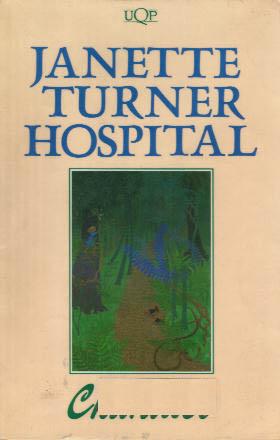
Charades Janette Turner Hospital |
Dustjacket synopsis:
"This stunning and intoxicating novel speaks of passion and obsession, ranging in setting from an Australian rainforest
to Boston and Toronto. A mysterious and elusive love affair haunts the lives of three women in Australia. Twenty years
later, on the other side of the world, Charade Ryan sorts through story and counter-story for her father, the
legendary Nicholas, and the truth about her origins."
Quotes:
"Janette Turner Hospital goes from strength to literary strength - ever brilliant in ideas, graceful in expression,
resourceful in story - and in Charades throwing in, for good measure, a heady eroticism. I loved it!" - Fay
Weldon
"Vividly imagined . . . keeps the reader in thrall." - David Lodge
". . . delicious comic scenes . . . sexual encounters, moments of high drama, of suspense, of pathos . . . everything
the most hard-to-please reader of novels could wish for." - Mary Lord, Overland
"Charades is an accomplished novel - written with wit and high-spirited intelligence." - Peter Pierce, Herald
First Paragraph
The grand unified theories, Koenig writes, are difficult to verify experimentally. Nevertheless, they illuminate our understanding of elementary-particle interactions so elegantly that many physicists find them extremely attractive.
"What an extraordinary sentence," she says.
He is deeply startled and spins full circle, almost pitching his desk chair off its base and virtually colliding with her. "Good God!" he says. "How-?"
"So elegantly." The girl brings her hands together in an odd gesture of wonder. A mass of hair, which is fair and unruly though tamed into a single thick braid, falls over one shoulder. Her eyes are a curious colour, a kind of borderline blue, intense; or perhaps (it is the middle of the night, and the desk lamp casts odd shadows) a sort of sea-green.
"So elegantly," she repeats, opening her hands, looking at them as if the words, mysterious and glittering, were cradled there. Her smile is speculative, dry, possibly mocking. "Elegance as scientific methodology?"
From the UQP paperback edition, 1991.
Notes:
You can read more about Janette Turner Hospital here.
|
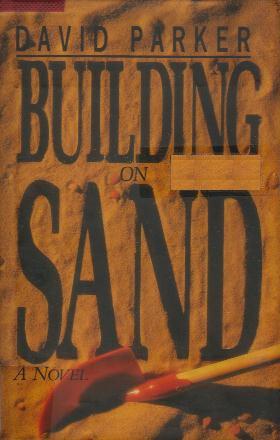
Building on Sand David Parker |
Dustjacket synopsis:
"Can Jude Watson discover the truth about himself. Mysteriously abandoned by his mother at an early age, torn between his loyalties to a nostalgic, Victorian grandfather and to a warm, Irish-Catholic grandmother, and completely captivated by the adolescent capers of his heroic footballer uncle, the young Jude is forced to create many names for himself before he is able to carve his own place in the uncertain, adult world.
"Jude Rowe-Jones, St Jude Hope of the Hopeless, JRJ the dashing naval officer, Judd the failed schoolboy-poet, Judah the biblical lion ... The names accumulate, but a question constantly echoes behind all these facades and all through Jude's life: "Who the hell are you?"
"His world is the growing city of Adelaide in the nineteen-fifties. It's postwar Australia, new waves of European migration, the advent of American pop culture with souped-up FJ Holdens, rock-and-roll beach parties and teenage jiving at the drive-in ... It is a world that is rapidly changing, very much like the shifting sand that Jude played in as a child. Will he discover, among his intense memories of the place where he once lived, his true identity?
"Building On Sand is a moving, gripping tale of childhood betrayals and fantasies. Full of humour, irony and pathos, it is also a powerful and vivid depiction of an entire era."
First Paragraph:
The house was built on sand. When the winds blew straight in oil the sea, as they did all winter, rocking and buffeting the house like a ship, and rain thrashed against the window-panes, and the sea thudded all night against the Esplanade wall, and the back paddocks flooded, my grandfather lay awake awaiting the fate of the foolish man in the Bible and dreamed of his bunker. He would dig deep into the lea-side of the hill, prop it up with railway-sleepers, then bring in rocks for the foundations, setting the whole thing in concrete two-foot thick. It would be solid, solid as a rock. And he would sleep all night.
As it was I would wake up to the striking of a match in the dark, catch for a moment the weathered face, the scarf and tweed cap he wore day and night in winter. Then the tiny coal of his pipe would glow, a small warming fire in the midst of the tempest, as he sucked, sucked, into the small hours and dug back through all the rain-bitten winters of his grown-up life, two Depressions and two world wars, back to the Old Days, to his childhood, the days of the horse and trap, when his family lived in a vast house set on the firm rocks of enterprise, uprightness, and reputation.
Edward was a talker. I often asked him about these Old Days, and he would make them come to life like Aladdin's wishes out of the smoke that twisted in endless ethereal skeins about his head.
When he told his stories he was no longer worried, and so I didn't have to worry either. In the mornings, at the distant drumming sound of cold water going into the kettle, we settled back and pulled up our bedclothes, warm in a world of known beginnings and known ends.
From the Angus and Robertson hardback edition, 1988.
This page and its contents are copyright © 2006 by Perry Middlemiss, Melbourne, Victoria, Australia.
Last modified: January 26, 2006.