Glenda Adams
The following novels constitute the shortlist for the 1987 Miles Franklin Award:
|
|
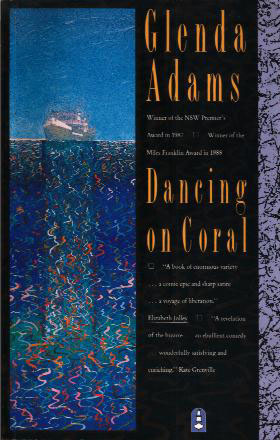
Dancing on Coral Glenda Adams |
Quotes:
"A book of enormous variety...a comic epic and sharp satire...a voyage of liberation." - Elizabeth Jolley
"A revelation of the bizarre...an ebullient comedy...wonderfully satisfying and enriching." - Kate Grenville
"There is no other Australian novelist writing at present with such a finely judged mixture of zany wit and unforced
wisdom, with such a control of character and material, such urbanity and exuberance...Dancing on Coral is witty,
wry and extraordinarily evocative of the mental muddles of the 1960s. The book's undeniable brilliance stems from a
number of things - the sophistication of its approach combined with the directness of its telling; the strength and
awfulness of its characters; the sheer obliqueness of angle between understanding and actions; the continual teasing
references to island, to birds, to boxes and to bodies adrift on coral or on ice..." - Barbara Jefferis, The Australian
"Dancing on Coral is a deeply political novel...a very funny one...intricate, subtle, resonant, comic...This
is a novel to be savoured like a fine, mature, complex wine." - Don Anderson, Times on Sunday
"...wickedly funny. The intellectual conversations, dialogues, diatribes...are excellent parody...The pleasures of this
book are in the multiplicity and complexity of its episodes..." - Marion Halligan, The Canberra Times
"This is a lovely book - supple and reflexive...Nothing here is wasted - references recur and build on each other, ideas
interlock and enrich, satire slices cleanly to the bone." - Katharine England, The Advertiser
"Glenda Adams has written a wicked and witty novel." - Diane Johnson, The Sydney Morning Herald
First Paragraph
The rooster was crowing, at two in the afternoon, and the cicadas had started up again after their lunchtime quiet.
"It's a case of too much noise," said Henry Watter, the father of Lark. "Far too much noise." He was in the basement working on his project. He thrust the rooster in the small wooden crate that rested under the gum tree within the circle of chicken wire that formed its coop and hammered it shut, the sun glinting on the hammerhead and on the lenses of his metal-rimmed glasses. The Bakers' dog next door started barking. The rooster continued crowing. From farther off came the buzz of a lawnmower.
Lark watched the hammering, then went back to looking through the old seventy-eights and the shetet music stacked near the pianola -- Caruso singing "Vesti la giubba," a silly song called "I Lift Up My finger and I Say Tweet, Tweet," and polonaises and rhapsodies played by Ignaz Friedman. She had already save a hundred pounds, almost enough for a one-way passage to somewhere, Singapore or Ceylon perhaps, and she had arranged for an interview with Qantas to be an air hostess, after her exams. That was one way to get away.
From the Sirius paperback edition, 1988.
Notes:
This novel also won the 1987 NSW Premier's Award.
You can read more about Glenda Adams here.

|
Holden's Performance Murray Bail |
Dustjacket synopsis:
"Holden's Performance is the epic story of the four stages of the life of Holden Shadbolt. In his
matter-of-factness, Holden passes through the Australian landscape, seeing the world around him flicking
by in black and white. Holden develops a reputation for silence and reliability, and for an amazing
photographic memory, making him useful to men of power and women who appear to need protection. His life moves
him from the straight tramlines of Adelaide to the irregularities of Sydney, and on to Canberra, where
the streets form ever-decreasing circles.
"Holden Shadbolt is surrounded by larger-than-life figures: Frank McBee, ebullient ex-corporal, scrap dealer and tycoon; Vern Hartnett, earnest proofreader, provider of a factual diet; the comely usherette next door, teacher of the facts of life; and finally Colonel Light, who beckons Holden to join his team of bodyguards to prime ministers."
Quotes:
"The clotted magnificence of this chortling midden of ratbags, pervs and wastrels does keep you
reading." - Valentine Cunningham, The Observer
"Holden's Performance is a work of dazzling imagination." - Kate Saunders, The Independent
First Paragraph
When the last of the city's trams were removed with their poles and bells and the industrial paraphernalia of lines imposed on the mind's eye, it was as though a great net had been lifted clear of the city, letting in light. The trams had been inflicting all kinds of untold damage, running amok at will. Anyone living there beyond a certain length of time was in danger of becoming marked, ruled by inner grooves.
Day after day, for years on end, the heavy oblong shapes had been lumbering backards and forwards across the field of vision and conversations, or there'd be one travelling away in an absolute straight line, its pole waving, demonstrating the laws of perspective, which is how they entered the souls of generations.
From the Penguin paperback edition, 1988.
Notes:
You can read more about Murray Bail here.
|
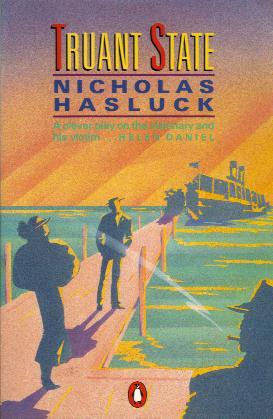
Truant State Nicholas Hasluck |
Dustjacket synopsis:
"To play truant is to reach out, to escape from one world into another, to explore seductive dreamscapes.
"Soon after the Great War the Traverne family abandons England for Australia, but within weeks of their arrival in Perth they meet the man who will change their lives - Romney Guy, political maverick, newspaper entrepreneur, raconteur, mining magnate and charming fraud.
"The hopes, fears and changing fortunes of the Traverne family, and the love affair between Jack Traverne and Diana Guy, are manipulated at every twist and turn by the enigmatic Romney Guy. Until at last, amidst the mounting turmoil of the depression years and the secessionist movement, the Travernes are forced to take a stand.
"By the author of the award-winning novel, The Bellamine Jug, Truant State is a gripping drama, rich with mystery and intrigue, which brings into relief contemporary issues."
Quotes:
"A clever play on the visionary and his victim." - Helen Daniel
First Paragraph
On the Stratford side of Newbold stood a double row of houses which local people called The Wharf.
Most of the cottages in Newbold village had thatched roofs and were built of honey-coloured Cotswold stone. These houses were different. They were red brick. Their windows seemed squarer; harder. The window panes in the afternoon sun gleamed with a flat, metallic light.
The Wharf! I sometimes imagined that, one day, the school bell might ring and we would all rush out to see a huge sailing ship riding at anchor there; or even a brightly painted barge, bowsprit pointing down the weed-infested avenue, ready to chart a course across the fields to Meon Hill.
From the Penguin paperback edition, 1987.
Notes:
You can read more about Nicholas Hasluck here.

|
Bloodfather David Ireland |
Dustjacket synopsis:
"Davis Blood is born on the wooden butcher's table at Bellbird Corner. A precocious child, he asks questions and looks for answers to the mysteries of the world.
"The redoubtable Aunt Mira tricks him with riddles and plays games of verbal illogic and paradox. She speaks of 'being hit over the head with blunt concepts', of 'uninhabited behavious'. Aunt Ursula teaches him rhymes, dignity and a framework for his ideas. Although confined to a wheelchair she opens up many corners of the world for him. His father takes him to the church of the Dissenters, his mother sings her inner song, and all around him the natural landscape, the household dogs and cats provide him with raw material.
"Bloodfather unfolds concentrically, each part revealing another dimension in the development of the young Davis Blood. The novel plumbs the depths of the creative consciousness of the young artist at a turning point."
Quotes:
"The novel is a delight, Davis Blood is a truly memorable character..." - Helen Daniel
First Paragraph:
Midwife Althea Chappell hurried to Legge's Butcher Shop at Bellbird Corner, part of that strange land between city and country called 'outer suburbs'; belonging to neither. She asked for several traditional items to help her deliver the woman lying on the butcher's block, which had been covered with a blanket and some spare aprons. The steel counter was too cold in August.
'It's either very big, or twins.' She said when she felt the abdomen of Lillian Blood, who knew it was twins. She was a good midwife, and liked to be in charge; glad no doctor was present. The mother had collapsed in the shop with her meat order incomplete. After the whole rump and the dogs' meat she gave a terrifyingly loud sneeze, and doubled up with pain. Jim Legge decently put up a Closed sign. It was Wednesday morning.
From the Viking hardback edition, 1987.
Notes:
You can read more about David Ireland here.

|
Home is the Sailor Nancy Phelan |
Dustjacket synopsis:
"'Life in the Blue Mountains is neither city nor country, though country tempo prevails. In this strange world, part-wilderness, part-resort, nature is not yet driven out, there are birds trees, pure air and clear light but man has not beautified his surroundings or worked the stony soil.'
"Set in a Mountain village and written with affectionate warmth and humour, these two novelss illustrate the vulnerability of the elderly and the difficulties facing those who feel responsible for them.
"The eccentric old Commander in 'Home is the Sailor' is happily independent in his own home, inventing bizarre ways of coping with domestic problems, until his daughters' misguided intervention results in calamity.
"In 'The Best of Intentions' the loneliness of Mary Crow's past life is intensified by a fading memory and anxiety about the future. When her gradual decline is accelerated by misfortune, medical ethics become the unwitting agent of prolonging her ordeal.
"What are the choices in old age? To risk independence and a continuation of the self-determination available in the prime of life; or to accept infirmity and hand over personal rights to thse who can provide the safest, most comfortable, if barren care?
"Nancy Phelan portrays the options with deep concern and compassion, yet with ironic humour. There can be few among us who will not be touched in our conscience by these moving stories, which show a rare ability to write from the point of view of the aged rather than the well-wisher. The background of the novellas, the Blue Mountains of New South Wales is vividly conveyed."
First Paragraph:
At the anchorage, Sinbad, the yellow cat, had gone when the Commander woke. Getting out of bed the old man inhaled, exhaled, slapped his chest, rubbed his ribs, took a deep cleansing breath and flung himself forward from the waist, expelling the air in short blasts. He loosened up spine and shoulders with circular movements, stretched arms above head, bent and touched toes several times. After knee and ankle joints had been exercised and arms swung like windmills he ran on the spot for a minute or two, then calmed downed with a few slow breaths.
Barefoot, in flannel pyjamas, he made his way to the kitchen and lit the gas under the saucepan upon the stove. While the water came to the boil he uncovered the corned beef sandwiches made before bed and left between two plates. He stirred the rolled oats that had been soaking all night, threw a half-cupful of tea into the boiling water, added milk, turned the gas down to a simmer and set the porridge upon another jet.
As he worked he thought grimly about his daughters. Margot and Angela! Incapable of understanding! If they had their way they would stop all this and shove in a housekeeper to make his life hell.
From the Hyland House hardback edition, 1987.
Notes:
This novella was published as part of Home is the Sailor and The Best of Intentions.
This page and its contents are copyright © 2006 by Perry Middlemiss, Melbourne, Victoria, Australia.
Last modified: January 26, 2006.